Mastering the Automation Advantage
Golden Hook & Introduction
SECTION
Nova: Alright, Atlas, quick game. Five-word review. I say "automation," you give me your instant five-word take. Go!
Atlas: Efficiency, robots, job loss, shiny, complicated.
Nova: "Complicated." I love that. It’s honest, and it perfectly sets the stage for what we’re untangling today. Because for many, automation still feels like this futuristic, slightly intimidating black box, doesn't it?
Atlas: It absolutely does. And for anyone running a business or trying to future-proof their career, the question isn't just it's coming, but to actually harness it without turning your team into a bunch of highly skilled button-pushers.
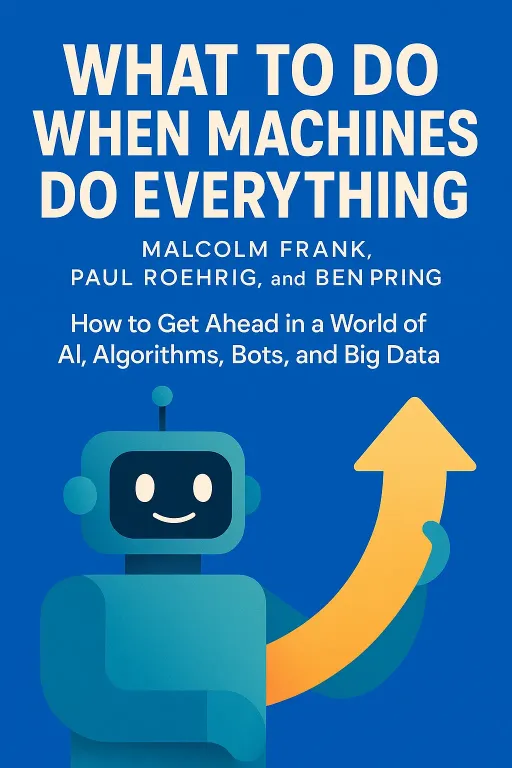
Nova: Exactly! And that's precisely what we're diving into, drawing insights from two incredibly sharp books. First, we have "WHAT TO DO WHEN MACHINES DO EVERYTHING" by Malcolm Frank, Paul Roehrig, and Ben Pring, all veterans from Cognizant who really laid out the strategic roadmap for this new era. Then, we pair that with "The Automation Advantage" by Bhaskar Ghosh, Rajendra Prasad, and Gayathri Pallail, a team from Accenture who provide a much more hands-on, practical guide to implementing intelligent automation.
Atlas: Right, so we’re getting both the high-level strategy from the Cognizant folks and the boots-on-the-ground how-to from the Accenture team. That’s a powerful combo, because it’s one thing to say ‘automate,’ it’s another to actually make it work.
Nova: Absolutely. And the core of our podcast today is really an exploration of how we move beyond just automating for efficiency, to leveraging automation to unlock entirely new forms of value that human-machine collaboration. It's about seeing machines not as replacements, but as partners.
Strategic Vision & New Human Roles
SECTION
Nova: So let's start with Frank, Roehrig, and Pring’s big picture. Their premise is that the rise of AI and automation isn't just changing we work, but work fundamentally means. They introduce this strategic framework, the "Future of Work Operating Model," which highlights how businesses need to rethink everything from talent acquisition to organizational structure.
Atlas: That makes me wonder, though, for a lot of our listeners who are focused strategists or empathetic leaders, the immediate concern is always, "Are machines just going to take our jobs?" How do these authors address that very real fear?
Nova: That’s a crucial question, and they tackle it head-on. Their perspective is that while many will be automated, entire are less likely to disappear than they are to. They argue for new human roles, categorizing them into three key areas: 'Trainers,' 'Sustainers,' and 'Explorers.'
Atlas: Oh, I like that. So, not just 'users' of technology, but active participants in its evolution and application. Can you break down what those mean?
Nova: Of course. Think of 'Trainers' as the people who teach the machines. This isn't just data scientists; it could be a customer service expert labeling data to improve a chatbot’s responses, or a marketing specialist refining an AI's content generation. They bring human context and nuance to machine learning.
Atlas: So, it's about embedding human intelligence into the AI itself, making it smarter, more empathetic, more relevant. That’s actually really inspiring. It means our existing expertise isn't obsolete; it's just redirected.
Nova: Exactly. Then you have 'Sustainers,' who are essentially the guardians of the automated systems. They ensure AI runs ethically, securely, and efficiently. This could be someone monitoring for algorithmic bias, maintaining the underlying infrastructure, or ensuring compliance. They're the ones making sure the machines play by the rules we set.
Atlas: That makes perfect sense. Because if you just let algorithms run wild, you could end up with some pretty unintended consequences. So, 'Sustainers' are the human oversight, the moral compass, almost.
Nova: Precisely. And finally, the 'Explorers.' These are the roles that leverage automation to discover entirely new opportunities. They're the innovators, the strategists, the creative problem-solvers who use AI as a tool to push boundaries, uncover new markets, or design novel customer experiences. They're the ones asking, "Now that the machines can do X, what thing can do?"
Atlas: That makes me think of a company that used to produce high-end custom furniture. They were struggling with long lead times and high costs for intricate designs. Instead of just automating their existing cutting machines, which would have been the obvious efficiency play, they introduced an AI-powered design assistant. This AI could generate thousands of complex, optimized designs in minutes, something a human designer would take weeks to do.
Nova: Oh, that's a brilliant example. What happened next?
Atlas: Well, the human designers, instead of feeling threatened, became 'Explorers.' They used the AI to rapid-prototype entirely new product lines, experimenting with materials and forms they never thought possible. They even started offering unique, one-of-a-kind pieces at a much faster turnaround. Their human creativity wasn’t replaced; it was amplified, leading to premium custom orders that were previously unimaginable. They moved from mass production to mass customization, unlocking new value by creating bespoke experiences.
Nova: What a fantastic illustration of human-machine collaboration in action. It’s not just about doing the old things faster; it’s about doing entirely new things better. The core takeaway from Frank, Roehrig, and Pring is that businesses need to proactively identify and invest in developing these 'Trainer,' 'Sustainer,' and 'Explorer' capabilities within their workforce, seeing them as the strategic advantage for a machine-driven economy.
Practical Implementation & Value Unlocking
SECTION
Atlas: That example really highlights the 'unlocking new value' part, which is what every pragmatic innovator and focused strategist is aiming for. But how do you actually there? Because the gap between strategic vision and practical implementation can feel like a chasm. That's where Ghosh, Prasad, and Pallail's "The Automation Advantage" comes in, right?
Nova: Exactly. While the first book gives you the "what" and "why," "The Automation Advantage" is the definitive "how." They focus on intelligent automation and its strategic benefits across various sectors. What’s critical here is their emphasis on a structured, phased approach rather than just jumping into tech for tech's sake.
Atlas: So, it's not just about buying the latest AI software and hoping for the best?
Nova: Far from it. They argue that successful automation isn't a single project; it's a journey. They introduce this concept of a "digital core" – building a robust, integrated foundation that allows automation to scale. One of their key points is that many companies automate processes that are already broken, which only leads to faster, more efficient chaos. They advocate for process optimization automation.
Atlas: That’s a common pitfall! It’s like paving a dirt road with potholes instead of fixing the road first. So, what’s their practical advice for an empathetic leader who wants to avoid that?
Nova: They emphasize starting small, with a clear understanding of the business problem you're trying to solve, not just the technology you want to use. They suggest identifying high-impact, repeatable processes that are ripe for automation, but only after streamlining them manually first. For example, think about a large financial institution that was drowning in compliance checks. Each check involved pulling data from multiple legacy systems, cross-referencing regulations, and generating reports – all very manual and prone to human error.
Atlas: That sounds like a perfect candidate for automation. But the "fix the road first" principle would apply here, right?
Nova: Precisely. Before they even considered an AI solution, they mapped out every step of their existing compliance process, identifying redundancies and bottlenecks. They found that different departments were performing similar checks in slightly different ways. By standardizing the process across the board, they reduced the initial workload significantly. they introduced intelligent automation.
Atlas: And what did that look like in practice? How did they unlock new value beyond just speeding up compliance?
Nova: They implemented a robotic process automation system that could pull data from disparate systems, cross-reference it with regulatory databases, and flag potential issues. This freed up their human compliance officers from the tedious, repetitive data gathering. But here's the crucial part: instead of just letting those officers go, they redeployed them.
Atlas: Ah, the human-machine collaboration again. So, they became those 'Explorers' and 'Sustainers' we talked about earlier.
Nova: Exactly. The human officers became 'Sustainers' by focusing on the complex, nuanced cases that the AI flagged, providing the critical human judgment and interpretation that machines can't yet replicate. They also became 'Explorers,' using the freed-up time to proactively analyze emerging regulatory trends, predict future risks, and even design new, more robust compliance frameworks. They shifted from reactive checking to proactive risk management, creating a more secure and adaptable organization. That's unlocking new value – not just faster compliance, but better, forward-looking compliance.
Atlas: That’s a powerful distinction. It moves from simply reacting to regulations to actually shaping their future response, which is a massive strategic advantage. It sounds like both books are really pushing us to redefine productivity itself. It’s not just about doing more, but doing and with machines as our co-pilots.
Synthesis & Takeaways
SECTION
Nova: Absolutely. The profound insight here is that the true "automation advantage" isn't found in replacing humans, but in elevating human potential. It’s about creating a symbiosis where machines handle the repetitive, data-intensive, or dangerous tasks, allowing humans to focus on creativity, critical thinking, empathy, and strategic exploration. This partnership isn't just about efficiency; it's about innovation, resilience, and discovering capabilities we didn't even know we had.
Atlas: What really matters is that for the pragmatic innovator, the focused strategist, or the empathetic leader, this isn’t a passive journey. It requires a deliberate choice to reskill, to rethink organizational structures, and to actively design human-machine collaboration into every process. It's an investment in your people and your future, transforming your business from simply surviving the age of AI to truly thriving within it.
Nova: And it’s not just about the big enterprises. Even for small businesses or individuals, understanding these frameworks means you can start identifying those tasks you can offload to smart tools, freeing your own time for higher-value, more creative pursuits. The deep question we started with—how can your role or business leverage automation not just for efficiency, but to unlock new forms of value that require human-machine collaboration—becomes your guiding star.
Atlas: It’s a call to action, really. To move from viewing automation as a threat, to seeing it as the ultimate enabler of human ingenuity. What one concrete step would you recommend listeners take after hearing this?
Nova: I'd say, take 15 minutes this week to identify one repetitive task in your daily or weekly routine that, if automated, would free up your mental energy for something more creative or strategic. Then, start researching simple, accessible tools that could help you automate just that one thing. Small steps build great momentum.
Atlas: That’s a fantastic, actionable challenge. It's about starting small, but thinking big about what's possible with human-machine collaboration.
Nova: This is Aibrary. Congratulations on your growth!