From Automated Tasks to Strategic Product Value
Golden Hook & Introduction
SECTION
Nova: What if the biggest mistake you can make with cutting-edge AI isn't failing to implement it, but successfully automating the?
Atlas: Oh, I like that. It’s like building a super-efficient machine that manufactures… well, nothing anyone actually needs. For engineers and architects, that's a terrifying thought: putting all that effort into something that just misses the mark.
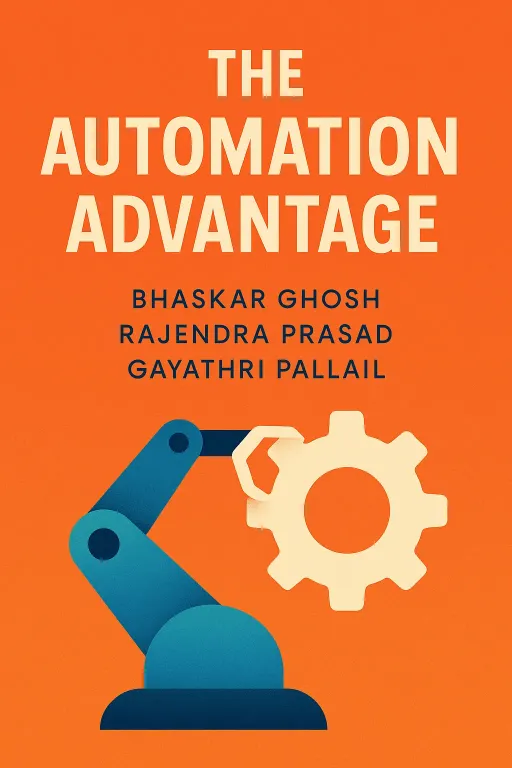
Nova: Exactly! It’s the difference between just moving faster and actually moving forward. And that critical distinction is what we're dissecting today, drawing profound insights from two giants in their fields. We’re talking about Bhaskar Ghosh’s "The Automation Advantage" and, a foundational text for any product person, Marty Cagan’s "INSPIRED."
Atlas: Ah, Cagan! Anyone who’s ever wrestled with product roadmaps or tried to build something truly impactful knows "INSPIRED." It’s practically required reading for value creators, and it’s stood the test of time. Ghosh, though, might be a newer name for some, but his insights on AI at scale are coming from a deeply experienced place, rooted in years of real-world enterprise transformation.
Nova: Precisely. Ghosh is a veteran technology leader, so his framework isn't just theoretical; it's forged in the crucible of large-scale implementation. And combining his strategic vision with Cagan's pragmatic approach to product risk... well, that's where the magic happens for anyone building intelligent agent systems. Today, we're asking a fundamental question: are you simply automating a task, or are you solving a high-value customer problem that genuinely justifies the architectural complexity of your agent project?
From Task Automation to Strategic Agent Value
SECTION
Nova: Many organizations, in their rush to embrace AI, fall into what we call the "automation trap." They see a manual process, they see the potential for an agent to handle it, and they leap without truly asking the deeper question:?
Atlas: That makes sense. For full-stack engineers, the instinct is often to optimize, to make things more efficient. If I can automate a repetitive task, that feels like a win. But you’re saying that’s not always enough?
Nova: Not always, especially when you’re building complex agent systems. Consider a large financial institution that decides to automate the generation of quarterly compliance reports. It’s a massive, time-consuming task. They build a sophisticated agent that pulls data, formats it, and generates these reports in a fraction of the time. On the surface, huge efficiency gain, right?
Atlas: Absolutely. That’s hundreds of hours saved, potentially. Less human error, faster turnaround. Sounds like a textbook win.
Nova: But what if, upon closer inspection, those reports were rarely read, or if they were, they didn't actually lead to any actionable changes in strategy or operations? The task was automated, but the —the lack of actionable insights or genuine compliance—wasn't solved. The complexity of the agent architecture, the maintenance overhead, the cost... it all becomes a burden for a low-impact outcome.
Atlas: Hold on. So you’re saying that freeing up human hours, even a lot of them, isn't inherently valuable if those hours weren't contributing to something truly impactful in the first place? That's a challenging thought for anyone focused on efficiency. It forces us to look beyond the "doing" and into the "why."
Nova: Exactly. Now, let’s flip that. Imagine another company, a logistics firm, struggling with unpredictable delivery delays, leading to frustrated customers and lost revenue. They deploy an agent system that doesn't just track packages, but proactively analyzes weather patterns, traffic data, driver availability, and even historical incident reports to potential delays hours or days in advance. It then automatically reroutes shipments or notifies customers with precise, updated ETAs, and suggests alternative solutions.
Atlas: Wow. That's a completely different level. The first example was about automating a that might have been busywork. This second one is solving a core —unpredictable delays and customer dissatisfaction—by creating a new capability.
Nova: Precisely. That agent system isn't just making an existing process faster; it's transforming the customer experience and directly impacting the bottom line by reducing churn and improving operational reliability. The architectural complexity is justified because it’s tackling a high-value problem, not just a high-effort task. It’s about building a strategic asset, not just a digital assistant.
Atlas: I see that distinction now. It’s about the outcome and the impact, not just the effort saved. For an architect focused on integrating agent tech into existing business, the question then becomes: how do we for that kind of impact from the start, especially when these systems are inherently complex and sometimes unpredictable?
Frameworks for Strategic Agent Deployment: Ghosh's Vision Meets Cagan's Risks
SECTION
Nova: That’s where our two authors truly shine, giving us the maps to navigate this territory. Bhaskar Ghosh, in "The Automation Advantage," provides a powerful roadmap for implementing AI at scale: the 'Augment-Automate-Transform' framework.
Atlas: Okay, 'Augment-Automate-Transform.' Tell me more. How does that help us aim for that high-impact value?
Nova: It’s a progression. 'Augment' is where AI assists humans, making them more effective. Think of an agent that suggests code optimizations to a full-stack engineer, or an intelligent assistant that helps customer service reps find answers faster. It enhances human capability.
Atlas: So, human-in-the-loop, intelligence amplification. That’s a good starting point, less risky too.
Nova: Then comes 'Automate.' This is where AI performs tasks entirely, often repetitive or rule-based ones. An agent handling routine customer support queries, generating standard reports, or performing data entry. This is where most companies stop, often falling into that "automation trap" we discussed.
Atlas: That makes sense. It’s the easiest leap, the most tangible ROI in terms of efficiency. But it doesn’t necessarily mean value.
Nova: Exactly. The final, and most impactful, stage is 'Transform.' This is where AI creates entirely new business models, capabilities, or customer experiences that weren't possible before. Our logistics example, with the predictive delay agent, that’s transformation. Or an agent system that enables personalized, proactive healthcare interventions based on real-time biometric data. It redefines what's possible.
Atlas: That 'Transform' stage sounds like where the real strategic value lies. It’s about breaking boundaries and creating new business value, which is exactly what many of our listeners, as value creators, are striving for. But it also sounds like the riskiest. How do we ensure these ambitious 'Transform' projects don't just collapse under their own architectural complexity or fail to deliver on their promise?
Nova: That’s the million-dollar question, and it's precisely where Marty Cagan's "INSPIRED" becomes indispensable. Cagan identifies four big risks in product development that are absolutely critical for agent deployment, especially when you're aiming for transformation. He calls them: Value, Usability, Feasibility, and Business Viability.
Atlas: Ah, the guardrails. So Ghosh gives us the ambition, and Cagan gives us the reality check.
Nova: Precisely. Let's quickly break them down in an agent context. 'Value risk': Is this agent truly solving a problem for users, or a high-value customer problem? Is it creating new capabilities they desperately need? This circles back to our initial discussion. If you're automating a low-value task, you're failing this risk.
Atlas: That's the most important one, isn't it? If there's no value, nothing else matters.
Nova: Then 'Usability risk': Can users easily interact with and trust the agent? Is its behavior intuitive? Does it integrate seamlessly into their workflows? An agent that's technically brilliant but frustrating to use will be abandoned.
Atlas: I’ve seen that happen. A technically perfect system that no one actually adopts because it’s a pain to use.
Nova: Next, 'Feasibility risk': Can we actually it reliably, scalably, and securely? This is huge for architects and full-stack engineers. Agent systems, with their reliance on data, models, and complex interactions, often introduce significant feasibility challenges. Can we integrate it with existing systems? Can it handle the load? Will it be stable?
Atlas: Bingo! That’s the architect’s nightmare, isn't it? Building something that looks good on paper but crumbles under real-world conditions. High-performance, stable, scalable systems are the holy grail.
Nova: And finally, 'Business Viability risk': Does it make sense for the business? Is there a clear ROI? Does it fit our market strategy? Will it be sustainable? A technically feasible, usable, and even valuable agent might still fail if it doesn't align with the broader business goals or is too expensive to maintain.
Atlas: So, it’s about aiming high with Ghosh's 'Transform' vision, but constantly checking those four Cagan risks. It’s like, 'Aim for the moon, but don't forget your oxygen, your navigation, your structural integrity, and your budget.' How do these risks interplay, especially when trying to integrate agent tech into existing business?
Nova: They're interconnected. Neglecting any one risk can sink the entire project. You can have an agent that's perfectly feasible and usable, but if it doesn't deliver real value or isn't viable for the business, it's a wasted effort. The architectural complexity of agent systems means the feasibility risk is often higher, demanding meticulous design and robust engineering. The 'break boundaries' advice from the user profile comes alive here: you're not just building a piece of tech; you're building a strategic business asset. You have to think beyond the code and deeply into the product, the user, and the business context.
Synthesis & Takeaways
SECTION
Nova: The core message here is about intentional design for value, not just automation for its own sake. These frameworks provide a powerful lens for strategic thinking.
Atlas: So, for our listeners, the full-stack engineers, architects, and value creators out there who are driven to turn cutting-edge tech into concrete results, what's the one thing they should take away? How can they apply this 'break boundaries' mindset to their next agent project?
Nova: It comes down to this: Before you write a single line of agent code, before you even finalize your architectural design, ask yourself if you're merely automating a task or truly solving a high-value customer problem. Then, use Ghosh's 'Augment-Automate-Transform' framework to aim for that transformative impact, and constantly use Cagan's four risks—Value, Usability, Feasibility, and Business Viability—as your navigational stars. They will guide you away from the pitfalls of complexity and towards building truly intelligent, robust, and impactful agent systems.
Atlas: It's about being a value creator, not just a code implementer. It’s the difference between building a faster horse and inventing the car. It’s about asking if the complexity of your agent system is genuinely justified by the value it creates.
Nova: Absolutely. And that distinction, between a faster horse and a car, is perhaps the ultimate question for any architect or engineer today: What kind of future are you building?
Atlas: A future where agents are truly intelligent, and truly valuable.
Nova: This is Aibrary. Congratulations on your growth!