The Creativity Trap: Why Rules Unlock True Art
Golden Hook & Introduction
SECTION
Nova: What if everything you thought about creativity was wrong? We've been sold a myth that true art demands boundless freedom, but today, we're flipping that script entirely.
Atlas: Wait, are you saying freedom is bad for creativity? That sounds almost sacrilegious to an artist! I mean, isn't the whole point of being creative to break free from rules?
Nova: It’s the ultimate paradox, isn't it? We’re diving into a fascinating concept today that suggests the very opposite of what most people believe about artistic genius. We’re talking about what I’ve called "The Creativity Trap: Why Rules Unlock True Art." And the trap isn't the rules themselves, but the belief that we don't need them.
Atlas: That title alone is a constraint, in a way! It immediately sets up a challenge to conventional thinking. So, what you’re hinting at is that some of the most groundbreaking art wasn't born out of pure, unadulterated freedom, but perhaps from very specific limitations?
Nova: Precisely. Think about someone like Igor Stravinsky, who was a master of his craft, yet constantly sought new forms and constraints to push his music forward. He famously said, "The more constraints one imposes, the more one frees oneself." He wasn't looking for less freedom, but a different kind, one that sharpened his focus. This isn't about stifling your inner muse, but about giving it a launching pad. So, let’s start with a deep question for all of us, and for the curious learners out there: Where in your creative process can you introduce a new, intentional constraint this week to spark fresh ideas? Because the 'why' behind that question is where the real magic happens.
The Paradox of Creative Freedom: How Constraints Spark Originality
SECTION
Nova: Most people believe true creativity springs from boundless freedom. You know, the image of the artist in a garret, waiting for inspiration, no limits, no rules. But the reality is, this often leads to overwhelming choice and creative paralysis.
Atlas: Oh, I know that feeling. It’s like staring at a blank document and having so many options for what to write, you end up writing nothing. Or trying to pick a movie on a streaming service with hundreds of thousands of titles – you spend more time choosing than watching.
Nova: Exactly! That’s the "blind spot" we’re talking about. When you have infinite possibilities, the sheer weight of choice can be crippling. It’s too much. It’s not inspiring; it’s suffocating. This perspective frees you to create within a supportive structure.
Atlas: But wait, are you saying that putting yourself in a box is actually beneficial? That sounds almost counter-intuitive to everything we’re taught about innovation and thinking outside the box. For someone who loves exploring new knowledge, it feels like I'd be limiting my learning.
Nova: It's not about putting yourself in box, Atlas, it’s about choosing the box. It's about embracing constraints and established forms not as limits, but as springboards for original thought. Consider a poet writing a sonnet. They have a strict structure: 14 lines, a specific rhyme scheme, iambic pentameter. That’s a massive constraint.
Atlas: Yeah, and my high school English teacher would tell you that it sounds incredibly restrictive. I’d imagine it would make it harder to express what you really want to say.
Nova: But here's the thing: those very constraints the poet to be incredibly inventive with their word choice, their imagery, their phrasing. They have to find new ways to express profound ideas those boundaries. The constraint isn't a barrier to originality; it's the very thing that originality. The challenge of fitting emotion and meaning into a rigid form often results in something far more profound and impactful than free verse might.
Atlas: So it's not about creativity, but creativity? Like a river that carves a canyon because it's forced into a path, rather than just spreading out flat and shallow? That’s a great analogy. But how do you choose a good constraint?
Nova: It’s about setting up a puzzle for yourself. If you have a chef who can use any ingredient in the world, the possibilities are endless, and the dish might be good, but not necessarily innovative. But if you tell that same chef they can only use five ingredients, suddenly their creativity explodes. They’re forced to combine things in new ways, to rethink traditional approaches. The constraint becomes the catalyst for a truly unique and memorable meal. This frees the artist from endless 'what ifs' and allows them to focus on the 'how.'
Structured Inspiration: Stealing, Remixing, and Ritualizing Creativity
SECTION
Nova: And that idea of solving a puzzle within boundaries leads us perfectly to how some of the most influential creative minds actually operate, bringing us to our second big idea: how structured inspiration, through 'stealing' and ritual, unlocks breakthroughs.
Atlas: Okay, 'stealing' sounds a bit provocative. What exactly do you mean by that? Are we advocating for plagiarism now? Because that's definitely not what our curious learners are looking for.
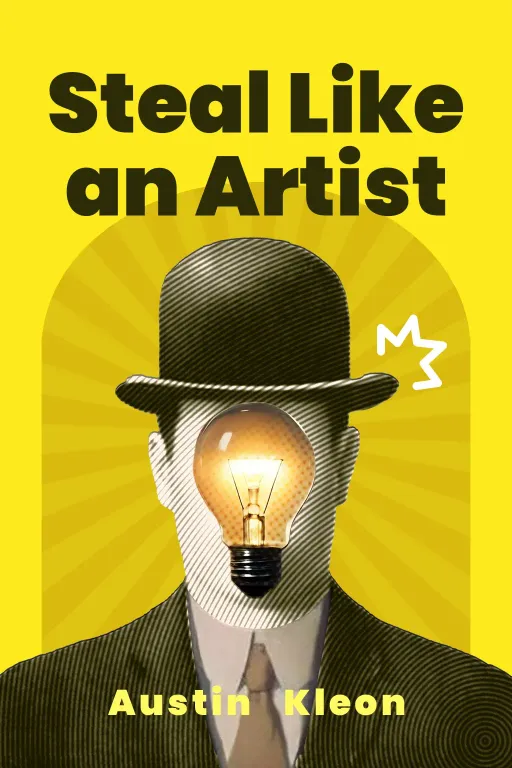
Nova: Not at all! We're talking about "Steal Like an Artist" by Austin Kleon. Kleon argues that nothing is truly original. All creative work builds upon what came before. He encourages artists to embrace influence, collect good ideas, and remix them into something new. Think of a DJ sampling different tracks to create a brand new sound, or a fashion designer taking elements from historical garments and reinterpreting them for a modern collection. They aren't copying; they're curating, combining, and transforming.
Atlas: Oh, I see. So it's not about being a copycat, it's about being a curator and a DJ of ideas? But how do you know what to 'steal' and what to leave behind? And how does that connect to constraints?
Nova: The "constraint" here is the existing body of work. The artist work within the context of what came before. They’re not creating in a vacuum; they’re engaging in a dialogue with history. And then, Nova’s take really emphasizes this: true originality often emerges from a deep understanding and playful manipulation of existing ideas, not from a void. It's about knowing the rules so well you can bend them effectively. And to do that, you need practice, which brings us to Julia Cameron.
Atlas: Julia Cameron? "The Artist's Way"? I've heard of that. Isn't that all about tapping into your inner artist?
Nova: Exactly. Cameron emphasizes the importance of routine and structured practice, like "morning pages" and "artist's dates." These aren't about waiting for inspiration to strike, which is a common misconception, but about creating the fertile ground for creativity to flourish. Morning pages are a constraint – writing three longhand pages every morning, stream-of-consciousness, no matter what.
Atlas: That sounds rough, but I know that feeling of waiting for inspiration to strike, and it rarely does. So, for someone like me, who wants to explore new knowledge areas and learn deeply, how do I apply these 'rules' without feeling like I'm stifling my own unique voice?
Nova: For morning pages, the constraint is simply every day. It clears the mental clutter, it unblocks your subconscious, and it trains your creative muscles. It’s a dedicated time and space. For "artist's dates," it’s an intentional, solo outing each week to explore something that sparks your curiosity – a museum, a walk in nature, a new coffee shop. It's a constraint on your time, carving out space purely for creative input and rejuvenation. These rituals create a supportive structure, ensuring that your well of ideas is constantly being refilled and your creative channels kept clear.
Atlas: So it's about building habits that serve your creativity, rather than just hoping for it to show up. It’s putting a framework around the elusive idea of inspiration. That makes a lot of sense.
Synthesis & Takeaways
SECTION
Nova: So, what we're really saying is that true originality isn't a bolt from the blue; it's the result of playful manipulation within established forms and consistent, structured practice. It's about turning the infinite into the finite, and then playing within those boundaries.
Atlas: So, the 'trap' isn't the rules, it's the belief that we need them. It's almost like the rules are the training wheels that allow us to eventually ride without them, but even then, we're still following the 'rules' of gravity and balance. This is a profound shift in perspective. What's one thing our curious listeners can do to put this into practice?
Nova: I'd go back to that deep question we started with. Think about where in your creative process you can introduce a new, intentional constraint this week to spark fresh ideas. Maybe it's writing a short story with a specific word count, or trying to solve a problem at work using only resources you already have, or even just dedicating 15 minutes every morning to those "morning pages." The results might just surprise you.
Atlas: It’s about giving yourself a starting point, a boundary to push against, rather than staring at a blank canvas of endless possibility. That’s incredibly liberating in its own way.
Nova: Exactly. Because sometimes, the most liberating thing you can do for your creativity is to give it a little less freedom. It's about realizing that structure isn't the enemy of art, but often its most powerful ally.
Atlas: Profound. And a fantastic challenge for all of us.
Nova: Absolutely. This is Aibrary. Congratulations on your growth!