

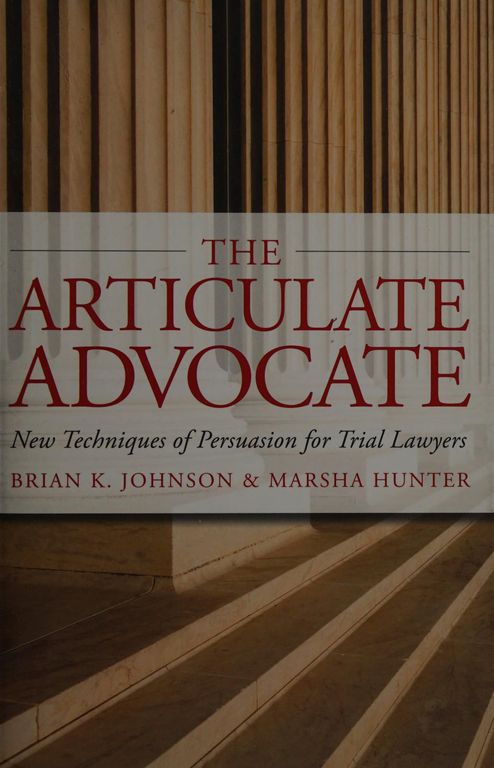
The articulate advocate
Introduction
Nova: Welcome to the show. I'm Nova, and today we're cracking open a book that every trial lawyer should have on their shelf — and honestly, anyone who speaks for a living might want to steal from it. It's called "The Articulate Advocate" by Brian K. Johnson and Marsha Hunter, published in 2016 in its second edition.
Nova: : And I'll admit, Nova, when I first heard the premise — a book about body language and persuasion for lawyers — I thought, great, another one of those. Don't tell me eye contact is important. Don't tell me to be confident.
Nova: I love that skepticism, and here's the thing — the authors actually agree with you. They acknowledge up front that most people have heard the standard advice a hundred times. But what makes this book different is depth. Johnson and Hunter don't just tell you to gesture — they explain why blind children gesture instinctively from birth, cite studies showing that people comprehend spoken sentences twice as well when gestures accompany speech, and then give you a framework to use that knowledge deliberately.
Nova: : Wait, blind children gesture? Even when talking to other blind people?
Nova: Exactly. There's a profound connection in our brains between hand movement and fluent speech. This isn't a parlor trick — it's hardwired. And that's the kind of counterintuitive, research-backed insight this book delivers on every page. Johnson spent forty years as America's preeminent teacher of legal speaking skills, and with Hunter, they've coached lawyers through the National Institute for Trial Advocacy for over three decades. They've seen every mistake in the book.
Nova: : Alright, I'm intrigued. So where do we start?
Nova: Let's start with the most provocative idea in the entire book: the Paradox of Naturalness. It turns everything you've ever been told about "just being yourself" completely upside down.
The Paradox of Naturalness and the Three Rs
The Body as an Instrument
Nova: Here's the paradox, spelled out directly by Johnson and Hunter: the most natural thing in the world is poor advocacy. Think about it — when you're standing in front of a judge or jury, adrenaline is pumping, you're hyperaware of every move you make, and you're trying to control all of it simultaneously. Your natural reaction under that pressure is to freeze up, talk too fast, and look like a deer in headlights.
Nova: : So telling someone to "just be natural" in that situation is almost cruel.
Nova: It really is. The authors put it this way — and I'm quoting: advocates "need to consciously employ certain unnatural behaviors to look and feel natural." That's the paradox. Naturalness is not something you achieve by relaxing. It's something you build through deliberate, practiced behaviors that eventually become second nature.
Nova: : That's actually kind of liberating. You don't have to feel natural. You have to train naturalness.
Nova: Exactly. And Johnson and Hunter provide a concrete tool for this, which they call a Performance Ritual. They borrow this straight from sports psychology. Think about a baseball player — every time they step up to the plate, they tap their cleats, adjust their helmet, roll their shoulders, take a deep breath, take the same number of practice swings. It's the same sequence every single pitch. The ritual's function is to enable the mind, through repetition, to control the body, and for the body in turn to control the mind. Together, body and mind regulate emotion.
Nova: : So what would a lawyer's performance ritual look like? I'm not tapping my cleats in court.
Nova: It's about creating your own consistent pre-speaking sequence. Maybe it's taking two or three deep tactical breaths, adjusting your notes, planting your feet firmly shoulder-width apart, centering your weight, placing your hands in the ready position. The key is that it becomes automatic. When the ritual kicks in, the nervous system calms down.
Nova: : Okay, let's talk about hands. You mentioned the ready position.
Nova: This is where Johnson and Hunter introduce one of their most useful frameworks: the Three Rs of Natural Gesture. Ready, Release, and Relax. Ready means placing your hands in front of your waist, loosely touching, forearms slightly separated from your abdomen. The authors describe this as a rectangle about two feet tall by four feet wide — what they call the Zone of Gesture — extending from your waist to your nose. In this neutral ready position, research shows your hands are virtually invisible to the audience because people naturally focus on your eyes.
Nova: : And then Release?
Nova: Release your gestures the moment you start speaking. Don't wait. Your hands know which words matter — they'll instinctively rise to emphasize important points if you let them. The study I mentioned earlier found that gestures improve comprehension by 100 percent. That's doubling your effectiveness just by using your hands. And the third R, Relax, means letting your arms drop back to your sides between gestures, releasing all tension from your muscles. No one gestures continuously. The silence between gestures is just as important as the gestures themselves.
Nova: : What about bad gestures? I've seen some real disasters in courtrooms.
Nova: The book is wonderfully specific about what to avoid. There's the "political thumb puppet" — that's when your thumb sticks up over the index finger of a loose fist, which Johnson and Hunter say will make you lose credibility because you'll look like a politician giving a stump speech. There's the "fig leaf" position — hands clasped over your groin. There's finger wagging at the jury, which comes across as scolding. Holding a pen while you're not writing. Hands in pockets. And here's a subtle one: the authors note that if you purposefully try not to gesture, your body will impulse anyway — you'll get a twitch in your forearm or some other part of your arm that draws negative attention. Restrained gestures actually make you speak in a monotone.
Adrenaline, Structured Improvisation, and Planning to Forget
Mastering the Inner Game
Nova: Let's move from the body to the brain, because that's exactly how Johnson and Hunter organize their book — and it's intentional. The second major section is called "Your Brain," and it opens with a fascinating discussion of adrenaline.
Nova: : I feel anxious just hearing the word.
Nova: And that's exactly what most advocates feel. But Johnson and Hunter reframe adrenaline completely. They point out that adrenaline does something remarkable to your perception of time — it creates a time-warp effect. When adrenaline surges, time seems to slow down. Your brain is processing faster. The authors argue you can use this to your advantage: that perceived extra time is actually a gift. It gives you space to think carefully about what to say next.
Nova: : So instead of panicking that time feels slow, you lean into it?
Nova: Exactly. The book teaches you to say to yourself, "Good, I'm nervous. That provides me with extra energy — and energy is the raw material of communicating persuasively." It's psychological judo. You take the thing that scares you and turn it into fuel. The authors are adamant that you should increase your vocal energy when nervous, but never your speed. Energy and speed are not the same thing.
Nova: : So what do you do with all that mental processing power? Just wing it?
Nova: This leads to one of my favorite concepts in the book: structured improvisation. Johnson and Hunter argue that the style of thinking you need as an advocate is best described as structured improvisation. You are not memorizing a script. You are not reading from notes. You are improvising within a structure. You prepare your core elements in advance — your themes, your key arguments, your essential facts — but you allow natural language variation when you deliver them.
Nova: : That sounds terrifying if you're someone who clings to a script.
Nova: It does, and that's why the authors include a brilliant subsection called "Plan to Forget." Most advocates cling to their notes because they're terrified of the question, "What if I forget?" Johnson and Hunter tell you to reframe that question entirely. Instead of "What if I forget?" ask yourself, "When I forget, how will I recover?" Because you will forget something at some point. You're human. The key is having a recovery plan.
Nova: : That's such a mindset shift. From fear to preparedness.
Nova: And it connects back to structured improvisation. If you've internalized your structure, you don't need to remember every word — you just need to remember the next point. The exact words can be spontaneous. This actually makes you sound more authentic, not less.
Nova: : What about electronic evidence? That's such a huge part of modern trials.
Nova: Great question. The book has a dedicated subsection on using electronic evidence in the courtroom, which is particularly interesting given it was published in 2016, pre-pandemic. Johnson and Hunter provide step-by-step guidance: first, identify what is on the screen for the record. Second, tell the jury what they're looking at. Don't just flash it up there and expect them to understand. And a reviewer from Pace University noted that this section feels almost prescient given how much court business now happens on screens and via Zoom. The principles of clear explanation and deliberate pacing apply even more intensely when you're competing with a screen for attention.
Tactical Breathing, Meaningful Pauses, and Eliminating Thinking Noises
The Voice as a Persuasive Instrument
Nova: Let's talk about the voice. Johnson and Hunter dedicate an entire section to it, and it starts with something you're doing right now without thinking about it — breathing.
Nova: : I breathe all day. I'm pretty good at it.
Nova: But are you good at tactical breathing? That's what the authors call it. Conscious, deliberate breathing. Here's the physiology: your diaphragm is a dome-shaped muscle underneath your lungs. When you inhale deeply, the diaphragm flattens downward toward your waist, your abdominal wall protrudes slightly, and your lungs fill with air. This is lower-torso breathing, and it's what athletes are trained to do. By contrast, upper-torso breathing — the kind where your shoulders and chest rise — is shallow, visible to observers, and associated with anxiety.
Nova: : I've definitely done the shoulder-heaving thing before a big presentation.
Nova: And your body reads that as panic, which creates a feedback loop. Johnson and Hunter teach that you breathe like you feel, and you feel like you breathe. Fast, shallow breathing signals anxiety to your brain. Slow, deep breathing signals calm. And here's the crucial part: your respiratory system is controlled by your autonomic nervous system — the same system that regulates your heartbeat and blinking — but you can override it consciously at any time. When you take deliberate deep breaths, you're hacking your own nervous system.
Nova: : How does that affect your actual speaking voice?
Nova: More air equals more sound. The authors teach that you should start speaking when your lungs are full and slowly exhale through your speech. Deep breathing also oxygenates your brain — your brain consumes at least 20 percent of the oxygen in your bloodstream. So tactical breathing literally helps you think more clearly under pressure.
Nova: : Okay, so you're breathing properly. You're gesturing. What about the actual words coming out of your mouth?
Nova: Two more critical concepts. First, and this might be the single most quotable line from the book: "Silence is the secret ingredient of persuasive speech." Johnson and Hunter explain that people are not persuaded by what you say as you're saying it — they're persuaded when they have a moment of silence to reflect on what you just said. If you never pause, your audience never processes.
Nova: : So you're saying talking too much and too fast actually prevents persuasion?
Nova: That's exactly what the authors argue. Meaningful pauses give the jury, the judge, or the arbitrator time to think. The silence is where the persuasion actually happens. This connects back to the adrenaline time-warp — when you feel like time is slowing down, use that to create deliberate pauses rather than rushing to fill the space.
Nova: : And the second concept?
Nova: Eliminating thinking noises. Um. Uh. Er. You know. Like. The authors are blunt: this is not about intelligence or education — it's pure habit. And it undermines credibility every time you do it. The solution is conscious pausing. Instead of filling the gap with "um," simply pause silently. It feels uncomfortable at first, but to the listener, a silent pause sounds thoughtful and deliberate, while "um" sounds uncertain and unprepared.
Nova: : I'm now hyperaware of every time I say "um."
Nova: That self-awareness is the first step. Johnson and Hunter recommend practicing alone, aloud, and recording yourself. Video review is brutal but indispensable. You'll notice patterns you never knew you had.
Deliberate Practice, Specific Exercises, and Bringing It All Together
Practice With Purpose
Nova: The fourth section of the book is called "How to Practice," and this is where Johnson and Hunter transform theory into action. They're emphatic that practice is not just repetition — it's deliberate, focused repetition with specific goals.
Nova: : So not just running through your opening statement in the car on the way to court?
Nova: Not even close. The authors provide a menu of specific exercises tied to specific problems. If you talk too softly, there's an exercise for that. If you sway back and forth like a boat lost at sea, there's an exercise for that. If you talk too fast, there's an exercise for that. If you're monotone, there's one for that too. Each problem has a detailed, step-by-step solution.
Nova: : That's incredibly practical. Give me an example.
Nova: Let's take movement in the courtroom. The authors teach purposeful movement — the idea that you should only move when your move is motivated by and connected to your words and ideas. A purposeful move happens when you finish one line of argument, walk slowly to a new location in the courtroom, and begin a new topic. This physical shift helps the jury distinguish between two independent arguments. But constant movement — pacing — creates what the authors call visual monotony. It's like watching a tennis match. Eventually the jury stops paying attention.
Nova: : And the flip side — standing frozen behind the lectern?
Nova: Also a problem, because leaning on the lectern makes you extremely unlikely to gesture. Your hands are anchored. The book advises that if movement isn't natural for you, learn to present effectively from the lectern — but don't grip it. Place your hands lightly, don't interlace your fingers, and keep your hands free to gesture.
Nova: : You mentioned earlier that the authors draw heavily on athlete analogies. How does that play into practice?
Nova: They emphasize visualization, which sports psychologists have championed for decades. Before you perform — before you stand up to give your opening or begin a cross-examination — visualize yourself doing it successfully. The authors write that visualizing an action that has been ingrained through practice frees you to gesture with even greater skill and confidence. Your brain doesn't fully distinguish between a vividly imagined performance and a real one. The neural pathways strengthen either way.
Nova: : So you're mentally rehearsing alongside physical rehearsal?
Nova: Exactly. And they recommend practicing alone and out loud. Not silently in your head. Out loud. Your mouth needs to form the words. Your body needs to go through the gestures. Your lungs need to manage the breath. The integration of body, brain, and voice only happens when all three systems are engaged simultaneously.
Nova: : I want to ask about something specific — what about jurors' facial expressions? I'd be glued to them, trying to read every reaction.
Nova: Johnson and Hunter address this directly, and their advice is counterintuitive. They say you cannot worry too much about jurors' expressions. Jurors listening to you will often have stoic, neutral faces — and those expressions, while intimidating and distracting to you, are completely natural for them. It's not their job to telegraph their reactions with nods, smiles, or frowns. If you let a juror's blank expression throw you off your game, you're giving away power that isn't theirs to have.
Nova: : That's a relief. So you focus on your performance, not their reactions?
Nova: Focus on connection, not approval-seeking. Eye contact is critical — but meaningful eye contact, not eye darting. The book recommends holding eye contact with individual jurors for three to ten seconds, not just glancing around the room. And when you do move on from a juror, don't abandon them abruptly — smile, nod, hold the contact for a beat longer, and then transition.
Conclusion
Nova: So let's bring this together. "The Articulate Advocate" is built on a simple but profound framework: body, brain, and voice working in concert. The body provides the foundation — stable stance, purposeful movement, natural gestures released from the ready position. The brain masters the inner game — channeling adrenaline, improvising within structure, planning to forget and recover. The voice delivers the message — powered by tactical breathing, punctuated by meaningful silence, free of thinking noises.
Nova: : And all of it, as you said at the start, comes back to the Paradox of Naturalness. You don't achieve naturalness by trying to be natural. You achieve it by deliberately practicing unnatural behaviors until they become second nature.
Nova: That's the core insight. Johnson and Hunter have spent decades coaching lawyers, and they've seen that the most skilled advocates in the courtroom are not the ones who "wing it" naturally. They're the ones who have done the work. They have a performance ritual. They breathe deliberately. They gesture from the zone. They pause with confidence. They plan for imperfection.
Nova: : What's the single most actionable takeaway for our listeners today?
Nova: I'd say start with the Three Rs. Before your next presentation — whether it's in a courtroom, a boardroom, or a Zoom call — put your hands in the ready position at your waist. Release your gestures the moment you start speaking. And relax your arms back to neutral between gestures. It's simple, it's free, and according to the research, it can double your audience's comprehension. That's an extraordinary return on a very small investment.
Nova: : And maybe take a deep breath before you stand up. A real one, from the diaphragm.
Nova: Tactical breathing. It's the first move in any performance ritual, and it's available to you right now. Johnson and Hunter remind us that the goal isn't perfection — it's persuasion. And persuasion happens in the space between words, in the gesture that illustrates a point, in the silence that lets an idea land. The articulate advocate isn't the one who talks the most or the fastest. The articulate advocate is the one who is heard, understood, and believed.
Nova: : Beautifully put. This is Aibrary. Congratulations on your growth!
Nova: Congratulations on your growth!