

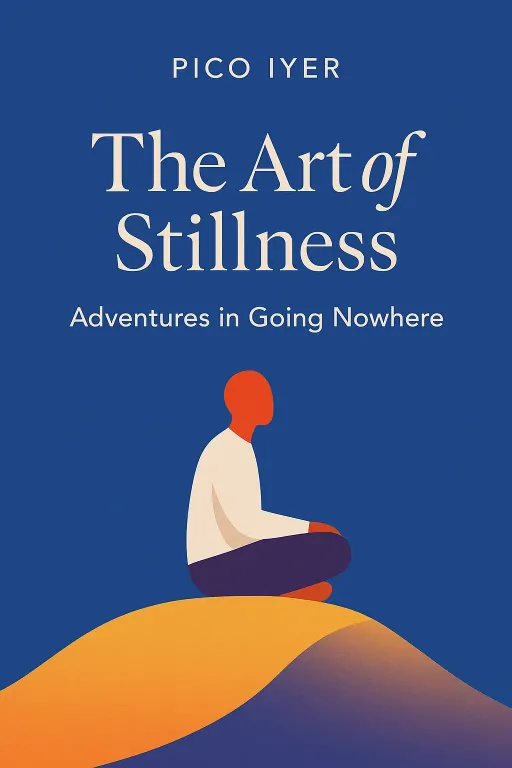
The CIO's Stillness Protocol: Decoding Pico Iyer's 'The Art of Stillness'
Golden Hook & Introduction
SECTION
Nova: In a world that runs on code, connectivity, and constant acceleration—a world that leaders like our guest today are building—what if the most powerful tool for success isn't another app or a faster processor, but the radical act of doing nothing? That's the provocative idea at the heart of Pico Iyer's book, 'The Art of Stillness,' and it feels more urgent than ever.
gaetman: It’s a huge paradox, isn't it? The very tools we build to connect everyone, everywhere, instantly, are the same tools that can fragment our attention and pull us away from the deep thinking we need to innovate in the first place.
Nova: Exactly! And that's why I'm so excited to have you here, gaetman. As a CIO in the B2B software space and an operations manager with over 15 years of experience, you live at the center of this paradox every single day. Welcome to the show.
gaetman: Thanks for having me, Nova. It's a topic that's on my mind a lot, both as a tech leader and as a dad to a six-year-old, trying to figure out what a healthy relationship with technology even looks like.
Nova: Well, you are the perfect person for this conversation. Today, we're going to tackle 'The Art of Stillness' from two powerful perspectives. First, we'll explore what Iyer calls the 'Nowhere' Advantage, looking at how personal stillness can unlock a leader's greatest insights. Then, we'll shift gears to discuss the 'Stillness ROI,' examining how companies at the heart of the tech industry are turning this practice into a powerful corporate strategy.
Deep Dive into Core Topic 1: The 'Nowhere' Advantage
SECTION
Nova: So let's start there, gaetman. As a CIO, your world is about uptime, speed, constant progress. When you hear a title like 'The Art of Stillness,' what's your gut reaction? Does it sound like a luxury or a necessity?
gaetman: Honestly, my first reaction is a bit of both. The 'operations manager' part of my brain immediately thinks, 'We don't have time for stillness. We have deadlines, sprints, product launches.' But the 'strategist' and, frankly, the human part of me knows it's a necessity. We've all experienced burnout. We know that our best ideas rarely come when we're staring at a screen, frantically answering emails.
Nova: That's so true. And Iyer captures this with such a powerful story. He talks about the late, great Leonard Cohen. Here's a man who was a global icon, a world traveler, someone who had experienced everything life has to offer. But in his sixties, he felt a sense of emptiness. So what did he do? He moved into a tiny, bare cabin at a Zen monastery on Mount Baldy, near Los Angeles.
gaetman: He basically went completely offline.
Nova: Completely. For years. He'd just sit still in a meditation hall, sometimes for hours on end. And when Iyer visited him and asked what he got out of it, Cohen didn't talk about piety or sacrifice. He described it as, and I'm quoting here, "the real deep entertainment... the real feast that is available." He called it a "sumptuous response to the emptiness of my own existence." He found his greatest adventure by going nowhere.
gaetman: That's fascinating. He's framing it not as deprivation, but as a form of richness. And it resonates with what we see in complex problem-solving, especially in software development. You can have a team of brilliant engineers banging their heads against a problem for days, stuck in meetings, running endless tests. The breakthrough doesn't happen in that chaos.
Nova: Right. So where does it happen?
gaetman: It happens when one of them goes for a walk. Or on the drive home. Or, famously, in the shower. It's in those moments when the conscious, frantic mind finally quiets down that the subconscious can connect the dots in a novel way. Cohen just took that principle to its absolute extreme. He created a total void of external input so he could hear the internal signal.
Nova: I love that framing: "hear the internal signal." Iyer argues that this is the real advantage of stillness. It's not about being lazy or unproductive. It's about creating the conditions for clarity. He quotes the philosopher Blaise Pascal, who said, "All of humanity's problems stem from man's inability to sit quietly in a room alone." In a leadership context, that inability to sit still can lead to reactive, poor decision-making.
gaetman: Absolutely. As a leader, you're constantly bombarded with information, requests, and fires to put out. Your calendar is a battlefield. If you don't intentionally carve out time to go 'nowhere'—to just think, without an agenda—you risk spending your entire day reacting to the urgent instead of focusing on the important. You become a manager of chaos, not a leader with a vision.
Nova: So that 'Nowhere' that Cohen found on the mountain is actually the place where real vision is born.
gaetman: I think so. It's the ultimate signal-to-noise filter.
Deep Dive into Core Topic 2: The Stillness ROI
SECTION
Nova: That's a perfect bridge, gaetman. You're talking about the individual benefit, the need for a personal filter. But what happens when an entire organization recognizes this? This isn't just a philosophical idea anymore; it's becoming a business strategy. Iyer points to some fascinating examples, right in your backyard, the tech industry.
gaetman: This is where it gets really interesting for me. Moving from personal practice to scalable corporate policy is a huge leap.
Nova: A huge leap that some are taking. Iyer describes visiting the Google headquarters. You'd expect it to be a whirlwind of activity, and it is. But he found they have a program called "Search Inside Yourself." It's not about searching the web; it's an internal course, developed by an engineer, that teaches meditation and mindfulness to improve emotional intelligence and focus. They even have "Yoglers"—Googlers who train others in yoga.
gaetman: So they're building the infrastructure for stillness right into the company culture.
Nova: Exactly. And it's not just Google. Iyer mentions that the computer chip maker Intel experimented with a "Quiet Period" for four hours every Tuesday. They asked engineers and managers to turn off their email and phones and just... think. The response was so enthusiastic that they expanded the program. It's a recognition that the brain needs downtime to do its best work.
gaetman: That's a bold move. In a B2B software company, the pressure for constant availability, for immediate customer support, is immense. The idea of telling a whole department to go dark for four hours would give some executives a heart attack. The question they'd immediately ask is, "What's the ROI?"
Nova: And that's the billion-dollar question, literally. Iyer cites a staggering statistic: these kinds of stress-reduction programs are estimated to be saving American corporations three hundred billion dollars a year, through reduced burnout, lower healthcare costs, and improved productivity.
gaetman: Wow. Okay, a number like that gets a board's attention. But as an operations guy, my next question is about attribution. That's a macro number. How do you, within your own company, draw a straight line from a weekly meditation session to a ten-percent reduction in employee churn or a five-percent increase in product innovation? That's the hard part.
Nova: It is the hard part. But there are breadcrumbs. Iyer brings up a study at General Mills, where they put senior executives through a seven-week mindfulness program. Afterwards, 80% of them reported a positive change in their ability to make decisions, and 89% said they had become better listeners. Those are leadership-critical skills.
gaetman: Better decision-making and better listening... those are tangible outcomes. You can see how that would lead to fewer costly mistakes and better team alignment. The challenge is selling it. You can't just mandate mindfulness. It has to be an invitation, and the culture has to genuinely support it. It can't just be another box-ticking wellness initiative that everyone rolls their eyes at. It has to be seen as a performance-enhancing tool, just like a new piece of software or a better project management methodology.
Nova: "Performance-enhancing tool." That's the key, isn't it? Reframing it from something "soft" to something strategic. Iyer even tells the story of military veterans with PTSD using yoga-based breathing to manage their trauma, with one Marine saying, "Something so soft could also make me so much harder as a Marine." It's about building resilience.
gaetman: Resilience is the perfect word. In the tech world, you're dealing with constant change, market shifts, and intense pressure. A resilient team isn't one that never gets stressed; it's one that knows how to recover, refocus, and stay clear-headed under pressure. Maybe that's the real ROI of stillness.
Synthesis & Takeaways
SECTION
Nova: So, as we bring this all together, we have this fascinating dual reality. On one hand, stillness is this deeply personal tool for finding clarity and meaning, like Leonard Cohen alone on his mountain. On the other, it's emerging as a powerful corporate strategy with a measurable ROI, being implemented by the very companies that create our fast-paced world.
gaetman: It's a full-circle moment. The tech industry created this firehose of information and connectivity, and now it's rediscovering the ancient technology of the human mind to cope with it. It's not about rejecting technology, which is impossible and undesirable. It's about mastering our relationship with it.
Nova: So, for the other leaders listening—the CIOs, the managers, the entrepreneurs who feel like they're drowning in that firehose—what's the one practical takeaway from 'The Art of Stillness' that you think is most valuable?
gaetman: I think it's the idea of the "secular Sabbath" that Iyer talks about. It doesn't have to be a whole day. It's about reclaiming a small piece of time. For anyone in a leadership role, maybe the most important question to ask yourself isn't 'How can we go faster?' but 'Where can we, as a team and as individuals, build in a moment of pause?'
Nova: A moment of pause. Simple, but not easy.
gaetman: Not at all. But it could be the most productive part of your day. Block out 30 minutes on your calendar. Label it "Thinking Time." No devices, no meetings. Just you, a notebook, and a problem to solve or a vision to shape. That small act of going 'nowhere' might be the very thing that takes you, and your company, somewhere extraordinary.
Nova: A powerful and practical place to end. gaetman, thank you so much for bringing your insight to this conversation. It was fantastic.
gaetman: The pleasure was all mine, Nova. Thank you.









