

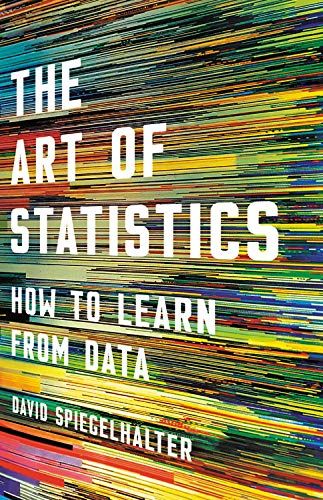
The Art of Statistics
Introduction
Nova: Imagine for a second that a spreadsheet could have saved over two hundred lives. Not through a medical breakthrough or a new safety regulation, but simply by noticing a pattern that everyone else missed. That is exactly how David Spiegelhalter opens his book, The Art of Statistics.
Nova: In a way, yes. He starts with the case of Harold Shipman, a British doctor who turned out to be one of the most prolific serial killers in history. For years, he was murdering his patients, and nobody noticed because he was a respected local GP. But Spiegelhalter shows that if anyone had been looking at the mortality data of his patients compared to other doctors, the statistical red flags would have been screaming for years.
Nova: Exactly. And that is the whole point of The Art of Statistics. Spiegelhalter, who was the Winton Professor for the Public Understanding of Risk at Cambridge, wants to move us away from the idea that statistics is just a dry collection of formulas. He argues it is an art form—a way of storytelling and problem-solving that helps us make sense of a messy, uncertain world.
Nova: And that is exactly what Spiegelhalter is trying to fix. He wants to take the math out of the basement and put it into the real world. Today, we are going to dive into his framework for how to actually think about data, why your morning bacon sandwich might not be as dangerous as the headlines say, and why being data literate is basically a superpower in the twenty-first century.
Key Insight 1
The PPDAC Cycle
Nova: One of the biggest shifts Spiegelhalter proposes is moving away from what he calls the technique-led approach. Usually, people learn a statistical test and then go looking for data to use it on. He says we should do the opposite.
Nova: Exactly. He introduces this framework called the PPDAC cycle. It stands for Problem, Plan, Data, Analysis, and Conclusion. Most people jump straight to the Analysis part, the math, but Spiegelhalter argues that the Problem and the Conclusion are actually the most important bits.
Nova: Because if you do not define your question correctly, the math will give you an answer to a question you did not mean to ask. He uses the example of child heart surgery at a specific hospital. If you just look at the raw survival rates, one hospital might look terrible. But if that hospital is the one taking the most difficult, high-risk cases that everyone else turned away, then a lower survival rate might actually mean they are doing an incredible job.
Nova: Precisely. That is the Problem and Plan phase. Then comes the Data and Analysis, which is the technical stuff. But then there is the final C: Conclusion and Communication. Spiegelhalter is obsessed with how we talk about these findings. He says that a statistic is useless if it is communicated in a way that misleads people.
Nova: That is the perfect segue into how we actually interpret risk. Spiegelhalter wants us to stop being passive consumers of these headlines and start asking: What is the actual number here?
Key Insight 2
The Bacon Sandwich Paradox
Nova: Let's talk about that bacon sandwich. A few years ago, the World Health Organization released a report saying that eating fifty grams of processed meat a day—about two slices of bacon—increases your risk of pancreatic cancer by eighteen percent.
Nova: It does, doesn't it? But this is where Spiegelhalter teaches us the difference between relative risk and absolute risk. The eighteen percent is a relative risk. It means your risk goes up by eighteen percent of whatever your risk already was.
Nova: Exactly. Spiegelhalter breaks it down into real numbers. In the UK, about six out of every one hundred people will get bowel cancer anyway. If all one hundred of those people eat a bacon sandwich every single day of their lives, that number goes from six people to seven.
Nova: Right. That is the absolute risk. One in a hundred. But eighteen percent sounds way more terrifying in a headline than one out of a hundred, doesn't it?
Nova: This is what Spiegelhalter calls statistical science fiction. It is not that the number is a lie; it is just that it is framed to provoke a reaction rather than to inform. He argues that we should always ask for the absolute numbers. If someone says a new drug reduces the risk of a heart attack by fifty percent, you need to know if that means it goes from two in a hundred to one in a hundred, or from fifty in a hundred to twenty-five.
Nova: Exactly. And he applies this to everything. He even looks at the Titanic. We all know the story, but he uses statistics to ask: Who was actually the luckiest person on that ship? He looks at the survival rates of different classes, ages, and genders to show how data can reveal the social structures of the time.
Nova: You nailed it. But he goes deeper, looking at how even within those groups, there were anomalies. It is about using data to find the story, not just to prove a point.
Key Insight 3
Correlation, Causation, and Supermarkets
Nova: One of the most famous phrases in statistics is correlation does not imply causation. We have all heard it, but Spiegelhalter gives some great examples of why we still fall for it every single day.
Nova: Exactly. They are both caused by a third factor: warm weather. But Spiegelhalter brings up a more subtle one: house prices and supermarkets. There is a very strong correlation between having a high-end supermarket like a Whole Foods or a Waitrose nearby and high property values.
Nova: That is what a lot of people think! But Spiegelhalter points out this is likely reverse causation. The supermarket doesn't make the neighborhood wealthy; the supermarket does a ton of statistical research to find neighborhoods that are already wealthy and then moves in.
Nova: Precisely. And this gets really dangerous when we talk about things like public policy or health. He discusses how we often see studies saying people who take multivitamins live longer. Does the vitamin cause the long life? Or is it just that people who are already health-conscious and wealthy enough to buy vitamins are the ones who live longer anyway?
Nova: Not at all. He suggests we look for what he calls natural experiments or use more advanced techniques like randomized controlled trials. But mostly, he wants us to have a healthy dose of skepticism. He says we should always ask: Is there a third factor here that we are missing?
Nova: Definitely. He even touches on the replication crisis in science, where a lot of famous studies can't be repeated. He blames a lot of this on p-hacking—where researchers keep slicing and dicing their data until they find something that looks statistically significant, even if it is just a fluke.
Key Insight 4
Algorithms and the Human Element
Nova: As we move into the world of Big Data and AI, Spiegelhalter spends the later part of the book talking about algorithms. We tend to think of algorithms as these objective, perfect machines, but he reminds us they are only as good as the data we feed them.
Nova: It is more than just garbage, though. It is about bias. He uses the example of an algorithm used to predict whether a criminal will re-offend. If the historical data you use to train the AI is biased—say, if certain groups were policed more heavily in the past—the algorithm will just bake that bias into its future predictions.
Nova: Exactly. He also talks about the limits of prediction. He mentions a study on speed dating where researchers tried to use data to predict which couples would hit it off. They collected everything: interests, backgrounds, personality traits. And do you know how well the model did?
Nova: It was a disaster. The model was barely better than random guessing. Spiegelhalter uses this to show that some things are just inherently unpredictable. There is a level of randomness in the world that no amount of data can fully eliminate.
Nova: He calls this the dark matter of statistics—the things we don't know and maybe can't know. He argues that the art of statistics is knowing when to trust the numbers and when to trust your common sense and the context of the situation.
Nova: That is the perfect way to put it. He emphasizes that we need to be data literate not so we can all become statisticians, but so we can participate in society. If you can't understand a risk or a claim in a political ad, you are at the mercy of whoever is crunching the numbers.
Conclusion
Nova: We have covered a lot today, from serial killers and bacon sandwiches to the survival of Titanic passengers. If there is one thing David Spiegelhalter wants you to take away from his work, it is that statistics is not a spectator sport. It is a vital tool for navigating modern life.
Nova: Exactly. It is about moving from being intimidated by numbers to being curious about them. Next time you see a shocking headline with a big percentage, remember the bacon sandwich. Ask for the absolute risk. Ask about the baseline. Ask if there is a third factor at play.
Nova: Spoken like a true statistical thinker. Spiegelhalter’s book is a call to arms for all of us to become more critical, more questioning, and ultimately, more informed citizens. Data is the language of the modern world, and learning even just a little bit of that language changes how you see everything.
Nova: And that is the best we can hope for—making decisions with our eyes wide open. Thank you for joining us on this deep dive into the fascinating world of David Spiegelhalter.
Nova: This is Aibrary. Congratulations on your growth!