

Stop Guessing, Start Deriving: The Guide to Analytical Mastery
Golden Hook & Introduction
SECTION
Nova: If you think being a "quick thinker" is always a superpower, you might actually be sabotaging your own analytical genius. We're about to expose the subtle mental traps that keep even the smartest minds from true mastery.
Atlas: Whoa, hold on. That's a pretty bold claim, Nova. I mean, in our fast-paced world, isn't speed often the goal? We're constantly trying to optimize, to get to the answer faster. Are you saying that's wrong?
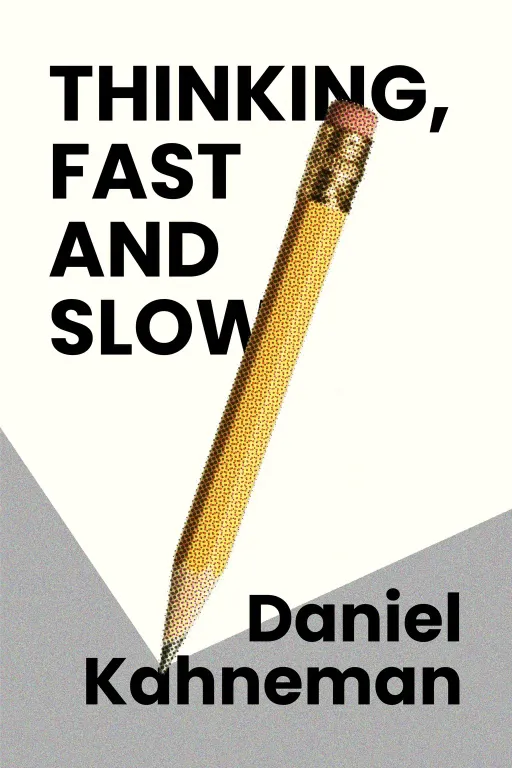
Nova: Not wrong, Atlas, but incomplete. There’s a crucial difference between quick and quick. And for anyone who truly wants to build a robust, error-free knowledge base – whether it's mastering stoichiometry or understanding complex systems – understanding this distinction is everything. Today, we're diving into two foundational texts that give us the ultimate guide: Daniel Kahneman’s landmark "Thinking, Fast and Slow" and W. I. B. Beveridge’s incredibly insightful "The Art of Scientific Investigation."
Atlas: Kahneman, the Nobel laureate psychologist, who basically mapped our brains for us. And Beveridge, a virologist who meticulously broke down how scientists think, not just what they discover. These aren't just academic books; they're like user manuals for optimizing your own problem-solving mind.
Nova: Exactly! Kahneman, despite being a psychologist, won the Nobel Prize in Economics for his work on how our minds make decisions, showcasing how deeply his insights penetrate every aspect of our lives. And Beveridge, a brilliant virologist, didn't just write about scientific discoveries; he wrote about the of discovery, the often messy, intuitive, yet ultimately systematic way great minds solve problems. These authors fundamentally solve the problem of inconsistent analytical reasoning by providing a meta-framework for understanding and improving your own thought processes.
Atlas: So, we're talking about going beyond just learning facts and actually architecting how we think about those facts? This sounds like a masterclass in building an internal framework for consistent, error-free reasoning. I'm in. Where do we begin?
The Duality of Thought: System 1 vs. System 2
SECTION
Nova: We begin with Kahneman, and his revolutionary idea of two distinct thinking systems. Think of it like this: Imagine you're driving down an empty highway. You're cruising, maybe listening to music, barely thinking about changing gears or steering. That's your System 1. It's fast, intuitive, automatic, and requires minimal effort. It’s brilliant for routine tasks.
Atlas: Oh, I like that. So, System 1 is like my autopilot. It handles all the mundane stuff so I can focus on... well, whatever else I'm thinking about.
Nova: Precisely. But now, imagine you need to parallel park a massive truck into a tiny spot on a busy street. Suddenly, you're focused, calculating angles, turning the wheel precisely, probably holding your breath. Every muscle is engaged, every thought deliberate. That’s System 2. It’s slow, effortful, logical, and it's what we engage for complex calculations, deep analysis, and conscious problem-solving.
Atlas: I know that feeling! The difference between cruising and that intense, focused effort is palpable. But for someone trying to build a really robust knowledge base, someone who wants clarity and strategic understanding, how does knowing about these systems actually help them errors? Because often, my System 1 feels so confident!
Nova: That's the crux of it, Atlas. System 1 is a fantastic shortcut, but it's also prone to biases and quick, often incorrect, answers, especially when faced with novel or complex problems. Kahneman illustrates this perfectly with a classic problem. Are you ready for a quick test?
Atlas: Always. Lay it on me.
Nova: Okay, listen closely: A bat and a ball cost $1.10 in total. The bat costs $1.00 more than the ball. How much does the ball cost?
Atlas: Oh, I know this one! It's ten cents, right? That's what my brain immediately screams.
Nova: Exactly! That's your powerful System 1 in action, firing off the most intuitive, but incorrect, answer. If the ball cost ten cents, and the bat cost a dollar more, the bat would be $1.10, making the total $1.20, not $1.10. The correct answer is five cents. The bat is $1.05, the ball is $0.05, total $1.10.
Atlas: Whoa. You got me. It's wild how strongly that first answer pulled me in. It feels so obvious! So, in a complex stoichiometry problem, or when I'm trying to balance an intricate chemical equation, when I see a number and my brain immediately wants to divide by two or jump to a familiar pattern, how do I force that System 2 check? How do I stop guessing and start deriving consistently?
Nova: That's the million-dollar question, and it's where analytical mastery truly begins. It's about cultivating a habit of. Your System 1 is powerful, but it’s also lazy. It will offer a quick solution and then try to convince System 2 to accept it. Mastery comes from deliberately engaging System 2, even when System 1 offers that tempting, quick, but often incorrect, answer. It’s about recognizing the signal of a complex problem and consciously switching gears.
The Scientific Method as an Internal Framework
SECTION
Nova: And that's exactly where our second framework comes in. If Kahneman gives us the "what" to watch out for – those mental shortcuts and biases – Beveridge gives us the "how" to build a solid, error-proof defense against them. He shows us how to construct a robust internal framework for consistent reasoning.
Atlas: The scientific method, really? Isn't that just for labs, for people in white coats and microscopes? How does 'observation, hypothesis, critical evaluation' apply to, say, debugging a complex organic chemistry mechanism, or even just understanding a dense financial report?
Nova: That's a great question, and it highlights a common misconception. Beveridge, in "The Art of Scientific Investigation," isn't just talking about lab procedures. He's talking about cultivating a. It’s about adopting the systematic approach of a brilliant detective, or an architect planning a skyscraper, or even a chef perfecting a recipe.
Atlas: So, it's not about test tubes, it's about a way of thinking?
Nova: Precisely. Take "observation." For Beveridge, it’s not just seeing; it’s. It's gathering all the facts, meticulously. In an organic chemistry mechanism, that means looking at every substituent, every bond, every potential reaction pathway, not just the one that immediately jumps out. Then, "hypothesis formation" is about proposing a plausible explanation or solution based on those observations.
Atlas: Okay, I can see that. You look at all the data, you try to figure out what's going on. But what about the "aha!" moments? Doesn't creativity play a role? Beveridge sounds very rigid, almost robotic.
Nova: That's the beauty of Beveridge. He actually intuition and creativity! But he argues it’s most effective when it’s by rigorous System 2 groundwork. Your "aha!" moments are far more likely to be correct if they spring from a foundation of thorough observation and systematically tested hypotheses, rather than just a wild guess. It’s structured exploration, not just random guessing. Imagine a chemist meticulously observing a new reaction, noting every color change, every gas evolved, every subtle shift. They then form a hypothesis about its mechanism, and then they each step of that proposed mechanism, testing assumptions, looking for weaknesses, before concluding.
Atlas: So it's like building your own internal "quality control" system for your thoughts, making sure each piece of your analytical architecture is sound. It's about being an architect of your own thoughts, ensuring each step is logically sound, and not just trusting that first intuitive leap.
Nova: Exactly! It prevents those natural pitfalls Kahneman warns us about. It’s the systematic approach that ensures each step is logically sound. It's not about eliminating intuition; it's about making sure your intuition is standing on solid ground. It’s about building a robust internal framework for consistent, error-free reasoning, which is exactly what "Stop Guessing, Start Deriving" is all about.
Synthesis & Takeaways
SECTION
Nova: So, in essence, Kahneman helps us recognize the mental biases and shortcuts our brains are prone to, especially System 1's quick but often flawed judgments. Beveridge, on the other hand, gives us the systematic tools—the scientific method internalized—to deliberately overcome these biases and build robust, error-free reasoning. It's a powerful combination for anyone seeking true analytical mastery.
Atlas: It really is. The tiny step from the book – pausing and consciously identifying if you're using System 1 or System 2 thinking – isn't just a mental exercise; it's practically a diagnostic tool for our analytical processes. It’s about being an architect of your own thoughts.
Nova: Absolutely. For those driven by a quest for mastery, for the foundational builders who seek detailed explanations and strive for deep understanding, this deliberate engagement of System 2, coupled with Beveridge's systematic approach, is the path to consistent, reliable problem-solving. It's how you move from merely solving problems to truly understanding and applying solutions with precision.
Atlas: That's incredibly valuable. For anyone who feels like they're constantly guessing, or just hoping they get to the right answer, what's the absolute first thing they should try, starting today, to "start deriving" and build that internal framework?
Nova: Before your next complex problem, whether it's a stoichiometry equation or even just a tricky life decision, consciously label your thought or gut reaction as "System 1." Then, force yourself to write down, or at least mentally articulate, the specific steps of your "System 2 check." Ask: What observations am I making? What's my hypothesis? How can I critically evaluate each step? It's like putting your brain through a mini-scientific investigation, every single time. It's a small shift that creates profound clarity over time.
Atlas: That's a powerful way to frame it. It's about turning intuition into a tool, not a master. It's about being deliberate in our thinking, especially when the stakes are high.
Nova: Exactly. It's about building a mental architecture that doesn't just hold facts but processes them with unshakeable logic.
Atlas: What a journey into the mechanics of our own minds. This is Aibrary. Congratulations on your growth!