

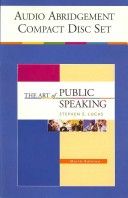
The Art of Public Speaking
Introduction
Nova: Picture this. You're standing at a podium. The lights are bright. A hundred faces stare back at you. Your heart is pounding, your palms are sweating, and your mind has gone completely blank. Sound familiar? That fear of public speaking — glossophobia, if you want the clinical term — is consistently ranked as one of the top fears people have. Sometimes even ahead of death itself. But here's the thing: what if there was a single book that has helped more than ten million people transform that terror into something powerful?
Nova: We're talking about "The Art of Public Speaking" by Stephen E. Lucas. It is, by any measure, the most widely used college textbook on public speaking in the world. Published by McGraw-Hill and now in its thirteenth edition, it has defined how an entire generation — actually, multiple generations — learns to stand up and speak.
Nova: That's exactly the question we're going to answer today. Lucas doesn't just give you tips. He builds a complete framework — grounded in classical rhetoric from Aristotle, backed by modern communication research, and tested in real classrooms for over fifty years. This book treats public speaking not as a performance trick but as a disciplined practice that combines critical thinking, ethical responsibility, and genuine audience connection.
Origins, Author, and Scope
The Book That Defined a Field
Nova: Let's start with the man behind the book. Stephen E. Lucas is a professor of Communication Arts at the University of Wisconsin-Madison. He's been there since 1972 and has directed the introductory public speaking course since 1973. He holds the Evjue-Bascom Professorship in the Humanities, has won the Chancellor's Award for Excellence in Teaching, and — here's a fun fact — he also wrote a book called "Portents of Rebellion" that was nominated for a Pulitzer Prize.
Nova: Exactly. And that depth shows. Lucas isn't just a communication scholar. He's a rhetorical critic and a historian of American political discourse. So when he writes about public speaking, he brings this rich understanding of how speech has shaped democracy, social movements, and civic life throughout history.
Nova: Right. The first edition came out decades ago, and the book has gone through thirteen editions. The most recent release, co-authored with Paul Stob, came out in 2023. Over its lifetime, it has reached more than ten million students and instructors. It's organized into five major parts spanning eighteen chapters — everything from the basics of speaking and listening, through speech preparation and organization, to delivery, visual aids, and the different varieties of public speaking like informative, persuasive, and special occasion speeches.
Nova: That's where Lucas does something really smart. He doesn't start with technique. He starts with psychology.
Managing Speech Anxiety
From Terror to Positive Nervousness
Nova: Chapter one of the book opens with a disarmingly simple observation: nervousness is normal. Lucas cites research showing that most people — including experienced speakers — feel some level of anxiety before speaking. The difference isn't that great speakers don't feel nervous. It's that they've learned to channel that nervous energy.
Nova: He calls it "positive nervousness." The idea is that the same physiological arousal that makes you feel anxious — the elevated heart rate, the adrenaline — is also what can make you energetic, alert, and compelling on stage. The goal isn't to eliminate nervousness. It's to transform it into something productive.
Nova: Lucas goes deeper. He offers a whole set of strategies: acquire speaking experience, prepare thoroughly, think positively, and use visualization. But here's the key insight — he also tells speakers that most nervousness is invisible to the audience. The trembling hands you feel? The audience probably can't see them. The racing heart? They can't hear it. Understanding that gap between what you feel and what the audience perceives is incredibly liberating.
Nova: Exactly. And he ties this to a broader point: public speaking is a skill, not a talent. It's learned through practice, preparation, and critical thinking. Your speech class — or your self-study with this book — is a laboratory where you build that skill incrementally.
The Core Framework
Ethics, Audience, and Architecture
Nova: This is where Lucas really distinguishes himself. Before he even gets to organizing a speech, he dedicates an entire chapter to ethics. He argues that public speaking is fundamentally about trust. If your audience doesn't trust you, nothing else matters.
Nova: Very. He lays out five guidelines: make sure your goals are ethically sound, be fully prepared, be honest in what you say, avoid name-calling and abusive language, and put ethical principles into practice consistently. He also devotes significant attention to plagiarism — and he breaks it down into three types that most people don't think about.
Nova: Most people do. Lucas distinguishes between global plagiarism — stealing an entire speech — patchwork plagiarism, where you cobble together phrases from multiple sources without attribution, and incremental plagiarism, which is the sneaky one: failing to credit specific ideas or quotations even when the overall speech is original. He's particularly concerned about incremental plagiarism in the internet age, where it's so easy to copy and paste without thinking.
Nova: Lucas places audience analysis at the absolute center of speech preparation. He introduces the concept of "audience-centeredness" — the idea that every decision you make, from topic selection to language choice to evidence, should be shaped by who your listeners are. He walks through demographic analysis — age, gender, cultural background, religion, group membership — and situational analysis — the size of the audience, the physical setting, their disposition toward you and your topic.
Nova: That's the core principle. And from there, Lucas builds the architecture of the speech. He shows how to craft main points, how to use connectives like transitions and signposts, how to build introductions that grab attention and establish credibility, and how to create conclusions that reinforce your central idea. He even provides two types of outlines — the detailed preparation outline and the lean speaking outline you actually take to the podium.
Nova: That's exactly the metaphor. And Lucas would say that clear organization is a form of respect for your audience. It says: I've done the work so you don't have to struggle to follow me.
Delivery, Language, Evidence, and Persuasion
The Speaker's Toolbox
Nova: Once the speech is built, Lucas turns to how you actually deliver it. And he's very clear about his preferred method: extemporaneous speaking.
Nova: Exactly. It's a carefully prepared and rehearsed speech delivered from a brief set of notes. Lucas argues this gives you the best of both worlds: the structure and precision of preparation, combined with the spontaneity and conversational quality that keeps an audience engaged. He contrasts it with reading from a manuscript, which can sound stiff, reciting from memory, which can sound robotic, and speaking impromptu, which risks being disorganized.
Nova: In detail. He discusses volume, pitch, rate, pauses, vocal variety, pronunciation, and articulation. On the body side: personal appearance, movement, gestures, and eye contact. But here's what I love — he never treats delivery as a performance. The goal is to enhance your message, not distract from it. He wants you to sound like the best version of yourself, not like someone else.
Nova: Lucas devotes multiple chapters to this. He covers three types of supporting materials: examples — brief, extended, and hypothetical — statistics, and testimony from experts and peers. Then in the persuasion chapters, he draws directly on Aristotle's rhetorical triangle: ethos, pathos, and logos. He explains how to build credibility, how to use evidence effectively, how to reason from specific instances, from principle, through causal reasoning, and by analogy. And he devotes an entire section to logical fallacies — the reasoning errors that can undermine your argument.
Nova: That's one of his central arguments. Public speaking and critical thinking are inseparable. When you learn to organize ideas clearly, evaluate evidence, spot weaknesses in reasoning, and adapt to an audience, you're not just becoming a better speaker. You're becoming a better thinker.
Nova: Right. The final section of the book covers informative speaking — speeches about objects, processes, events, and concepts — persuasive speaking on questions of fact, value, and policy, special occasion speeches like introductions, presentations, acceptances, and commemorations, and even small group communication. He also addresses modern contexts like online presentations and using PowerPoint effectively.
Conclusion
Nova: So let's bring this together. "The Art of Public Speaking" by Stephen E. Lucas has endured for decades and reached over ten million readers because it does something rare: it treats public speaking as a whole human endeavor. It's not just about technique. It's about ethics, critical thinking, cultural awareness, and genuine connection with other people.
Nova: That's beautifully put. And I think the reason this book has become the standard — the reason it's used in more college classrooms than any other public speaking textbook — is that Lucas never loses sight of the bigger picture. Public speaking isn't just a skill for the classroom or the boardroom. It's a form of civic participation. It's how ideas become public. It's how movements start, how communities form, how change happens.
Nova: They should know that effective public speaking is not about being naturally charismatic or fearless. It's a disciplined practice that anyone can learn. Lucas's book is essentially a master class in that practice — patient, thorough, and deeply humane. Whether you're a novice giving your first speech or an experienced speaker refining your craft, there's something in these pages for you.
Nova: This is Aibrary. Congratulations on your growth!