

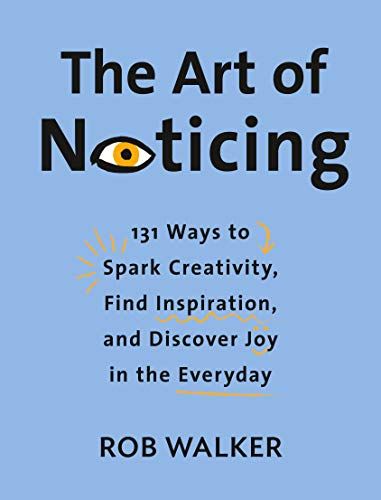
The Art of Noticing: Why Small Details Shape Great UI Experiences
Golden Hook & Introduction
SECTION
Nova: You know, Atlas, I think a lot of designers are looking for inspiration in all the wrong places.
Atlas: Oh, really? Where should we be looking then, Nova? Not in the latest Dribbble trends? Not in those glossy design magazines? Because that's usually my first stop.
Nova: Exactly! That's the trap. We're constantly chasing the "new," the "next big thing," when the most profound insights, the truly delightful and intuitive design solutions, are often hiding in plain sight. They’re in the mundane, the everyday, the stuff we've become so accustomed to, we literally un-see it.
Atlas: Un-see it? That's a provocative thought. As designers, our whole job is to things, to notice the details others miss. Are you saying our professional superpower might actually be our blind spot?
Nova: Precisely. And that's where Rob Walker steps in with his phenomenal book, "The Art of Noticing: 131 Ways to Spark Creativity, Find Inspiration, and Discover Joy in the Everyday." Walker, a celebrated journalist and columnist for The New York Times Magazine, has this incredible knack for dissecting culture and consumer behavior. His background gives him a unique, almost forensic, approach to observation, teaching us how to consciously re-engage with the world around us.
Atlas: A journalist teaching designers how to see? I'm intrigued. Because if our design inspiration is right under our noses, but we're "un-seeing" it, then we're missing a massive, untapped reservoir of potential. How does this "blind spot" actually manifest in our work?
The Blind Spot: Why UI Designers Miss Everyday Inspiration
SECTION
Nova: It’s a fascinating paradox, isn't it? We, as designers, are masters of micro-interactions, pixel-perfect alignment, and intricate user flows. But that very focus can make us myopic. We become like a chef who's a genius at seasoning, but forgets to taste the entire dish, missing the subtle interplay of flavors. We're so good at the details, we often filter out the richness of reality.
Atlas: But how? I mean, isn't a designer's keen observational skill almost a prerequisite? How can someone whose job literally demands attention to detail somehow miss the obvious? What's the psychological mechanism at play here?
Nova: It boils down to a couple of cognitive biases. One is "inattentional blindness." Think about it: you're so focused on counting how many times a basketball is passed, you completely miss a gorilla walking across the screen. Designers are often so focused on a specific UI problem – say, optimizing a checkout flow – that they become blind to the broader, more organic human behaviors that or that digital interaction.
Atlas: So, we're saying designers are so immersed in the digital canvas that they miss the real-world human interactions that could those pixels and flows? Give me a concrete design example where this blind spot is glaringly obvious.
Nova: Absolutely. Take a common login screen. How many times have you encountered one that feels clunky, impersonal, or even slightly hostile? It’s often designed purely for function: username, password, submit. But in the real world, when you "enter" a new space, there are subtle cues. A doorman might nod, a bell might jingle, there's often a brief moment of orientation before you proceed. We these things subconsciously in physical spaces. But in UI, we often jump straight to the utilitarian, forgetting the "greeting" or "acknowledgment" that makes an entry point feel welcoming and intuitive.
Atlas: That’s a powerful point. We’re designing for screens, but forgetting the human behind the screen is operating in a world full of physical cues. But sometimes, Nova, isn't the mundane intentionally ignored for efficiency? Like, we want a login screen to be fast, not necessarily poetic. Are you suggesting we need to add digital "doormen" everywhere? What's the of noticing the mundane in this context?
Nova: It's not about literally replicating physical interactions, Atlas. It's about understanding the of those interactions. The "value" is in creating interfaces that natural, almost instinctual, because they subtly align with our deeply ingrained patterns of perception and interaction cultivated over a lifetime in the physical world. When a UI element feels "right," it's often because it echoes something we've subconsciously noticed and understood from our everyday lives.
Cultivating Observational Mastery: Rob Walker's 'Art of Noticing' in UI Design
SECTION
Nova: The good news is, while this blind spot is real, it's not permanent. Our brain's filters can be retrained. And that's exactly where Rob Walker's "Art of Noticing" becomes an invaluable toolkit for designers. What if we could train our eyes, and our minds, to not just see, but truly again?
Atlas: Okay, so how do we actually this? What are some of Walker's "131 exercises" that could genuinely shift a designer's perspective from just functional to profoundly intuitive and delightful? I'm thinking of our listeners, the detail-oriented designers who are always looking for new methods, new '招式' to refine their craft.
Nova: One of my favorites, and it's deceptively simple, is what he calls "The Mundane Object Challenge." Pick any object you interact with daily – your coffee mug, a doorknob, your phone charger. And for a full day, just it. Don't just use it, but really observe it. How many distinct observations can you make? What's its texture? Its weight? The sound it makes when you set it down? The way light hits its surface?
Atlas: This reminds me so much of the '逐香人' idea—noticing subtle scents, the unspoken language of a space. How can a designer translate something as abstract as the 'feel' of a doorknob, or the 'aroma' of a space, into a digital interface? Are we talking about haptics, literally making our phones vibrate differently? Or something more metaphorical, tapping into the user's desire for sensory pleasure?
Nova: That's a brilliant connection, Atlas. It’s both literal and metaphorical. For example, if you notice the satisfying and of a well-engineered doorknob, that understanding of tactile feedback and clear affordance can directly inform the haptic feedback or animation of a digital button. It gives a button a perceived "weight" or "finality." But it goes deeper. Noticing the subtle changes in ambient light through a window might inspire more dynamic, context-aware UI themes that shift with the time of day, creating an emotional resonance that feels natural and unobtrusive. It’s about understanding the and translating its essence, not just its form.
Atlas: That's fascinating – so it’s not just about visual design, but about designing for the full human experience. What about noticing patterns across different mundane objects, or even across different environments? That aligns with the user's "探索与连接" style, building order from observed chaos. How does that help build 'order' in design?
Nova: Exactly. Another powerful exercise is to observe how people navigate public spaces. Watch a queue at a coffee shop, or how people instinctively form pathways in a crowded park. You'll notice subtle cues – body language, eye contact, implied boundaries. How do people determine whose turn it is, or which path to take? These small observations reveal profound truths about natural social protocols and wayfinding.
Atlas: And how does that directly translate to UI? Are we talking about information architecture? Or user flows in an app?
Nova: Precisely. If you observe how people naturally group themselves, or how they perceive "open" versus "closed" spaces, you can design more intuitive information hierarchies. You can craft user flows that feel less like a rigid path and more like a natural, guided journey. It's about designing a digital environment that respects and anticipates human behavior, rather than forcing users to adapt to an artificial system. It allows us to build interfaces that aren't just functional, but truly on a deeper, almost subconscious level, because they mirror the world we already understand.
Synthesis & Takeaways
SECTION
Nova: So, what we're really talking about here, Atlas, is that "noticing" isn't just about collecting data. It's about cultivating a deeper empathy and understanding of the human experience itself. It's the bedrock of truly great UI design, because it reminds us that true innovation often comes from re-seeing the familiar, rather than endlessly chasing the novel.
Atlas: It sounds like this practice allows us to build interfaces that aren't just functional, but truly on a deeper, almost subconscious level, because they mirror the world we already understand, and perhaps even elevate its beauty. It brings that "logic of beauty and sensory pleasure" right into the design process.
Nova: Absolutely. And for our listeners, especially those in UI design, we have a challenge inspired by Walker's work and your own growth advice. Pick one mundane object you interact with daily. A coffee cup, a doorknob, your phone charger. And for the next 24 hours, just it. How many distinct observations can you make? How does it feel, sound, look? And then, just for fun, ask yourself: how might inspire a new design element in your current project?
Atlas: And maybe even record that moment, that insight. Because those small, beautiful moments of noticing are where the truly great UI experiences begin. It’s about bringing that '逐香人' sensibility, that deep curiosity, right into your design process.
Nova: This is Aibrary. Congratulations on your growth!