

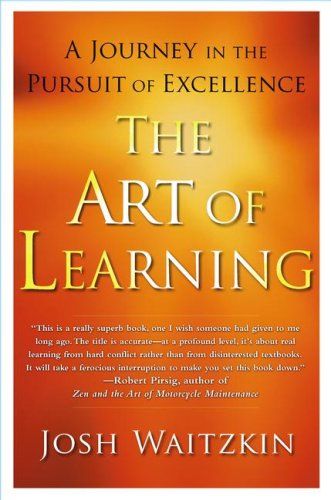
The art of learning
Introduction
Nova: Imagine being so good at chess that Hollywood makes a movie about you at age seven. Now imagine walking away from all of that, starting completely over in a physical discipline where people literally throw you to the ground, and somehow becoming a world champion there too. That's not fiction. That's Josh Waitzkin's actual life. Today we're diving into his book The Art of Learning, and I have to say, this is one of the most unusual and practical books on mastery I've ever come across.
Nova: : Unusual is right, Nova. Most learning books are written by academics who study other people's performance. But Waitzkin actually became world-class in two completely unrelated fields — chess and Tai Chi Push Hands. So what's the book really about? Is it a memoir or a how-to guide?
Nova: It's both, and that's what makes it so compelling. The Art of Learning is structured as an autobiography — Waitzkin walks us through his journey from child chess prodigy in Washington Square Park to eight-time US National Chess Champion, and then his complete reinvention as a two-time World Champion in Tai Chi Push Hands. But woven through every chapter are the mental frameworks, the performance psychology tools, and the learning principles that made all of that possible. He's not just telling his story — he's extracting the universal principles that anyone can use.
Nova: : So he found the thread that connects mastering chess and mastering martial arts. That's fascinating. What's the core philosophy?
Nova: The central idea is that mastery isn't about accumulating techniques — it's about building a deep foundation and then making it your own. Waitzkin calls this "making smaller circles." Instead of rushing to learn broad skills, you plunge into the detailed mystery of the micro to understand what makes the macro tick. His book challenges conventional wisdom about talent, practice, and performance. And the thing that really hit me — he actually tested all these ideas under extreme competitive pressure, not in a lab.
Nova: : So we're not talking theory. We're talking battle-tested principles. Let's get into it. Where does mastery actually begin?
Nova: It begins before technique — it begins with mindset. And that's where we're headed next.
Growth Mindset and Investment in Loss
The Mindset That Makes or Breaks You
Nova: Waitzkin opens the book with research that, in many ways, determines everything that follows. He draws on Carol Dweck's work on mindsets — and this was actually before Dweck's own book made the concept mainstream. The distinction is between what Waitzkin calls entity theory and incremental theory.
Nova: : Okay, so entity versus incremental. Entity learners believe intelligence is fixed — "I'm smart" or "I'm not a math person." And when they fail, they see it as proof of their limitations. Incremental learners believe ability grows through effort. When they fail, they search for what to fix. I've heard this before as fixed versus growth mindset. But Waitzkin lived it, right?
Nova: Exactly. He saw it firsthand in the chess world. Young players who were constantly told "you're a genius" would crumble under pressure because every difficult position felt like it threatened their identity. Meanwhile, kids who were praised for their effort and hard work would dig in when things got tough. Dweck's research found that students praised for effort outperformed those praised for intelligence on subsequent tasks by a staggering 30 percent.
Nova: : Thirty percent just from how you talk about success. That's wild. But Waitzkin takes this concept further with something he calls "investment in loss." What is that?
Nova: Investment in loss is one of the most counterintuitive ideas in the book. When Waitzkin started Tai Chi, he was a beginner getting thrown around constantly by more experienced practitioners. Instead of avoiding those stronger training partners, he actively sought them out. He chose to spar with people who would beat him, because every loss exposed a gap in his technique, in his balance, in his composure.
Nova: : It's interesting because most of us instinctively avoid situations where we might fail. It feels bad. But Waitzkin is saying that losing isn't just tolerable — it's the fuel for growth.
Nova: That's exactly it. His Tai Chi teacher, Grandmaster William C. C. Chen, used this phrase: "investment in loss." Giving yourself to the learning process means putting yourself in positions where you will fail — because that's where the deepest learning happens. Waitzkin writes that if a student could avoid ever repeating the same mistake twice, both technical and psychological, they would skyrocket to the top of their field.
Nova: : I love that. Never make the same mistake twice. That almost makes the goal feel attainable, even though it's incredibly demanding. But there's a nuance here, isn't there? He's not saying you should lose all the time.
Nova: Right. It's a balance. If you lose too much, you get discouraged. If you never lose, you never grow. The sweet spot is what Waitzkin calls the "outer reaches of your ability" — you're consistently pushing just beyond your comfort zone. And here's the key: when you lose or fail, you don't just shrug and move on. You analyze deeply. What went wrong technically? What went wrong psychologically? Then you set short-term goals to address those specific weaknesses, which fuel your long-term development.
Nova: : So the process is: lose, analyze deeply, set a specific fix, and repeat. You're almost systematizing failure into progress.
Nova: Yes. And this ties into another crucial point: process over results. Waitzkin says that while a fixation on results is unhealthy, short-term goals can be useful developmental tools if they're balanced within a long-term philosophy. The mindset shift is from "I need to win this game" to "I need to learn from this game." The person who can do that consistently has an almost unfair advantage over someone who just needs to prove they're smart.
Turning Distractions into Fuel
The Soft Zone
Nova: Let's talk about one of my favorite concepts from the book: the soft zone versus the hard zone. This is all about how you relate to pressure and distraction.
Nova: : I've definitely been in the hard zone — where any little noise or interruption completely derails me. You know that feeling when someone is chewing too loudly and suddenly you can't think about anything else?
Nova: That's exactly the hard zone. It's rigid, brittle concentration. The chess player who needs absolute silence. The performer who falls apart when conditions aren't perfect. Waitzkin contrasts this with the soft zone, which he describes as fluid, resilient awareness. In the soft zone, distractions don't break your focus — they get absorbed and sometimes even used as fuel.
Nova: : How do you actually train for that? Because being told to just ignore distractions is the least helpful advice.
Nova: Waitzkin gives a great example from his chess career. He once lost an important match because he had a catchy song stuck in his head — it completely disrupted his thinking. Most people would try to block out music entirely after that. Instead, he started deliberately practicing chess at home with loud music playing. At first it was chaotic. But over time, his brain learned to align his thinking with the rhythm of the music. Eventually, he could use the beat to maintain a flow state. He started actually singing songs in his head before tournaments on purpose to trigger this performance state.
Nova: : That's brilliant — he turned the liability into an asset. It's not about blocking out the world, it's about building a relationship with it where the world works with you instead of against you.
Nova: Exactly. And this applies beyond noise. Waitzkin talks about using adversity more broadly. Weeks before the 2002 Nationals, he broke his right hand. For a Push Hands competitor, that's potentially devastating. Instead of withdrawing, he started training exclusively with his left side. He ate with his left hand, wrote with his left hand, and did all his training on the left. This forced him to rebuild his technique from scratch, activate new neural pathways, and refine movements he had taken for granted.
Nova: : And what happened when his right hand healed?
Nova: His left side had become incredibly responsive and sensitive. And because he had been forced to be so precise with his left, when he reintegrated his right hand, his overall game was actually better than before the injury. He calls this the principle that constraints accelerate growth. The obstacle forced creative adaptation.
Nova: : Wait, I'm realizing this connects back to the mindset conversation. If you're a fixed-mindset person, an injury is a catastrophe that proves you're unlucky or fragile. But if you're an incremental learner, it's just a new constraint to grow through.
Nova: That's the thread running through the whole book. Every concept connects. And Waitzkin takes this even further. He writes about a progression in performance training: first you learn to flow with whatever comes. Then you learn to use whatever comes to your advantage. And finally, you learn to be completely self-sufficient and create your own earthquakes — meaning you generate your own optimal conditions regardless of what's happening around you.
The Depth-First Approach to Mastery
Making Smaller Circles
Nova: If there's one concept from The Art of Learning that has become almost legendary in learning circles, it's "making smaller circles." This is Waitzkin's signature framework for deep skill acquisition.
Nova: : I've heard this phrase before but I'm not sure I really understand it. What does making smaller circles actually mean?
Nova: Think of it this way: most people, when they're learning something new, try to cover a lot of ground quickly. They want to learn twenty chess openings, or a dozen guitar chords, or ten coding frameworks. Waitzkin did the opposite. In chess, instead of learning dozens of openings superficially, he would master a single endgame position — say, king and pawn versus king — until he understood every possible nuance. Hours and hours on one position. Six hours in one sitting, sometimes thirty hours over a week.
Nova: : That sounds excessive. One position for thirty hours?
Nova: It sounds excessive until you understand what's happening. By going incredibly deep on one simple position, Waitzkin was actually learning principles that transferred to every complex position. The theme, as he puts it, is "depth over breadth." The learning principle is to plunge into the detailed mystery of the micro in order to understand what makes the macro tick. A pianist who practices one difficult passage a hundred times learns more than one who plays the entire piece through twenty times.
Nova: : So "making smaller circles" means taking one thing, going so deep on it that it becomes bone-deep and instinctive, and then expanding outward from that foundation. The circle gets smaller as you compress more understanding into less visible movement.
Nova: That's exactly it. And the Tai Chi application makes it even clearer. When Waitzkin first learned Push Hands techniques, his movements were large and visible — big sweeping motions. Over years of practice, those same techniques got smaller and smaller, more and more internal. Eventually, a slight weight shift or a breath could disrupt an opponent's balance. The potency increased as the expansiveness decreased. That's the circle getting smaller.
Nova: : I'm thinking about how this applies to something like public speaking or writing. A beginner uses big, obvious techniques — dramatic pauses, memorized transitions. A master has internalized all of that into something that looks effortless but is deeply powerful.
Nova: Exactly. And Waitzkin connects this to the concept of "chunking" from cognitive psychology — the brain's ability to compress vast amounts of information into usable units. A chess grandmaster doesn't see individual pieces; they see patterns. A master musician doesn't think about finger positions; they just hear music. The technique has been internalized so deeply that it feels like natural intelligence.
Nova: : There's a quote I remember: "We have to be able to do something slowly before we can have any hope of doing it correctly with speed." I think that's from Waitzkin.
Nova: It is. And it cuts against so much of modern learning culture, where we want to go fast and cover a lot. Waitzkin's message is countercultural: slow down, go deeper, and the speed will come naturally as a byproduct of true understanding.
Presence, Triggers, and Building Your Own Zone
The Architecture of Peak Performance
Nova: So we've talked about mindset, the soft zone, and making smaller circles. But Waitzkin also gives us a practical blueprint for accessing peak performance states on demand. He doesn't just tell you that flow states exist — he shows you how to build a trigger that reliably gets you there.
Nova: : This is the part I'm most curious about. Because flow feels so elusive — sometimes it just shows up, sometimes it doesn't. How do you make it reliable?
Nova: Waitzkin's method is actually quite systematic. First, he says, identify an activity that already puts you in a good mental state. For him, it was playing catch with his son. Then, build a consistent routine around it — maybe meditation, then stretching, then music, then the catch. Over time, you gradually compress that routine. What started as a forty-five-minute ritual gets compressed down to just a few minutes.
Nova: : And eventually the compressed trigger alone activates the performance state? Like classical conditioning?
Nova: Precisely. The routine becomes an on-switch. Your brain learns that when you do these four things in sequence, performance mode follows. Eventually you can trigger it almost instantly. This is how elite performers seem to flip a switch before they compete. They've built that switch through hundreds of repetitions.
Nova: : But Waitzkin goes even deeper than routines, doesn't he? There's this idea of presence as a lifestyle.
Nova: Yes. This might be his most profound insight. He writes that "presence must be like breathing." You can't just be present during the big moments — the championship, the presentation, the exam — if you spend your everyday life distracted and unfocused. The secret is that everything is always on the line. How you practice is how you'll compete. How you spend a Tuesday morning is how you'll handle a crisis on Friday.
Nova: : So performance psychology isn't something you apply in special moments. It's woven into your entire life.
Nova: That's why he emphasizes interconnectedness so strongly. He says his entire approach to learning is based on breaking down artificial barriers between diverse life experiences. A hike in the woods or a dance lesson can unlock a truth about chess or martial arts. Everything connects. And when you live with that awareness, every moment becomes enriched.
Nova: : I want to circle back to something. Waitzkin had multiple chess teachers throughout his career. Some of them tried to break his natural style and mold him into something more conventional. How did that shape his philosophy?
Nova: It's actually one of the most moving parts of the book. His first teacher, Bruce Pandolfini, found this beautiful balance — he taught discipline without dampening Waitzkin's love for chess or suppressing his natural voice. But later coaches tried to force him into a cookie-cutter mold. On the outside, Josh was still winning. On the inside, he was burning out. By nineteen, he walked away from competitive chess entirely.
Nova: : That's heartbreaking but important. The method of teaching matters as much as the content.
Nova: Exactly. Waitzkin uses this analogy: there are two ways to tame a wild horse. One is to break it — through pain, exhaustion, until it yields. The other is the horse whisperer approach — building an alliance, guiding the horse toward doing what you want because it wants to do it. Great teaching and great self-coaching work the same way. You don't break your natural voice. You refine it from within.
Nova: : So the art of learning is also the art of staying true to yourself while growing.
Nova: That's beautifully put. And it brings us to where this all leads.
Conclusion
Nova: So let's bring all of this together. Josh Waitzkin's The Art of Learning gives us a framework that's both philosophical and intensely practical. It starts with the growth mindset — the understanding that ability is built, not born. From there, you invest in loss, deliberately seeking out challenges that expose your weaknesses. You develop the soft zone, turning distractions and adversity from threats into teachers. You make smaller circles, going deep on fundamentals rather than wide on superficial techniques. And you build triggers and routines that make peak performance a reliable state, not a lucky accident.
Nova: : What strikes me is how interconnected all of this is. You can't just pick one principle. The growth mindset makes investment in loss possible. Investment in loss deepens your ability to make smaller circles. Making smaller circles builds the internal foundation that lets you stay in the soft zone under pressure. It's a complete system.
Nova: That's exactly right. And the through line is presence. Waitzkin discovered that the common thread between chess mastery and martial arts mastery wasn't about specific techniques — it was about the quality of attention. Being fully present with the position on the board. Reading the micro-signals of an opponent's body. The ability to be clearheaded, cool under fire is what separates the best from the mediocre in every discipline.
Nova: : So for our listeners who want to start applying this today — what's the one thing they should do?
Nova: I'd say: pick one sub-skill you're working on right now and make a smaller circle. Don't try to learn ten things. Take one thing — one chess endgame, one guitar chord transition, one coding concept — and go so deep on it that it becomes second nature. Spend hours on it. Let it be uncomfortable. And pay attention to your mental state while you're doing it. Are you in the hard zone, rigid and brittle? Or can you find the soft zone, fluid and resilient?
Nova: : And frame everything as process, not outcome. Instead of "I'm bad at this" or "I'm good at this," try "I'm working on this." That tiny language shift protects you when things get hard.
Nova: Waitzkin's book reminds us that the pursuit of excellence is itself the reward. The trophies, the titles, the recognition — those are side effects. The real transformation happens in the thousands of hours nobody sees, in the losses you analyze instead of ignore, in the fundamentals you master instead of skip.
Nova: : In the end, the art of learning isn't about learning faster. It's about learning deeper. And that changes everything.
Nova: This is Aibrary. Congratulations on your growth!