

Beyond Textbooks: How to See the World as Your Classroom.
Golden Hook & Introduction
SECTION
Nova: What if everything you've been told about achieving mastery, about the 10,000-hour rule, about specializing early, was not just incomplete, but potentially holding you back from true innovation? What if being a generalist is the ultimate competitive advantage, especially in fields like advanced AI?
Atlas: Whoa, Nova, that's a bold claim right out of the gate! I mean, in the tech world, especially with something as complex as Agent engineering, we're constantly told to specialize, to dive deep into one niche. Are you seriously suggesting we've been barking up the wrong tech tree?
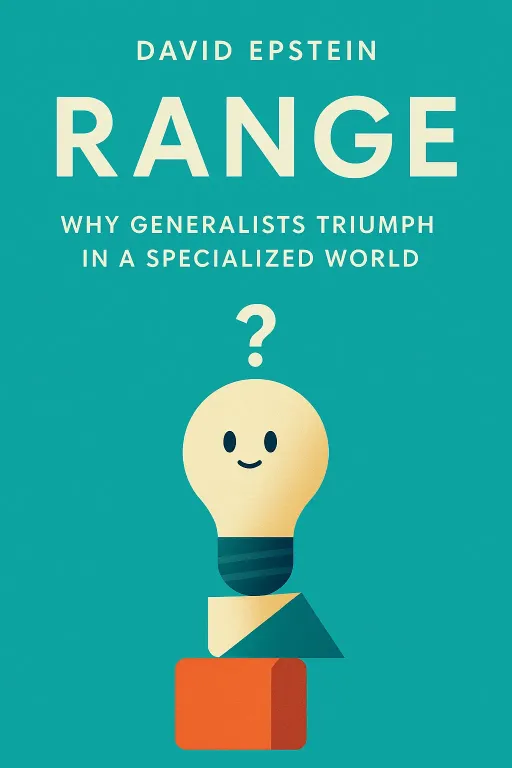
Nova: Absolutely, Atlas! And that's exactly what David Epstein masterfully argues in his book,. What's fascinating about Epstein is he's not some industry guru or a CEO; he's a science journalist. He meticulously researched across psychology, sports, science, and business to build his case, giving this incredibly robust, evidence-based foundation. It’s not just opinion; it's data-driven insight.
Atlas: That’s a great way to put it. And it reminds me of someone like Josh Waitzkin, author of, who wasn't just a chess prodigy but also became a world champion in martial arts. He didn't just specialize; he transferred principles across wildly different domains. It’s like they’re both saying the world itself is the ultimate classroom, if we just know how to look at it.
Nova: Exactly! That's the core of our discussion today: how to radically expand our definition of 'learning' to leverage the entire world as our classroom, transforming how we approach skill acquisition and innovation.
The Generalist Advantage: Why Broad Learning Trumps Early Specialization
SECTION
Nova: So, let's dive into that first idea. Epstein challenges what he calls our 'blind spot' in education. We're conditioned to think learning happens in institutions or within specific subjects. But this narrow view, especially in dynamic fields, can severely limit our growth.
Atlas: I can totally relate to that. As an engineer, there's immense pressure to pick a stack, master a language, become the expert in, say, a specific Agent framework. It feels like if you're not the deepest specialist, you're not valuable. So, what’s actually saying about that?
Nova: It's saying that while deep expertise is valuable, the world's most complex and unpredictable problems often aren't solved by the deepest specialists. They're solved by generalists. These are individuals who have broad and varied experiences, drawing connections between disparate fields that specialists often miss. Think about it: Agent engineering is still evolving rapidly. There aren't centuries of established best practices.
Atlas: I see what you mean. We're not just coding; we're designing systems that interact with humans, that need to understand context, ethics, business logic. That's not just a technical problem; it's a multidisciplinary one.
Nova: Precisely. Let's look at Kepler, for instance. Johannes Kepler, the astronomer. He wasn't just an astronomer; he was also deeply read in theology, philosophy, and optics. His groundbreaking work on planetary motion, which shattered centuries of astronomical dogma, wasn't just because he was good at math. It was because he brought these diverse lenses to bear. He saw the universe not just as a mechanical system but as something with deeper, almost musical, harmonies. This interdisciplinary perspective allowed him to challenge prevailing assumptions and make breakthroughs that a purely specialized astronomer might have overlooked.
Atlas: Wow. So, he wasn't just looking at the stars; he was looking at to understand the stars. That's a powerful point. It makes me wonder about our own work. When we're designing an Agent's decision-making logic, for example, it’s not just about algorithms. It’s about understanding human psychology, economics, even sociology. A narrow focus might give us a technically sound Agent that utterly fails in the real world because it lacks that broader contextual intelligence.
Nova: Exactly! The generalist advantage is about adaptability. When the rules of the game change, the specialist often struggles because their entire identity and expertise are tied to a specific, now potentially outdated, rulebook. The generalist, having practiced in multiple domains, is more adept at quickly acquiring new skills and adapting to novel situations. They have a wider "vocabulary" of solutions.
Atlas: That makes perfect sense for an architect. We're constantly integrating new technologies, new business requirements. If you're too specialized in one legacy system, you become obsolete. So, the "why" of being a generalist is clear: resilience, innovation, and seeing beyond the immediate problem.
Mastering the Art of Fluid Learning: Applying Foundational Principles Across Domains
SECTION
Atlas: So, if having a broad range of knowledge is the key, how do we actually across these different domains effectively? It can feel overwhelming to try and become a 'generalist' in everything.
Nova: That's where Josh Waitzkin's comes in. He offers the 'how' to Epstein's 'why.' Waitzkin isn't just about accumulating facts; he's about understanding foundational principles and then adapting them. He argues that true mastery isn't about memorizing every chess opening or every martial arts move. It's about understanding the underlying 'grammar' of learning, the core concepts that transcend specific applications.
Atlas: Okay, so what does that even mean for someone like me, who’s trying to master Agent engineering? What's the 'grammar' of integrating a new Agent framework, for instance?
Nova: It means looking past the superficial differences. When Waitzkin transitioned from chess to Tai Chi Push Hands, he didn't just start from scratch. He realized that the principles of deep focus, pattern recognition, understanding subtle shifts in balance, controlling the center, reading an opponent's intent – these were transferable. He wasn't learning a new game; he was applying a refined learning methodology to a new context.
Atlas: That’s a powerful analogy. So for Agent engineering, it’s not about memorizing specific APIs or libraries. It’s about understanding the core principles of autonomy, decision-making logic, context awareness, ethical alignment, or how to design for emergent behavior. These are concepts that would apply whether you're building a supply chain Agent or a creative AI Agent.
Nova: Absolutely. It’s about seeing the matrix, not just the individual pixels. Waitzkin emphasizes deliberate practice, breaking down complex skills into their smallest components, mastering those, and then integrating them. He also talks about 'making the soft hard' – consciously practicing fluid transitions and adaptability until they become second nature. This fosters a fluid approach to learning, where you can quickly understand the essence of a new domain and apply your existing cognitive tools.
Atlas: That makes me wonder, how do we, as architects, apply this? When we're faced with a completely new Agent architecture, instead of just trying to map old solutions to it, we should be asking: "What are the fundamental principles at play here? What problem is it trying to solve at its core?" Then, we can adapt our existing understanding of system design and value creation to this new context. It’s about finding the universal laws, not just the specific rules.
Nova: Precisely. It allows you to integrate diverse experiences. You might draw insights from psychology on human decision-making to improve an Agent's empathetic responses, or from economics to optimize its resource allocation. These aren't separate subjects; they become different facets of your expanded learning curriculum. This is how you don't just implement Agent tech; you it for maximum, sustainable value.
Synthesis & Takeaways
SECTION
Nova: So, bringing it all together: Epstein shows us being a generalist and having broad experiences is crucial for navigating complex, unpredictable environments. And Waitzkin provides the – the method for fluidly applying foundational principles across those diverse domains.
Atlas: Yeah, it’s like the ultimate cheat code for value creation in a rapidly changing world. Breaking the boundaries between technology and business, as our user profile suggests, isn't just a nice-to-have; it’s the direct application of this broad, principle-driven learning. It's how you go from being just a coder to a true architect and value creator.
Nova: Exactly. It's about seeing the world as your classroom and every new challenge as an opportunity to apply and refine your meta-learning skills. It's how you build robust, scalable Agent systems that aren't just technically sound, but deeply integrated and truly intelligent.
Atlas: So, for our listeners, here’s a concrete step you can take: Think about your current Agent project, or any learning goal you have. What seemingly unrelated area – maybe psychology, or even an art form, or a completely different industry – could offer a foundational principle that deepens your understanding or sparks a new, breakthrough solution? Don't just look for direct correlations; seek out those abstract, transferable principles.
Nova: Challenge yourself to break down those mental walls. The world is waiting to teach you.
Atlas: This is Aibrary. Congratulations on your growth!