The Dual Engine of Cognitive Peace and Ambition
Golden Hook & Introduction
SECTION
Nova: We are obsessed with the idea that the next milestone, the next big project, or the next promotion will finally be the thing that silences our internal noise. We build our lives like architects designing a skyscraper, convinced that if we just add one more floor, we will finally be safe. But the reality is that the foundation is cracking under the weight of that very ambition.
Atlas: That is a brutal way to put it, but I know exactly what you mean. We spend years trying to build a perfect structure, and then we look around and realize we are living in a house of cards. We are constantly waiting for the "success" that is supposed to bring us peace, but the peace never actually arrives.
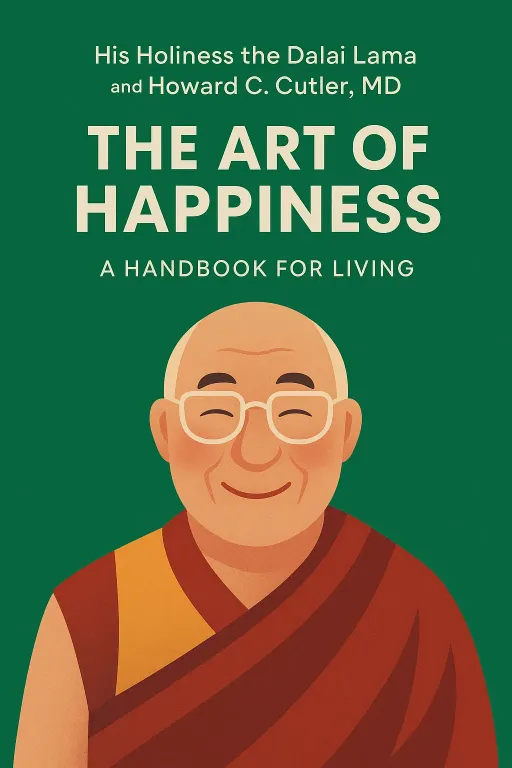
Nova: Exactly. Today, we are looking at how to fix that structural flaw. We are diving into a fascinating combination of insights. We are bringing together The Art of Happiness by His Holiness the Dalai Lama and Howard C. Cutler, alongside Max Lucado’s Anxious for Nothing.
Atlas: I have always found that pairing interesting. You have a Nobel Peace Prize winner and a psychiatrist, Dr. Howard Cutler, sitting down to dissect the mechanics of happiness like it is a clinical study. It takes the mysticism out of it and turns happiness into something tangible, almost like a skill you can train.
Nova: That is the perfect way to describe it. Cutler was the skeptic in the room, bringing that Western, analytical lens to the Dalai Lama’s ancient wisdom. And when you layer that over Max Lucado’s work, which focuses on the very practical, almost tactical, framework for dismantling anxiety, you get a blueprint for how to operate at a high level without burning out. We are talking about decoupling your internal state from your external circumstances.
Atlas: That sounds like a superpower. Most of us are chained to our circumstances. If the market is up, we are happy. If the project is late, we are miserable. I am curious, how do we actually break that link?
The Ambition Trap
SECTION
Nova: To break the link, we have to recognize the trap of the hedonic treadmill. We assume that happiness is a destination. We think, if I can just land this client, or finish this design, or get this title, then the baseline will shift. But the brain is wired for adaptation. We reach the goal, we feel a fleeting spike of joy, and then we immediately return to our previous baseline of anxiety or restlessness.
Atlas: I see that everywhere. I see it in high-performing teams, and I see it in my own life. We hit a massive goal, we celebrate for an hour, and then the brain immediately starts scanning for the next catastrophe or the next mountain to climb. It is exhausting.
Nova: It is, because we are training our brains to be dissatisfied. The Dalai Lama’s perspective, which Cutler articulates so well, is that happiness is not a feeling that happens to you. It is a state of being that you cultivate through systematic mental training. He argues that we have a choice. We can either let our external environment dictate our internal state, or we can build an internal environment that remains stable regardless of what happens outside.
Atlas: That sounds incredibly logical, but I have to play devil’s advocate here. If I stop being anxious, if I stop feeling that pressure to succeed, do I lose my edge? Does the ambition evaporate? There is a fear that if I find "peace," I will just become complacent.
Nova: That is the most common hesitation. But consider this: anxiety is not fuel. Anxiety is friction. You might move fast when you are anxious, but you are burning out your engine. When you cultivate a baseline of peace, you are not becoming complacent. You are becoming precise. You are replacing the frantic, reactionary energy of anxiety with the steady, purposeful energy of mastery.
Atlas: I love that distinction. Replacing friction with precision. That is a great way to frame it. It is like the difference between a car engine that is redlining and overheating, and one that is humming perfectly at high speed. You are going just as fast, but you are not destroying the machine in the process.
Nova: Precisely. And that is where the architecture of the mind comes in. If you are an architect of your own life, you have to design the internal systems that handle pressure. You don't just hope for a calm day. You build the capacity to remain calm during the storm.
The Mechanics of Calm
SECTION
Atlas: That brings us to the practical side of things. How do we actually do this? Because telling someone to "just be calm" is about as useful as telling a drowning person to "just swim." We need a framework, and that is where the work of Max Lucado feels so relevant. He offers a way to dismantle that anxiety, piece by piece.
Nova: Lucado’s approach is refreshing because it is not about suppressing the anxiety. It is about engaging with it cognitively. He provides a roadmap for managing the daily, nagging thoughts that eventually turn into full-blown burnout. It starts with the understanding that anxiety is often a result of our focus. We are focusing on the outcome, which we cannot control, rather than the input, which we can.
Atlas: That is the pivot point. We are obsessed with the outcome. We want the building to be finished, the deal to be signed, the approval to be given. But we have zero control over the reactions of others or the market or the timeline.
Nova: Exactly. When you focus on the outcome, you are effectively gambling with your mental health. You are handing the keys to your happiness over to forces you cannot influence. Lucado’s framework suggests that we need to actively reframe our thoughts. Instead of asking "What if this goes wrong?", we train our minds to ask "What is the one thing I can do right now that aligns with my purpose?"
Atlas: I have tried that, and it is harder than it sounds. My brain is a professional catastrophe simulator. It loves to run scenarios of everything that could possibly go wrong. How do we stop that loop?
Nova: You don't stop the loop by fighting it. You stop it by interrupting it with a specific, physical intervention. This is where we get to that tiny, powerful step. When you feel that surge of overwhelming ambition or anxiety, you have to physically interrupt the pattern. You spend two minutes—just two minutes—practicing targeted breathing.
Atlas: Two minutes? That is all?
Nova: Two minutes is the threshold. In those two minutes, you do three things. First, you breathe deeply to signal your nervous system that you are not in immediate physical danger. Second, you identify one thing you are genuinely grateful for. This is not just positive thinking; it is a neurological reset. It forces your brain to scan for something positive, which temporarily overrides the catastrophe simulator.
Atlas: I see what you are doing there. You are hacking the brain’s focus.
Nova: You are. And the third step is the most critical for the ambitious person: you explicitly practice letting go of the outcome. You say to yourself, "I have done the work, I have prepared, and now the outcome is out of my hands." You are essentially creating a mental boundary between your effort and the result.
Atlas: I can see how that would be a game-changer for someone who feels the weight of the world on their shoulders. It is not about giving up. It is about giving up the illusion of control.
Nova: That is the secret. You are not giving up on your goals. You are giving up the anxiety that you think is required to achieve them. The irony is that when you let go of the need to control the outcome, you usually perform better because your brain is no longer clouded by the fear of failure.
Synthesis & Takeaways
SECTION
Atlas: This is starting to feel like a complete system. We have the Dalai Lama’s perspective that happiness is a skill to be trained, and we have Lucado’s framework for managing the cognitive load of ambition.
Nova: And when you put them together, you realize that you are the architect of your own baseline. You can choose to set your baseline at "anxious and reactionary," or you can choose to set it at "focused and peaceful."
Atlas: I want to make sure I am capturing the essence of this for our listeners. We are talking about a shift from "I will be happy when I achieve X" to "I am training my mind to be steady while I work toward X." It is a fundamental shift in the timeline of success.
Nova: That is exactly it. You are not waiting for the future to give you permission to be at peace. You are claiming that peace right now, in the middle of the work. And that tiny, two-minute practice is the foundation. It is the ritual that keeps the foundation from cracking.
Atlas: I think the most important takeaway for anyone listening who is in the thick of a high-pressure career is this: your ambition is a gift, but your anxiety is a choice. You don't have to carry both. You can be incredibly ambitious and still be deeply at peace.
Nova: That is a beautiful way to synthesize it. The goal is to reach a point where your work is an expression of your values, not a desperate attempt to prove your worth. When you make that shift, everything changes. You are no longer building to escape your current life; you are building because you love the process of creation itself.
Atlas: I am definitely going to start using that two-minute breathing and gratitude reset before my next major meeting. It sounds simple, but I have a feeling it is the kind of simple that is incredibly difficult to master.
Nova: It is the simple things that require the most discipline. That is where the mastery lies. It is not in the grand gestures; it is in the daily, non-negotiable appointments with your own mental clarity.
Atlas: This has been a great exploration. We have taken some very complex ideas about happiness and anxiety and turned them into something we can actually use on a Tuesday afternoon.
Nova: And that is the goal. We are not just thinking about these ideas; we are building a life with them. Thank you for joining us in this conversation.
Atlas: It has been a pleasure. Let's keep building.
Nova: This is Aibrary. Congratulations on your growth!