

Beyond the Recipe: The Alchemy of Culinary Artistry and Personal Expression.
Golden Hook & Introduction
SECTION
Nova: What if I told you that the secret to being a truly great cook isn't about meticulously following instructions, but about bravely breaking them?
Atlas: Whoa, hold on. As someone whose culinary adventures usually involve a recipe, a timer, and a silent prayer, that sounds… terrifying and liberating all at once. Are you saying my carefully measured teaspoons are actually holding me back?
Nova: Exactly! Or at least, they’re holding back your full potential for culinary alchemy. Think about it, Atlas. How often does cooking feel like an obligation, a chore of following steps, rather than an act of creation, of infusing your very soul into a dish?
Atlas: Honestly, most weekdays. I mean, I enjoy eating, but the process often feels more like a science experiment where I’m just the technician, hoping the chemicals don’t explode. I guess there’s this longing to make something truly, but it feels like I need a master's degree in gastronomy to get there.
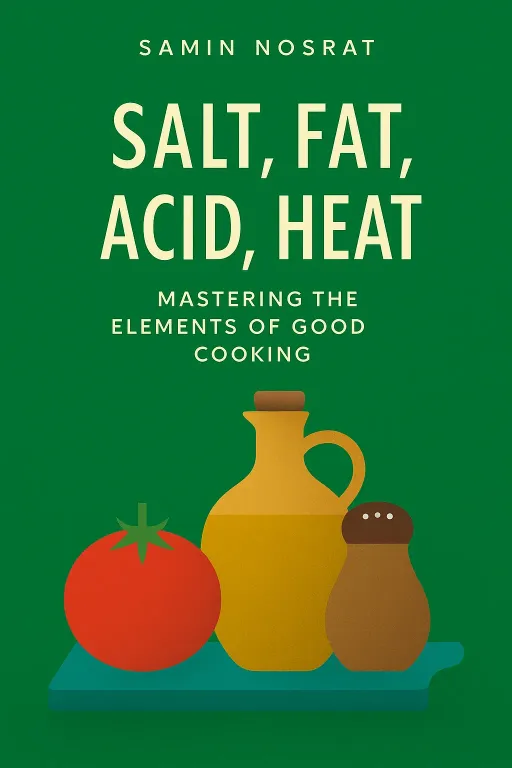
Nova: That longing, that desire to find your unique voice in the kitchen, is precisely what we’re exploring today. It's about elevating cooking from a skill to an expressive craft. And to guide us, we're diving into the wisdom of two incredible minds: Samin Nosrat, with her groundbreaking book, and the legendary food writer M. F. K. Fisher, whose essays in truly validate the emotional and personal acts behind every meal.
Atlas: Samin Nosrat, now there’s a name that resonates. I remember hearing about her. She actually worked in some of the most prestigious fine dining kitchens, right? Like Chez Panisse, under Alice Waters? Yet, she became famous for demystifying cooking, for making it accessible to home cooks. That’s quite a pivot from Michelin-star aspirations to teaching people how to roast a chicken intuitively.
Nova: It really is. Her journey is fascinating because she realized that while the precision of elite kitchens was important, the real magic, the true power, came from understanding the, not just memorizing recipes. That’s her unique brilliance: taking that high-level knowledge and translating it into core elements anyone can grasp. And that understanding is our first step on this journey to culinary artistry.
Mastering the Elements with Samin Nosrat
SECTION
Atlas: So, how does she help us, the mere mortals who cling to our cookbooks, actually move beyond those strict instructions? Because for many of us, the idea of just "winging it" in the kitchen feels like a recipe for disaster.
Nova: That's where her genius lies. Nosrat demystifies cooking by boiling it down to four core elements: salt, fat, acid, and heat. She argues that once you understand how these four interact and affect food, you gain an intuitive grasp that makes recipes almost secondary. Imagine cooking not as following a script, but as conducting an orchestra. You know what each instrument does, and you can improvise beautifully.
Atlas: Okay, that’s a powerful analogy. But can you give me an example? Like, how does understanding "fat" or "acid" help me make a better meal if I’m just trying to follow a recipe for, say, roasted vegetables?
Nova: Absolutely. Let's take those roasted vegetables. A recipe might tell you to toss them with olive oil, salt, and pepper and roast at 400 degrees. But Nosrat would push you deeper. She'd ask: What kind of fat are you using? Olive oil offers a fruity note, butter adds richness, coconut oil a tropical hint. How much salt? Enough to enhance flavor, not just make it salty. And where's the acid? A squeeze of lemon or a splash of vinegar roasting can brighten everything, cutting through the richness of the fat and waking up the other flavors. And heat? Not just a temperature, but understanding how different levels of heat create browning, tenderness, or crispness.
Atlas: Huh. So it's not just about adding the ingredients, it's about understanding what each one to the dish at a fundamental level. It's like learning the grammar of cooking, rather than just memorizing sentences.
Nova: Precisely! She empowers you to understand things work, not just to follow a recipe. Say you're making a simple vinaigrette. A recipe gives you proportions. Nosrat explains that fat carries flavor, acid brightens and balances, salt enhances, and maybe a touch of sweetness rounds it out. Once you know that, you can adjust to your taste, to the specific greens you're dressing, to your mood. You can switch vinegars, use different oils, add herbs – all intuitively, because you understand the underlying principles.
Atlas: I guess that makes sense, but it still feels like a leap of faith for the uninitiated. How do you develop that intuition? What if my intuition leads me to a truly terrible dinner?
Nova: That's the beauty of it. It's not about abandoning recipes entirely; it's about using them as a starting point for understanding. Nosrat encourages experimentation within that framework. You start by consciously observing: "What happens if I add a bit more salt here? What if I use red wine vinegar instead of lemon juice?" It's like a musician learning scales and chords before they improvise. You practice, you taste, you adjust. And remember, every "terrible dinner" is a learning opportunity. It’s about building a repertoire of knowledge, not just recipes.
The Emotional Connection with M.F.K. Fisher
SECTION
Nova: But understanding the mechanics, the salt, fat, acid, and heat, is only half the alchemy. To truly infuse your soul into a dish, to make cooking an act of personal expression, we need to talk about the profound emotional connection to food. And that's where M. F. K. Fisher comes in.
Atlas: M. F. K. Fisher. I know her name, but I confess I haven't delved into her work. What makes her so essential to this idea of culinary artistry?
Nova: Fisher, through her exquisite essays in, explored the deep, often unspoken relationship between food, culture, and the human experience itself. She wasn't a chef teaching techniques; she was a philosopher and poet of the plate. Her writing validates the idea that cooking and eating are profoundly personal, emotional acts. She showed that a simple meal isn't just sustenance, but a conduit for memories, traditions, comfort, and even a form of self-expression.
Atlas: That’s a fascinating complement to Nosrat. So, while Nosrat gives us the technical toolkit, Fisher gives us the soul, the behind the act of cooking. How does understanding that emotional connection change how we approach ingredients or even the act of cooking itself?
Nova: Fisher would argue that when you understand this profound connection, every ingredient becomes imbued with more meaning. It's not just a tomato; it's the culmination of sunshine and soil, a memory of summer, a connection to the farmer who grew it. She wrote about the sensual pleasure of food, the way it evokes memory, the comfort it provides. For her, the act of preparing and sharing food was deeply tied to love, to identity, to belonging.
Atlas: So, for someone like me, who wants to be more of an "Artisan" in the kitchen, to infuse "beauty and expression" into every meal, Fisher is telling us to pay attention to that deeper narrative? To think about the story behind the food?
Nova: Exactly. Say you're making a family recipe. A cook merely following instructions might replicate the taste. But a culinary artisan, inspired by Fisher, would consider the history, the person who first made it, the occasions it was served, the feelings it evokes. They might subtly adapt it, not just for flavor, but to tell a new part of that story, to reflect their own journey while honoring its past. It’s about being present, mindful, and allowing your own experiences and emotions to inform your choices. That's where the true personal expression comes in.
Atlas: Wow. That's actually really inspiring. It’s not just about mastering techniques, but about embracing the of cooking. It’s about connecting the technical with the emotional, making cooking a truly personal and artistic endeavor. It's about finding that voice, as you said.
Synthesis & Takeaways
SECTION
Nova: Precisely. These two incredible writers, Nosrat and Fisher, connect the technical mastery with the emotional depth. They show us that true culinary artistry isn't about abandoning recipes, but about understanding them so deeply that you can transcend them. It's about realizing that your unique artistic vision, your voice in the kitchen, is already within you. You just need the tools and the permission to trust it.
Atlas: That makes so much sense. It's about being an explorer and an artisan in equal measure, seeking depth and applying yourself fully. So, for our listeners, what's a practical step we can take, maybe even today, to start this journey beyond the recipe? To begin trusting that inner artistic vision?
Nova: For your healing moment this week, I want you to do this: next time you cook, choose just ingredient. It could be an herb, a vegetable, a spice. Now, consciously consider how you can highlight its natural flavor. Don't just follow the recipe's lead for that ingredient; let intuition guide you. Ask yourself: Does this need more salt to sing? A touch of acid to brighten? A different cooking method to bring out its best? Experiment without judgment. It’s a small act of creative experimentation, but it's where true culinary artistry begins.
Atlas: I love that. Focusing on one ingredient makes it feel less daunting than trying to reinvent a whole meal. It's about building that confidence incrementally. A little bit of salt, fat, acid, and heat, combined with a whole lot of heart and personal connection.
Nova: Exactly. Trust your palate, trust your instincts, and let your kitchen become your canvas.
Atlas: That’s a beautiful thought. Thank you, Nova.
Nova: Thank you, Atlas.
Atlas: This is Aibrary. Congratulations on your growth!