

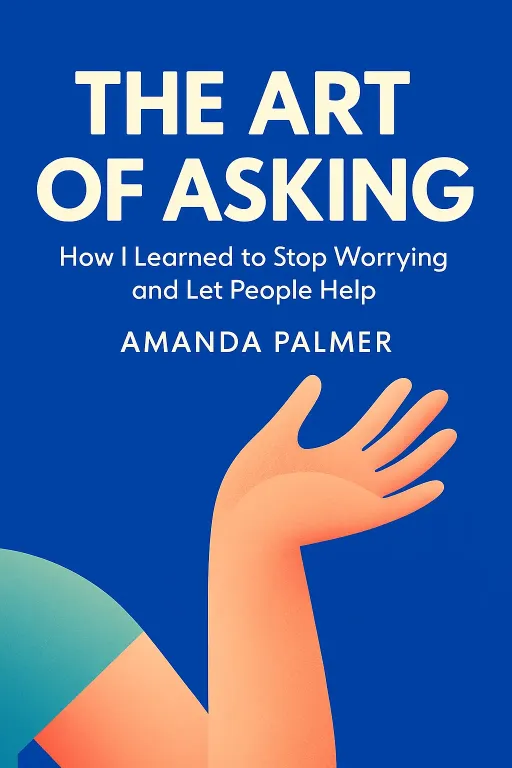
** The Radical Art of Asking: Unlocking Creativity, Confidence, and Deeper Connections
Golden Hook & Introduction
SECTION
Nova: Lovey, let me ask you something. Have you ever been in a public bathroom and suddenly realized you need a tampon? Amanda Palmer, the author of 'The Art of Asking,' calls this the 'karmic tampon circle.' A stranger helps you, no questions asked, because they know one day, it'll be their turn. But what happens when the ask isn't for a tampon, but for help with your biggest creative project, or for support from a partner? Suddenly, that easy generosity vanishes, and we're paralyzed by fear. Why is that?
Lovey: It's fascinating, Nova. It's exactly what Brené Brown, who actually wrote the foreword to this book, talks about—the difference between vulnerability in a safe container versus in the open arena. The bathroom is a sisterhood, a known system of reciprocity. But the boardroom, the artist's studio, or even our own living room... that can feel like a battlefield.
Nova: That's the core question we're exploring today through Amanda Palmer's incredible book. We're going to see how letting people help us is one of the most powerful things we can do for our creativity and our relationships. Today we'll dive deep into this from two perspectives. First, we'll explore the 'Fraud Police'—that inner voice that tells us asking for help is a failure. Then, we'll uncover the beautiful distinction between asking and begging, and how to master the art of the exchange.
Deep Dive into Core Topic 1: Deconstructing the 'Fraud Police'
SECTION
Nova: Exactly! A battlefield. And Amanda Palmer argues the main enemy on that battlefield is what she calls 'The Fraud Police.' These are the imaginary cops in our heads, with their sirens wailing, ready to arrest us for being a phony the second we admit we don't have it all figured out.
Lovey: I know those cops intimately. I think we all do. It’s that feeling of imposter syndrome, the fear that you’ll be 'found out.'
Nova: Precisely. And Palmer shares this incredibly moving story. After she gave her now-famous TED talk on this very subject, the speaker coach—a woman who helps the world's top minds appear confident and polished—approached her. Amanda was worried she'd gone over her time limit, but the coach just looked at her with tears in her eyes and said that the talk had unlocked something for her. She confessed that for years, she'd had this artistic project, this dream of her own, but she was completely paralyzed by the fear of asking for help. She kept asking, "Why the hell do we find it so hard to ask, especially if others are so willing to give?"
Lovey: Wow. That hits so hard. For so many women, especially in that 25-to-34 age range, we're told to be leaders, to be innovative, but also to be flawlessly competent. The 'Fraud Police' feels like a very real consequence of that double standard. We're afraid to ask for a raise, for a collaboration, or even for clarification on a project, because we think it'll expose us as not 'good enough.'
Nova: And it's not just professional. Palmer tells this raw, personal story about the night before her wedding party. She's having a full-blown panic attack, not because she doesn't love her husband-to-be, the writer Neil Gaiman, but because she can't bring herself to accept a loan from him. She's built her entire identity on being this independent, self-sufficient artist.
Lovey: The idea of being indebted, even to someone you love, can feel like a threat to your identity. It's that mindset of, "I have to do this on my own, or it doesn't count."
Nova: Exactly. And Neil finally confronts her, saying, "All you have to do is ASK me. I married you. I love you. I want to HELP. You won’t let me help you." It's this cultural programming she's fighting against. She quotes, "American culture in particular has instilled in us the bizarre notion that to ask for help amounts to an admission of failure."
Lovey: And that's the lie the Fraud Police tells us. That asking is failure. But what Palmer is really showing us is that refusing to ask, refusing to let people in, is the real failure. It's a failure of connection. It keeps us isolated and small.
Deep Dive into Core Topic 2: The Art of the Exchange
SECTION
Nova: And that fear of being 'not good enough' is exactly what separates a desperate beg from a confident ask. This brings us to our second big idea: The Art of the Exchange. And there's no better story to illustrate this than Amanda's time as a living statue.
Lovey: I am so fascinated by this part of her life. The commitment is just incredible.
Nova: It's amazing. So, picture this: after college, to avoid a 'real job' and support her music, Amanda creates a character called 'The Eight-Foot Bride.' She'd paint her face white, put on a vintage wedding gown, and stand perfectly still on a milk crate in the middle of Harvard Square for hours. At her feet was a hat for money. Now, you might think, "Oh, she was begging." But she wasn't.
Lovey: What was the difference?
Nova: The exchange. When someone put a dollar in her hat, she didn't just take it. She would break her stillness, slowly turn, lock eyes with them—truly them—and hand them a single flower she'd picked. It wasn't a handout; it was a transaction. A moment of performance art and human connection for a dollar.
Lovey: That's the key, isn't it? The eye contact. The flower. She's not just taking; she's something in return—a moment of being seen, a small piece of beauty. It completely reframes the power dynamic. It’s not begging; it's a collaboration.
Nova: It's a collaboration! She learned that the people who gave weren't pitying her; they were participating in the art. She contrasts this with the famous social experiment where the world-class violinist Joshua Bell played his multi-million-dollar Stradivarius in a subway station during rush hour. Almost no one stopped. He made about 32 dollars.
Lovey: Because the context was wrong. There was no invitation to connect, no exchange offered. People were just trying to get to work. They weren't in a space to receive the gift.
Nova: Exactly. The Bride, on the other hand, created that space. She was a living question mark. And by offering the flower, she made the answer a 'yes.' Palmer later had a blog discussion with her fans about this, and they helped her define it. They said asking is about dignity, collaboration, and trust. Begging is about desperation, shame, and a one-way demand.
Lovey: That distinction is so critical for our relationships. When we ask a partner for emotional support, are we just demanding it out of our own emptiness? Or are we also offering our own vulnerability, our attention, our trust in return? That's the difference between a healthy, collaborative 'ask' and an emotional drain. It's about creating a space where both people feel seen.
Nova: You're so right. It's about seeing the other person not as a resource to be tapped, but as a partner in the exchange. Whether it's for a dollar, for a creative idea, or for a shoulder to cry on.
Synthesis & Takeaways
SECTION
Nova: So, when we put it all together, what we've really learned today from "The Art of Asking" is that asking isn't about a lack of resources, it's about fostering connection. First, we have to silence that 'Fraud Police' by understanding that vulnerability is an act of courage, not weakness.
Lovey: And second, we have to frame our asks as an exchange, as an invitation to connect. It’s not about what you're getting, but about what you're building together in that moment of trust.
Nova: It's a total mindset shift. It moves asking from the column of 'shame' to the column of 'community' and 'creativity.'
Lovey: Absolutely. And for everyone listening, especially those of us trying to be more creative, more confident, or build better relationships, the takeaway is so powerful. I think the challenge Amanda leaves us with is this: What's one thing you need help with right now? It could be big or small.
Nova: A great question.
Lovey: Instead of seeing it as a burden on someone else, how can you reframe it as a gift? A gift of your trust. A chance for them to share their expertise. A moment to simply connect. Start small. Ask a coworker for their eyes on a project. Ask a friend to just listen for five minutes. And when you do, think about what you're offering in return—your gratitude, your attention, your own willingness to help them in the future. Just see what happens when you offer the flower.
Nova: Offer the flower. I love that. A perfect, beautiful way to end. Lovey, thank you for these insights.
Lovey: Thank you, Nova. This was wonderful.









