** The Anxious Generation: An Insider's Look at Tech's Great Rewiring
12 minGolden Hook & Introduction
SECTION
Socrates: August, you work as a data analyst. You build and interpret the digital world. But have you ever stopped to look at the data of what that world is building in?
august: That's a heavy question to start with, but it's one I think about a lot. We're so focused on the data of user behavior, but the data of user well-being? That's a different story.
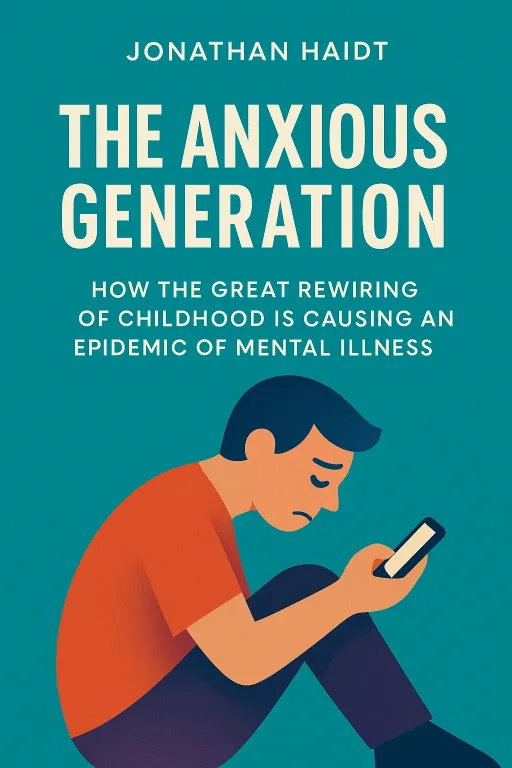
Socrates: It's the central question of Jonathan Haidt's new book, 'The Anxious Generation.' He presents a chilling dataset: around 2012, as smartphones became ubiquitous, the mental health of adolescents plummeted. It's a correlation so stark, it demands we ask if the greatest innovation of our time has inadvertently engineered a generation of anxiety. And you and I, we're the first test subjects.
august: We are. We're the first generation to go through puberty with a portal in our pockets, as Haidt says. It’s our lived experience.
Socrates: Exactly. So today we'll dive deep into this from two perspectives. First, we'll explore the shocking data that charts this 'tidal wave' of anxiety that hit Gen Z. Then, we'll deconstruct the very architecture of the technology that may be driving it, asking some tough questions about the responsibility of the tech industry.
august: I'm ready. It feels like a necessary conversation.
Socrates: Haidt's core argument is what he calls the "Great Rewiring." He says childhood was rewired from being play-based to phone-based. This happened because of two converging trends: we started overprotecting kids in the real world, taking away free play and independence, while simultaneously underprotecting them in the virtual world, giving them unfettered access to the entire internet.
august: A perfect storm, really. Less resilience-building in the real world, and more anxiety-inducing exposure in the virtual one.
Deep Dive into Core Topic 1: The Data Tsunami
SECTION
Socrates: Let's start with the evidence. Haidt doesn't just rely on anecdotes; he presents it like a crime scene investigator. The key piece of evidence is the timing. He points to the U. S. National Survey on Drug Use and Health, which shows that after being relatively flat for years, major depressive episodes among teens shot up by roughly 150 percent between 2010 and 2020.
august: A 150 percent increase. That's not a gentle curve; that's a cliff.
Socrates: It is. By 2020, one out of every four American teen girls had experienced a major depressive episode in the past year. And it gets darker. He cites CDC data showing that for the youngest adolescent girls, ages 10 to 14, emergency room visits for self-harm nearly tripled from 2010 to 2020. Tripled.
august: Wow.
Socrates: And this isn't just an American problem. He shows similar charts for Canada, the U. K., Australia, the Nordic countries. It's an international phenomenon that ignites in the early 2010s, right as smartphones went from a novelty to a necessity for teens. So, august, as a data analyst, when you see multiple, independent datasets all pointing to a dramatic shift around the same specific point in time—2012—what does that tell you? How do you approach that?
august: You have to take it seriously. In my world, if we roll out a new feature and see a 5% lift in engagement, it's a massive success. If we saw a 150% increase in users reporting a negative experience, it would be a five-alarm fire. To see it at a societal level across multiple countries... the null hypothesis, the idea that this is all a coincidence, seems incredibly weak.
Socrates: So you're saying the correlation is too strong to ignore.
august: It's more than that. It's the of the signal across different metrics—depression, anxiety, self-harm, loneliness—and across different, yet similar, cultures. In business, we'd call that a market-shifting event. Here, it's a society-shifting event. You have to start looking for the one variable that changed for all those groups at the same time.
Socrates: And that variable, Haidt argues, is the phone-based childhood. He has this powerful thought experiment. He asks us to imagine a tech billionaire announced a plan to raise a million children on Mars. The kids would live in enclosed habitats, interacting mostly through screens. We'd be outraged, right? We'd demand safety studies.
august: Of course. The long-term effects would be completely unknown.
Socrates: But isn't that what we did? We didn't send them to Mars, but we sent them into a new, disembodied, virtual universe with no safety studies, no guardrails, and no real understanding of the developmental consequences.
august: That hits hard because it's essentially the 'launch and iterate' model of Silicon Valley applied to human development. We launched a new form of childhood, and now, a decade later, we're seeing the bug reports. Except the bug reports are ER visits and depression statistics. We broke something, and we're only now realizing the severity.
Deep Dive into Core Topic 2: The Architecture of Anxiety
SECTION
Socrates: So if the data shows happened, Haidt then turns to. And this is where it gets personal for your industry, august. He argues this wasn't just an accident; it was, in part, by design.
august: The intentionality of it. That's the uncomfortable part.
Socrates: He quotes Sean Parker, the first president of Facebook, who admitted this in an interview. Parker said the thought process was, "How do we consume as much of your time and conscious attention as possible?" He said they were exploiting a "vulnerability in human psychology." He called it a "social-validation feedback loop."
august: Likes, comments, shares. The dopamine hits.
Socrates: Precisely. Haidt explains the "Hooked" model, which is well-known in tech. It's a simple loop. Step 1 is a trigger, usually a notification on your phone. Step 2 is the action: you touch it. Step 3 is the crucial one: a.
august: The slot machine effect.
Socrates: Exactly. You don't know what you're going to get. It could be a 'like' from someone you admire, a mean comment, or just your aunt sharing a cat video. That variability is what makes it so addictive. It's what keeps you pulling the lever, or in this case, refreshing the feed. August, these terms—variable rewards, engagement loops, time-on-device—these are the metrics of your world. When you hear them described as tools of psychological exploitation, how does that land?
august: It's a tension I think anyone in tech, especially in a product or data role, has to grapple with. On one hand, these are just tools to build a 'sticky' product. A product people want to use. But 'stickiness' is a pretty clean euphemism, isn't it? When the user is a 13-year-old whose brain is still developing, the line between 'sticky' and 'addictive' gets terrifyingly thin.
Socrates: So where is that line?
august: I think the line is about intent and outcome. Are you optimizing for the user's well-being or just for their attention? The current business model of social media is an attention economy. As Tristan Harris says, it's a "race to the bottom of the brain stem." We're optimizing for a number—daily active users, time on screen—but that number has a human cost. And this book puts a face, and a lot of data, on that cost.
Socrates: And it's not just addiction. Haidt talks about "attention fragmentation." He uses the analogy of Kurt Vonnegut's story "Harrison Bergeron," where intelligent people are forced to wear earpieces that blast loud noises every 20 seconds to shatter their thoughts. He argues that's what notifications do to us.
august: That resonates so much. It's not just about the time you spend on the phone; it's about the way it colonizes your time the phone. You can't get into a state of deep focus because you're always anticipating the next buzz. It also changes how we interact. Haidt talks about the shift from synchronous, face-to-face communication to asynchronous, performative communication. Real conversation is embodied, it's messy, you read non-verbal cues. Online 'connection' is disembodied and curated. We're trading the richness of real-world interaction for the volume of virtual validation.
Synthesis & Takeaways
SECTION
Socrates: So we have this perfect storm: a generation moved indoors, away from risky play that builds resilience, and given these powerful devices, designed to be addictive, at a crucial developmental stage. And the data shows a resulting mental health catastrophe.
august: Exactly. We've replaced the antifragile, play-based childhood that builds resilience with a fragile, phone-based one that seems to cultivate anxiety. We took away the small, manageable risks of the real world and replaced them with the huge, unmanageable risks of the virtual world—social comparison, cyberbullying, and addiction.
Socrates: Haidt proposes four foundational reforms, but I want to focus on one big idea he pushes for: a "duty of care" for tech companies. This is a legal concept, that companies have a responsibility not to harm their users, especially minors. August, from your perspective on the inside, what's one concrete step a company could take tomorrow if they truly accepted that duty?
august: It's actually not that complicated, technically. It's a shift in philosophy. For example, change the default settings. Instead of 'notifications on' by default, make them 'off.' Let users opt-in to being interrupted. Instead of infinite scroll, build in natural stopping points—"You've been scrolling for 20 minutes, want to take a break?" It's about shifting the design philosophy from 'how do we keep them here?' to 'how do we provide value and then respectfully let them leave?' It's about respecting the user's time and mental space, especially a young user's.
Socrates: Respecting their time and letting them leave. That feels like a revolutionary idea in the attention economy. And for the rest of us, for those not designing the apps?
august: I think it's about recognizing the trade-off. Every hour we spend in that disembodied virtual world is an hour not spent in the embodied real one. It's about consciously choosing the real world more often.
Socrates: A powerful thought. And perhaps for our listeners, the question is: How can we create more opportunities for real-world, synchronous connection in our own lives, to push back against the pull of the virtual? That's the thought we'll leave you with.