

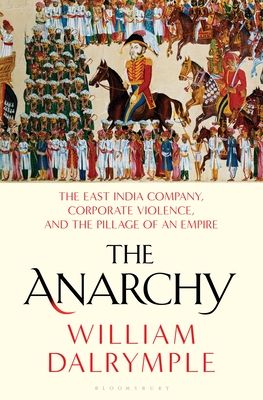
The Anarchy
The East India Company, Corporate Violence, and the Pillage of an Empire
Introduction
Nova: Imagine a company so powerful that its private army is twice the size of the national military, a corporation that controls territory larger than its home country, a business that topples empires and reshapes global trade. This isn't science fiction — this is the story of the British East India Company. Welcome to Aibrary. I'm Nova.
Nova: It absolutely does. Dalrymple is a master storyteller. He takes us from a cramped office in Elizabethan London where a handful of merchants dreamed of trading spices, all the way to the Red Fort in Delhi, where the aging, blinded Mughal emperor became a puppet of a private company. The central question is devastatingly simple: how did a small group of businessmen conquer an entire subcontinent?
Nova: By 1803, the East India Company commanded an army of nearly two hundred thousand men — twice the size of the British Army itself. It ruled over the Indian subcontinent not as a government but as a profit-seeking enterprise answerable to shareholders. The book traces how this happened, and it's not a story that makes anyone look good. So let's start at the beginning.
Origins of the East India Company
A Trading Company with an Army
Nova: The East India Company was founded in 1599, receiving a royal charter from Queen Elizabeth I on the very last day of 1600. It was a joint-stock company — a relatively new invention that pooled money from investors who shared both risks and rewards. The initial aim was modest. They wanted to compete with the Dutch and the Portuguese for a slice of the spice trade in the East Indies.
Nova: Exactly. The Company's first men landed on Indian soil in 1608. Their mission was straightforward: establish trade with the Mughal Empire, which at that time was one of the wealthiest and most sophisticated empires on earth. The word mogul — meaning a powerful, wealthy person — comes directly from these early English encounters with Mughal splendor. The Europeans were stunned by the jewels, the fabrics, the sheer opulence.
Nova: Still, Roe eventually secured permission to build a trading fort in Madras. Then Bombay. Then Calcutta. These three settlements — Madras, Bombay, Calcutta — became the foundation of British India. And for a while, it was genuinely a mutually beneficial relationship. Indian artisans and merchants flocked to these Company towns. By the 1690s, Bombay had grown from a backwater fishing port to a commercial hub of sixty thousand people.
Nova: Two things happened simultaneously. First, the Mughal Empire began to crumble. And second, the Company realized that in the chaos, military force could secure profits that trade alone never could. The turning point, according to Dalrymple, came in 1745 at the Battle of the Aydar River, when seven hundred French-trained Indian soldiers — called sepoys — routed ten thousand Mughal troops. The message was unmistakable: European military tactics could defeat anything the old empire could muster.
The Collapse of Mughal India
When Empires Crumble
Nova: The title of the book — The Anarchy — doesn't refer to British rule. It refers to the period before the British took over, when the Mughal Empire collapsed into chaos. And what a collapse it was.
Nova: It honestly is. The Mughal emperor Aurangzeb died in 1707 after a reign of nearly fifty years. He was a ruthless expansionist and a religious zealot who had stretched the empire to its largest geographic extent — but through decades of continuous warfare, crushing taxation, and mass suffering. When he died, he left no clear successor. What followed was a succession crisis of staggering brutality.
Nova: And as the center collapsed, local rulers stopped paying taxes. Banditry made trade routes unsafe. The empire was ripe for the taking. By 1737, Delhi still had around two million inhabitants — larger than London and Paris combined, one of the most magnificent cities on earth. Dalrymple describes it as hanging there like an overripe mango, huge and inviting, clearly in decay, ready to fall.
Nova: What followed was horrific. Nader Shah's forces massacred over a hundred thousand people in Delhi. After fifty-seven days of pillaging, he left with two hundred years' worth of Mughal treasure, carried on seven hundred elephants, four thousand camels, and twelve thousand horses, all laden with gold, silver, and precious stones. This included the Peacock Throne and the Koh-i-Noor diamond.
Nova: Precisely. Terrified Bengalis fled to the only safe place in the region — the Company's fortified settlement in Calcutta. The city's population more than tripled in a decade. Merchants, bankers, and artisans poured in. Calcutta had something the rest of India increasingly lacked: rule of law, enforceable commercial contracts, and strong fortifications. It became a haven for private enterprise, drawing in not just Bengalis but Parsis, Gujaratis, and Marwari entrepreneurs from across Asia.
How a Battle Won by Betrayal Changed History
Plassey and the Pillage of Bengal
Nova: This brings us to the most pivotal chapter in the book — the conquest of Bengal. And the central figure is Robert Clive, a man Dalrymple describes as violent, utterly ruthless, and intermittently mentally unstable. Clive was a corporate predator of the first order.
Nova: Dalrymple dismantles that myth thoroughly. Clive was certainly bold — he had what Dalrymple calls a streetfighter's eye for sizing up opponents, breathtaking audacity, and a willingness to take enormous risks. But the Battle of Plassey in 1757, which is often portrayed as a great British military triumph, was actually won through conspiracy and betrayal, not superior generalship.
Nova: The Nawab of Bengal, Siraj ud-Daula, was deeply unpopular. Dalrymple notes that not one of the many sources for the period — Persian, Bengali, Mughal, French, Dutch, or English — has a good word to say about him. He was by all accounts a vicious and unstable ruler who got his kicks from sinking ferry boats in the Ganges to watch travelers drown. But his fatal mistake was offending his bankers.
Nova: The Jagat Seths — a family of Marwari-Jain bankers who were the real kingmakers in Bengal. When Siraj ud-Daula came into conflict with Clive, the Seths conspired with the British. They arranged for Siraj's own general, Mir Jafar, to abandon him on the battlefield. Plassey was barely a battle. It was a fixed match.
Nova: Clive personally entered the Nawab's treasury in Murshidabad and took most of it for himself. He returned to Britain with a personal fortune worth two hundred thirty-four thousand pounds at the time — that's about thirty-five million pounds in today's money. But the real tragedy was what happened to Bengal itself. The Company gained the right to collect taxes — the diwani — and its officials engaged in what Dalrymple calls a systematic orgy of asset-stripping.
Nova: Yes. While millions of Bengalis starved to death — estimates range from one to ten million — the Company maintained its brutal tax collection. Tax collectors were described as shaking the pagoda tree, squeezing every last rupee from peasants who had nothing left. And unlike Indian rulers, who typically suspended taxes and organized famine relief during such crises, the Company did nothing. Its priority was maintaining a high share price for investors back in London.
Nova: And here's the cruel irony. The plunder was so extreme that it eventually crashed the Company's own share price. Bengal had been stripped bare. There was nothing left to extract. So the most successful corporate raid in history became, in a sense, too successful for its own good.
The First Mega-Bailout and the Trial of Warren Hastings
Too Big to Fail
Nova: By 1772, the East India Company was responsible for an astonishing fifty percent of global trade. But it was also facing bankruptcy. It could not pay its creditors. It could not pay its taxes. And it had become so embedded in the British economy — so many members of Parliament held its stock — that letting it fail was unthinkable.
Nova: Exactly. In 1773, Parliament passed the Regulating Act and provided what Dalrymple calls one of history's first mega-bailouts. In exchange, the government gained greater oversight over the Company's affairs. This was the beginning of the transition from pure corporate rule to something more like a hybrid state-corporate entity. But the bailout also sparked a fierce debate in Britain about what exactly was happening in India.
Nova: Hastings is one of the most fascinating figures in the book. He was the first Governor-General of India, and Dalrymple paints a very different picture of him than the one that emerged from history. Hastings was an intellectual, an Indophile — he spoke fluent Bengali and Persian, he appreciated Indian culture, he was abstemious and sensitive. He was nothing like the brutish Clive.
Nova: Edmund Burke, the great Whig orator, led the impeachment of Warren Hastings in a trial that stretched from 1788 to 1795. Burke thundered in Parliament about the Company's crimes: we have murdered, deposed, plundered, usurped. He spoke of the drain of wealth from India and the atrocities committed in the name of profit. But Dalrymple argues that Burke prosecuted the wrong man.
Nova: He argues that many of the worst abuses happened in spite of Hastings, not because of him. Hastings tried to rein in the worst excesses of Company officials. But the system was inherently corrupt — a for-profit corporation running a territorial empire with minimal oversight. Hastings was eventually acquitted on all charges, but his reputation was destroyed, and his trial marked a turning point. After Hastings, the Company became a very different organization — increasingly run by military commanders rather than merchants.
How a Private Army Conquered a Subcontinent
The Wellesleys and the Fall of Delhi
Nova: The last act of Dalrymple's story is dominated by two brothers: Richard Wellesley, who became Governor-General of India, and his younger brother Arthur — the future Duke of Wellington, who would later defeat Napoleon at Waterloo. Dalrymple describes them as having steely self-confidence, quick brains, and extraordinary chutzpah.
Nova: He did. He took immense pleasure in the chess-like maneuverings that led to dominance. Backed by Bengal's tax revenues and the Company's access to unlimited credit from Indian financiers, Wellesley embarked on territorial conquests that exceeded even Napoleon's in Europe. The Company's army by this point was enormous — up to two hundred sixty thousand men at its peak. Dalrymple likens it to Walmart having its own fleet of nuclear submarines.
Nova: Absolutely. Tipu Sultan of Mysore, the Company's most formidable enemy, had adopted European military techniques with French help. Indian armies had French mercenaries, modern artillery, and infantry trained in European drill. In fact, Indian powers had pioneered rocketry — the British later built their Congreve rocket system by studying captured Mysorean rockets. The technological gap had essentially closed.
Nova: Money. Pure and simple. Dalrymple is very clear on this point. The Company could pay its troops more than any Indian rival, and it could pay them on time. Indian bankers trusted the Company because it honored its debts. Access to deep credit markets — partly through stable land revenues, partly through collaboration with Indian moneylenders — allowed the Company to field the largest and best-trained army in the eastern world.
Nova: Dalrymple recounts a masterstroke by Wellesley. As late as 1803, the Maratha confederacy might have defeated the British if they had united. But Wellesley intercepted a letter in which one Maratha leader plotted against another, and he made sure it reached the right hands. The coalition collapsed. Divide and conquer, literally.
Nova: Yes. The aging, blind Mughal emperor Shah Alam II — a tragic figure who had been brutally blinded by a former protégé years earlier — finally came under the Company's custody. The capture of the Mughal capital gave the Company something invaluable: legitimacy. They now ruled in the emperor's name, wrapped in the symbols of the old empire. Dalrymple ends here, with this strange, unbalanced, symbiotic relationship between the Company and the Mughal throne — a relationship that would endure until the great rebellion of 1857 finally shattered it.
Conclusion
Nova: So what does The Anarchy leave us with? Dalrymple is not just telling a historical story. He's issuing a warning about corporate power that resonates directly with our own time.
Nova: But Dalrymple also gives us something more than a cautionary tale. He restores agency and dignity to Indian history. He shows that the Mughal Empire was not some decrepit relic waiting to be conquered — it was a sophisticated civilization torn apart by internal strife, and the Company succeeded not through inherent superiority but through a combination of luck, access to credit, and ruthless exploitation of divisions among Indians themselves.
Nova: What I find most haunting is the figure of Shah Alam II — the blind emperor, once a young and intelligent ruler who almost restored Mughal glory, reduced to a puppet, taking refuge in poetry and prayer as his empire dissolved around him. Dalrymple has a gift for making you feel the human tragedy behind the grand historical forces.
Nova: But beyond the drama, The Anarchy leaves us with an uncomfortable question. Today's corporate giants don't have private armies, but they wield immense power over our lives, our data, our politics, and increasingly, our planet. The East India Company was ultimately dismantled — absorbed by the British Crown after the 1857 rebellion and dissolved a few years later. Governments can reassert control. The question is whether they will.
Nova: This is Aibrary. Congratulations on your growth!