The Physics of Fortune: Deconstructing Naval Ravikant's Formulas for Wealth and Happiness
Golden Hook & Introduction
SECTION
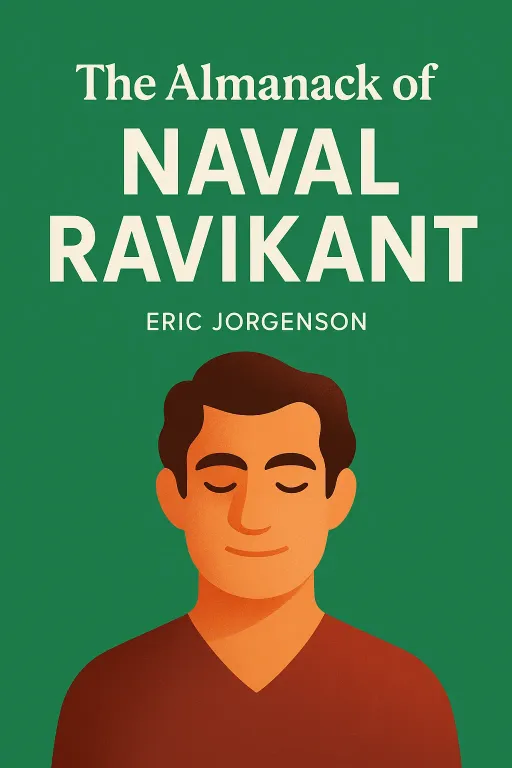
Albert Einstein: Imagine for a moment that wealth isn't earned, but by applying a force multiplier to a unique skill. And what if happiness isn't a destination, but your factory default setting, obscured by a lifetime of buggy code? These aren't just philosophical musings; they are the core principles from 'The Almanack of Naval Ravikant,' a book that treats life's biggest questions as solvable problems. Our guest today, 韦晓亮, is a leader and analytical thinker deeply interested in the systems behind success and well-being. Together, we're going to deconstruct these powerful ideas.
韦晓亮: It's a pleasure to be here, Albert. I'm fascinated by this approach. Treating life as a set of systems to be understood and optimized is a very powerful mental model.
Albert Einstein: Ah, a systems thinker! I knew I'd like you. Naval would approve. He's less of a guru and more of a… well, a physicist of life. He looks for the fundamental laws. Today we'll dive deep into this from two perspectives. First, we'll explore the physics of building wealth, focusing on the powerful concepts of specific knowledge and leverage. Then, we'll shift to the internal world and discuss the engineering of happiness, treating it as a skill you can learn and master.
Deep Dive into Core Topic 1: The Mechanics of Wealth
SECTION
Albert Einstein: So, 晓亮, let's start with wealth. Naval makes a fascinating distinction. He says, 'Seek wealth, not money or status.' To him, wealth is the thing that earns while you sleep. It's a system. How does that resonate with your understanding of the tech world?
韦晓亮: It resonates completely. Money is just a transfer of value, and status is a zero-sum social game. But wealth… wealth is about owning equity in a scalable system. It's the difference between being paid for your time and being paid for your judgment and the assets you create. The entire venture capital and startup ecosystem is built on this principle. You're not just building a product; you're building an asset.
Albert Einstein: Precisely! An asset. And Naval gives us a beautifully simple, yet profound, formula for creating it. He says you need two things: Specific Knowledge and Leverage. He has this wonderful story about his mother. When he was a teenager, he dreamed of being an astrophysicist. He was in his kitchen, telling a friend all about his grand cosmic plans.
韦晓亮: A noble pursuit!
Albert Einstein: Indeed! But his mother, from the other room, without even looking up, just says, "You're going to go into business." He was insulted! He thought she didn't understand him. But years later, he realized she saw his. She didn't see a future scientist; she saw a boy who was a natural at sales, who loved tinkering with technology, and who could argue from first principles. That, my friend, is specific knowledge—it's a unique combination of talents and curiosities that can't be taught in a classroom.
韦晓亮: That's a powerful idea. It's the difference between being a cog in the machine and designing the machine. Steve Jobs didn't have a degree in 'CEO-ing.' He had specific knowledge in design, user experience, and an almost religious devotion to simplicity. He then applied leverage—first through the brilliant engineering talent at Apple, and then through code and media—to scale his very specific vision to hundreds of millions of people. Naval's formula, Wealth = Specific Knowledge + Leverage, is essentially the blueprint for Silicon Valley.
Albert Einstein: Yes! And the leverage part is where the magic of scale comes in. It's the fulcrum that allows one person to move the world. In my day, leverage was capital or labor—you needed money or you needed to command armies of people. But today, Naval points out the new, permissionless forms of leverage: code and media. You can write a piece of software or create a podcast, and it can work for you while you sleep, serving millions at almost no marginal cost. It’s a force multiplier for your judgment.
韦晓亮: And that’s why it’s so critical to develop that judgment, that specific knowledge, first. Leverage without judgment is dangerous. It just amplifies your mistakes. But when you combine a unique skill set with the infinite scalability of code or media, you get the kind of non-linear outcomes we see with figures like Bill Gates or Jeff Bezos. They found their specific knowledge and then built leverage engines around it.
Albert Einstein: A perfect summary. You build the engine, and it generates the fortune. It’s a system, not a salary. But this leads to a curious paradox, which brings us to our second topic.
Deep Dive into Core Topic 2: The Engineering of Happiness
SECTION
Albert Einstein: Precisely! It's a force multiplier. But Naval argues there's a second, more important equation to solve. He says success does not earn you happiness. He was born poor and miserable, became well-off, and was miserable. He had to to be happy. This is a curious paradox, isn't it? He treats happiness as a skill.
韦晓亮: It’s a radical idea for many. We're conditioned to believe happiness is a reward for achievement. You get the promotion, you'll be happy. You buy the house, you'll be happy. But it’s a finish line that keeps moving. The idea that happiness is an independent skill, one you practice, is much more empowering. It puts the locus of control back inside you.
Albert Einstein: Exactly! He says happiness is our default state. It's what's there when you remove the sense that something is missing from your life. He tells this story, he calls it the "New Car Delusion." He had recently bought a new car and found himself obsessively reading online forums about it, tracking its delivery, thinking about it constantly.
韦晓亮: Ah, the dopamine loop of a new purchase. I think many of us can relate to that.
Albert Einstein: But he caught himself. He had a moment of clarity and realized he wasn't addicted to the car; he was addicted to the for the car. He says, "Desire is a contract you make with yourself to be unhappy until you get what you want." It’s a bug in our mental code. The moment the car arrived, the desire would vanish, and his mind would simply find a new thing to want.
韦晓亮: It's like running a program with a memory leak. The desire-loop consumes all your mental processing power, leaving no room for the present moment. Naval's solution—meditation, acceptance, choosing your desires very, very carefully—is like debugging your own mind. It's not about adding 'happiness features' or forcing positive thoughts. It's about removing the bugs that cause the system to crash.
Albert Einstein: What a perfect analogy! Debugging the mind. You’re not installing joy, you’re uninstalling misery. He believes our minds are in a constant state of judging everything: this is good, this is bad. This creates a constant wave of turmoil. Peace, and therefore happiness, comes from seeing things as they are, without the layer of judgment.
韦晓亮: This resonates deeply with the principles of self-care and emotional regulation. In leadership, you can't make clear decisions if your judgment is clouded by your own desires or fears. You have to be the engineer of your own inner peace to effectively lead others. It's a foundational skill. You have to recognize the 'bug' of envy, the 'bug' of comparison, and choose not to run that code.
Albert Einstein: And it is a choice. He is adamant about this. "Happiness is a choice you make and a skill you develop." It's a daily practice, like exercise. You don't get fit by going to the gym once. You don't get happy by having one good day. You build habits.
韦晓亮: Right. And the habits are often about subtraction, not addition. Less mindless scrolling, less sugar, less alcohol, less time with negative people. Each one removes a source of static from your internal operating system, allowing you to return to that clearer, default state.
Synthesis & Takeaways
SECTION
Albert Einstein: So we have two beautiful, elegant theories. One for the external world: build wealth with specific knowledge and leverage. And one for the internal world: find happiness by removing desire and returning to your default state. They are not sequential; they are parallel processes. You can, and should, work on both at the same time.
韦晓亮: Exactly. They are two different games, played on two different fields, but both are essential for a well-lived life. And what I love is that Naval gives us a practical starting point that connects both worlds. He asks us to find work that feels like play.
Albert Einstein: Ah, the intersection of joy and value. A beautiful concept.
韦晓亮: It is. So the question I'd leave for everyone listening, the one I often ask myself, is this: What is the one activity you do where you lose track of time? The thing that feels like play to you, but looks like work to others? That's the signal. That's the breadcrumb trail leading to your specific knowledge. Start there. The wealth and the happiness will follow.
Albert Einstein: A wonderful thought to end on. Find your unique play, and you may just solve both equations at once. 晓亮, thank you for exploring these ideas with me. It’s been a true delight.
韦晓亮: The pleasure was all mine, Albert. Thank you.