

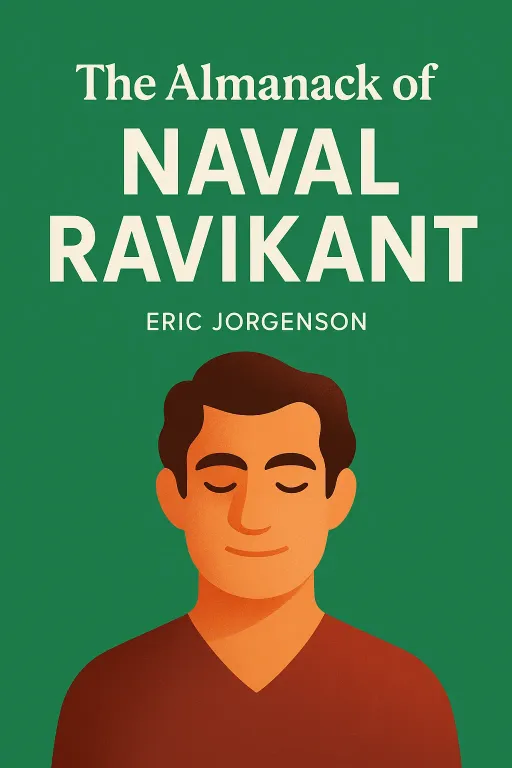
** The Naval Algorithm: Building Intellectual Wealth in the Age of AI
Content
Content
Dr. Warren Reed: Yes, focus on conversational flow.
Dr. Warren Reed: Yes, AngelList and Naval's reading habits will be fully explained. - Guest's Zone of Proximal Development: Yes, Gloria's contributions are insightful and directly related to her profile.
Dr. Warren Reed: Yes, the dialogue map is detailed enough to hit this target.
Dr. Warren Reed: Yes.
Dr. Warren Reed: English.
Golden Hook & Introduction
SECTION
Dr. Warren Reed: In a world where AI can write, code, and create with breathtaking speed, what is the most valuable asset a human can build? Is our knowledge becoming obsolete, or is there a deeper, more timeless skill we should be cultivating? That's the question at the heart of our conversation today, and our guide is 'The Almanack of Naval Ravikant.' This isn't just a book; it's an operating system for thriving in a world of infinite leverage. Today we'll dive deep into this from two perspectives. First, we'll explore Naval's twin engines for building wealth: specific knowledge and leverage. Then, we'll discuss how to develop the most crucial skill of all: judgment, the human operating system that runs everything.
Okoye Gloria: It's the defining question of our time, Warren. We're building these incredible intellectual tools, but the instruction manual for the user—for us—is what's missing. I think Naval provides exactly that. It’s less about competing with AI and more about understanding our own unique role in a world augmented by it.
Dr. Warren Reed: I couldn't agree more. It’s about finding our place alongside this new technology, not being replaced by it. And Naval’s philosophy is the perfect starting point. He argues that true wealth isn't about working harder; it's about understanding a few fundamental principles.
Deep Dive into Core Topic 1: Specific Knowledge & Permissionless Leverage
SECTION
Dr. Warren Reed: Precisely. And that instruction manual starts with two core concepts Naval calls the 'twin engines' of wealth creation. The first is Specific Knowledge. This is the real magic ingredient. Naval defines it as knowledge that you cannot be trained for. If society can train you, it can train someone else and replace you.
Okoye Gloria: That’s a powerful and slightly terrifying thought. So it’s not about a certification or a degree, necessarily.
Dr. Warren Reed: Not at all. It's often found by pursuing your genuine curiosity, your innate talents. It’s the thing that feels like play to you but looks like work to others. It’s a unique combination of skills and obsessions that can't be easily replicated. But specific knowledge on its own isn't enough. It needs a multiplier. That's the second engine: Leverage.
Okoye Gloria: And leverage is where things get really interesting in the modern world, right?
Dr. Warren Reed: Exactly. Historically, leverage meant labor—having people work for you—or capital, using money to make more money. Both required permission. You needed to hire people or raise money. But Naval identifies a new, third form of leverage that is 'permissionless': code and media. You can write a piece of software or create a piece of content that works for you while you sleep, and you don't need anyone's approval to do it. As he says, "Fortunes require leverage."
Okoye Gloria: Permissionless leverage. I love that term. It’s the essence of the internet, and now, AI. It’s the ability to scale an idea to millions of people with near-zero marginal cost.
Dr. Warren Reed: You've hit on the perfect example. Let's look at the story of AngelList, which Naval co-founded. To really understand the power of this, you have to picture the world before 2010. If you were a talented entrepreneur with a brilliant idea, finding investors was like trying to get into a secret society. It was all based on who you knew in Silicon Valley, closed-door meetings, and a lot of luck. The entire process was opaque, inefficient, and deeply unfair to outsiders.
Okoye Gloria: A classic information asymmetry problem. The people with capital had all the power because the network was closed.
Dr. Warren Reed: Precisely. Naval and his co-founder, Babak Nivi, had the of this deep pain point. They had lived it. They understood the frustration of both founders and aspiring investors. So, what did they do? They applied permissionless leverage. They built AngelList, a software platform. They used code to create a transparent, open marketplace that connected founders directly with investors. They didn't ask for permission from the old guard of venture capital. They just built it.
Okoye Gloria: They essentially wrote a new set of rules with code.
Dr. Warren Reed: And the outcome was transformative. They democratized early-stage startup funding, enabling thousands of companies to get off the ground. They created a cornerstone of the modern tech ecosystem, all by combining their specific knowledge of a problem with the leverage of a software platform.
Okoye Gloria: That's a perfect example, Warren. The platform itself, the code, was the leverage. But the real, enduring value wasn't just in the lines of code; it was in the to build that specific platform. Anyone could have written code, but they had the unique insight. In the AI world, we see this daily. An AI can generate a thousand business plans in a second. It can write the code for a generic app. But it can't feel the founder's pain point or have that authentic, specific knowledge of a broken market. That's the human's job: to be the source of the problem worth solving. The AI is the ultimate leverage, but it's a powerful engine without a steering wheel. The specific knowledge is the steering wheel.
Dr. Warren Reed: A powerful engine without a steering wheel. That’s a fantastic way to put it. And it leads us directly to the person who has to be in the driver's seat.
Deep Dive into Core Topic 2: Training Your Internal AI: Judgment
SECTION
Dr. Warren Reed: Exactly. The AI is a tool, but the direction comes from a human. And the quality of that direction depends entirely on our second core topic today: Judgment. Naval argues this is the most underrated and most important skill in the modern world.
Okoye Gloria: Because with infinite leverage, the consequences of your decisions—good or bad—are also amplified infinitely.
Dr. Warren Reed: You're one step ahead. That's the core of it. In an age of leverage, one correct decision can win everything. One bad decision can be a catastrophe. This is why Naval says, "Earn with your mind, not your time." Your time is finite. Your judgment, applied with leverage, has an almost infinite impact. The question then becomes, how do you build world-class judgment?
Okoye Gloria: I’m guessing it’s not by getting an MBA, based on what I’ve read in the book.
Dr. Warren Reed: You’re right. His method is completely counterintuitive. He doesn't talk about business classes or management theory. He talks about reading. But not just any reading. He has this wonderful line: "Read what you love until you love to read." He suggests you should treat your book budget as a critical investment in yourself, not an expense. And he doesn't just read business books. He reads the foundations: science, philosophy, history, mathematics.
Okoye Gloria: He’s not just gathering facts, is he? He’s doing something deeper.
Dr. Warren Reed: That's the key. He's collecting mental models. A mental model is a framework for thinking, a different way of seeing the world. He'll take a concept from evolutionary biology, like survival of the fittest, and apply it to business markets. He'll use a principle from game theory to understand negotiations. He's building a latticework of understanding in his mind, so when he encounters a new problem, he doesn't just have one tool; he has a whole toolbox of mental models to analyze it from different angles.
Okoye Gloria: I love that framing. It's exactly like training a custom AI model. If you only train a large language model on, say, 21st-century financial news, it will only see the world through that very narrow, recentist lens. It will lack historical context and philosophical depth. Naval's approach is about creating a rich, diverse, and foundational dataset for your own mind.
Dr. Warren Reed: A personal, proprietary dataset.
Okoye Gloria: Exactly! By reading the 'great books,' by exploring physics and philosophy, and by following your own unique curiosity, you're building a personal mental model of the world that is far more robust and unique than any generic algorithm. It's about developing the wisdom to know tool to use and. This is a classic problem in AI alignment—getting the machine to understand the true, nuanced goal, not just the literal instruction. That wisdom, that ability to define the goal correctly, is judgment.
Dr. Warren Reed: And it's a skill that requires constant debugging. Naval is a huge fan of the physicist Richard Feynman, who famously said you don't truly understand something unless you can explain it simply. That's the test for your own judgment. Can you strip away the jargon and explain the core idea? If not, your own understanding is fuzzy.
Okoye Gloria: You're debugging your own mental code. It's a continuous process of learning, applying, and simplifying. You're not just consuming information; you're integrating it into a coherent worldview. That's the intellectual asset that can't be outsourced to an API call.
Synthesis & Takeaways
SECTION
Dr. Warren Reed: So, when you put it all together, the Naval Algorithm is beautifully simple, though not easy. Step one: Build your specific knowledge and judgment by reading foundational ideas and relentlessly following your unique curiosity. Create that proprietary mental model.
Okoye Gloria: And that becomes the core of your intellectual wealth. It’s the asset.
Dr. Warren Reed: Step two: Apply permissionless leverage—like code, media, or AI—to scale that unique knowledge and judgment to the world. That’s how you create impact and, as a byproduct, wealth.
Okoye Gloria: Absolutely. It reframes the entire conversation around AI. The goal isn't to be faster than the machine. The goal is to be wiser, to have better taste, to ask more interesting questions. The machine is the how; we have to be the why.
Dr. Warren Reed: Perfectly said. So, Gloria, what’s the one thought you’d want to leave our listeners with today as they think about building their own intellectual assets?
Okoye Gloria: I think the final question for everyone listening isn't, 'How can I use AI?' It should be, 'What is the one thing I can become the best in the world at, that feels like play to me?' Find that deep, authentic curiosity that society doesn't have a training manual for yet. Pursue it relentlessly. That's the starting point. Find that, and the leverage will follow. That's how you build intellectual wealth that can't be automated away.









