

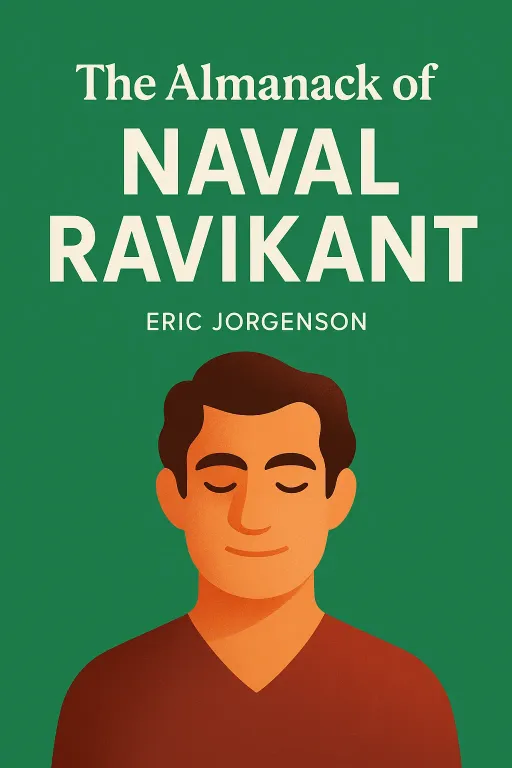
The Marketer's Almanack: Building Wealth and Happiness with Naval Ravikant's Playbook
Golden Hook & Introduction
SECTION
Orion: What if the path to getting rich isn't about working harder, but about working smarter in a way most of us never consider? We're told to climb the corporate ladder, but Naval Ravikant argues that's a trap. He says, 'You’re not going to get rich renting out your time.' This single idea changes everything, especially for someone in a creative and strategic field like marketing. It forces us to ask a different question: how do you stop trading hours for dollars and start building assets that earn for you?
Nishat Tasnime: That line is so provocative because it cuts against the grain of everything we're taught about career progression. It's all about more hours, more responsibility, the next title. But he's suggesting the game itself is flawed.
Orion: Exactly. And that's why I'm so excited to have you here, Nishat. As a marketing manager and an avid reader, you live at the intersection of strategy, creativity, and deep thinking. Naval's ideas in "The Almanack of Naval Ravikant" feel tailor-made for this. Today we'll dive deep into this from two perspectives. First, we'll explore Naval's playbook for building real wealth, not just a salary, by learning how to 'Productize Yourself.'
Nishat Tasnime: I love that framing. It sounds like personal branding on steroids.
Orion: It is! And then, we'll discuss his revolutionary approach to 'Hacking Happiness' as a skill you can learn, completely separate from your achievements. So, two games: the external game of wealth, and the internal game of happiness.
Deep Dive into Core Topic 1: Productize Yourself: Wealth Beyond a Paycheck
SECTION
Orion: So Nishat, let's start with that explosive idea: 'You’re not going to get rich renting out your time.' Naval's alternative is to build wealth through two key ingredients: Specific Knowledge and Leverage. Let's quickly define those. Specific Knowledge, he says, is knowledge you can't be trained for. It's the stuff you know almost intuitively, born from your unique combination of talents and curiosities. It feels like play to you, but looks like work to others.
Nishat Tasnime: That's fascinating. So, it’s not about getting another certification that anyone can get. It’s about honing that unique thing you do, that perspective only you have. In marketing, that could be an uncanny ability to understand the Gen Z mindset, or a flair for writing copy that just... works. It’s not something you can teach in a textbook.
Orion: Precisely. And once you have that, you need Leverage. Leverage is a force multiplier. Naval identifies three kinds, but the two most important for us today are code and media. These are forms of "permissionless leverage" because you don't need anyone's approval to use them. You can write a blog post, record a podcast, or build an app that can, in theory, reach the entire world. The best story to illustrate this is how Naval himself built one of his most famous companies: AngelList.
Nishat Tasnime: Right, I'm familiar with the platform, but I'd love to hear the origin story through this lens.
Orion: Okay, so picture it. It's 2010. The startup world is buzzing, but raising money is a nightmare. It's all about who you know in Silicon Valley, closed-door meetings, and incredible inefficiency. Countless great ideas were dying because founders couldn't get in the right rooms. Naval and his co-founder, Babak Nivi, saw this massive, systemic problem.
Nishat Tasnime: A huge market inefficiency.
Orion: A huge one. Now, the old way to solve this would be to become a consultant, making introductions one by one. That's renting out your time. Instead, Naval asked a leverage question: "How can we build a system that solves this problem for everyone, at scale, without our direct involvement in every single interaction?"
Nishat Tasnime: They wanted to build a machine.
Orion: They built a machine. That machine was AngelList. It was a platform—code—that allowed any startup to create a profile and any accredited investor to browse and fund them. They created it once. It didn't cost them more if one thousand startups joined, or ten thousand. That is the magic of code leverage. They didn't sell their time; they built an asset that generated value—and wealth—while they slept. They identified a need and used technology to serve it at scale.
Nishat Tasnime: That's a brilliant parallel to what we strive for in marketing. A single great ad campaign, a viral video, or an automated email sequence is a form of media leverage. You create it once, and it can reach and persuade millions. The 'specific knowledge' isn't just knowing how to use Facebook Ads, but that deep, almost intuitive understanding of what message will resonate with a specific audience. AngelList didn't just build a tool; they understood the psychology of both founders and investors. That was their specific knowledge.
Orion: That's the perfect connection. Your specific knowledge is the unique insight. The blog, the video, the ad campaign—that's the leverage that scales it. Naval's point is that the modern path to wealth is to find your unique angle and then build a media or code-based product around it. To "productize yourself."
Nishat Tasnime: It shifts the career question from "How do I get the next job?" to "What asset can I build?" Even within a company, you can think this way. Is your work creating a scalable system, or is it just fulfilling a one-off task? It's a powerful mental model.
Deep Dive into Core Topic 2: Hacking Happiness: The Internal Skill Set
SECTION
Orion: Exactly. It's about building systems of impact. But here’s the twist, and this is where Naval's philosophy gets really deep. He argues that winning this external game of wealth doesn't automatically make you happy. This brings us to our second, and perhaps more profound, topic: the idea that happiness itself is a skill. He says, and I quote, 'Success does not earn happiness.'
Nishat Tasnime: This is the part that really resonates with me, especially as an INFJ. The external world is one thing, but the internal world is everything.
Orion: You'll appreciate this story then. Naval is brutally honest about his own journey. He talks about achieving significant financial success early in his career—the kind of success most people dream of. But he describes himself during that period as being deeply unhappy. On a scale of one to ten, he rated his happiness a 2 or 3. He had won the external game, but was losing the internal one.
Nishat Tasnime: That's a terrifying thought. To get everything you thought you wanted and still feel empty.
Orion: It forced him to re-evaluate everything. He realized wealth and happiness were not correlated. So, he spent the next decade actively to be happy, treating it like a skill, just like learning to code or invest. He dove into philosophy, he started meditating, and he fundamentally worked on his mindset. And one of his biggest breakthroughs was this idea: 'Desire is a contract you make with yourself to be unhappy until you get what you want.'
Nishat Tasnime: Wow. Say that again. 'Desire is a contract you make with yourself to be unhappy.'
Orion: Think about it. When you say, "I'll be happy when I get that promotion," or "I'll be happy when this campaign hits its target," you've just signed a contract to be unhappy right now. You've outsourced your well-being to an external event you can't fully control.
Nishat Tasnime: That concept is incredibly powerful for anyone in a creative or performance-based role. In marketing, you're always chasing the next metric, the next successful launch, the next quarter's numbers. If your happiness is tied to that outcome, you're perpetually on a hedonic treadmill. The goalposts are always moving. What you're saying is that Naval is suggesting we need to build an internal 'brand' of well-being that's independent of external validation. That's a huge mindset shift.
Orion: It's a complete paradigm shift. He learned to be happy first. He started choosing his desires very, very carefully. He realized happiness is our default state. It's what's there when you remove the feeling that something is missing from your life. The outcome of this ten-year project? He now rates his happiness a 9 out of 10. And he's clear: it's not because of his money. It's because he cultivated the internal skill of being present and at peace.
Nishat Tasnime: So happiness isn't the prize you get at the finish line. It's the way you run the race. It's about managing your own internal state, regardless of what the scoreboard says. For a marketer, that means learning to love the process of creation—the brainstorming, the writing, the strategy—separate from whether the campaign goes viral or not.
Orion: You've nailed it. The joy has to be in the work itself, in the act of applying your specific knowledge. Because if you do that, you're playing a game you can't lose. You either get the external reward, or you simply enjoy the process. Or, in the best case, both.
Synthesis & Takeaways
SECTION
Orion: So we have these two powerful, parallel tracks from Naval. On one hand, build external wealth by productizing your unique skills with leverage. Stop renting out your time and start building assets.
Nishat Tasnime: And on the other hand, build internal happiness by treating it as a skill. Decouple your well-being from your external goals and learn to find peace in the present moment.
Orion: It’s a complete philosophy for modern life. It's ambitious, but it's also deeply peaceful. It's about striving, but without the anxiety.
Nishat Tasnime: I think it really comes down to this. As you go about your week, don't just ask 'What do I need to do?' Ask 'What is the one thing only I can do, that feels like play to me?' That's your specific knowledge.
Orion: Find that spark.
Nishat Tasnime: Find that spark. And then ask, 'How can I build a small system around it so it can have an impact beyond my own two hands?' That could be a short blog post, a helpful Twitter thread, a simple tool. That's the first step on Naval's path to both wealth and a well-lived life.









