

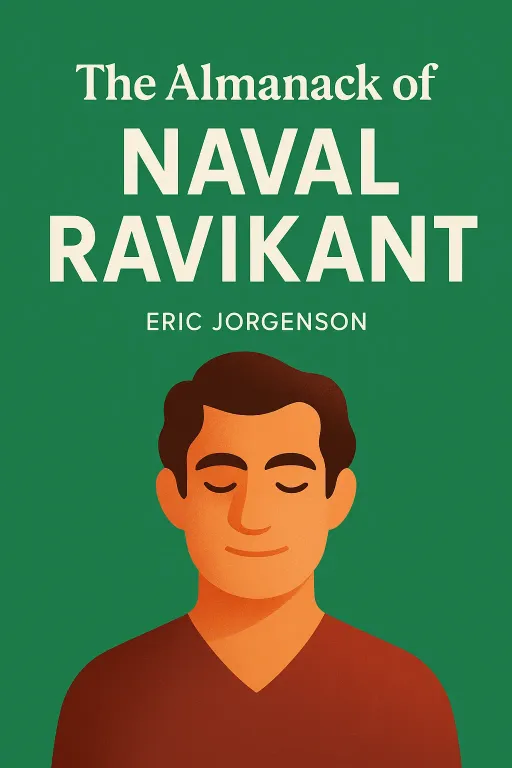
The Founder's Compass: Decoding Naval Ravikant's Playbook for Leverage and First Principles
Golden Hook & Introduction
SECTION
Nova: Peris, there's a line from the investor and philosopher Naval Ravikant that I think every entrepreneur feels in their bones. He says, "You're not going to get rich renting out your time." Does that hit home for you?
Peris Karanga: It's the fundamental truth, isn't it? It’s the difference between having a job and building a business. So many of us start by just creating a high-stress job for ourselves, where we're the chief employee. Breaking out of that cycle… that’s the whole game.
Nova: Exactly. And that's why we're diving into "The Almanack of Naval Ravikant" today. It’s less of a book and more of an operating system for thinking about that exact problem. It’s about how to stop renting out your time and start building real, sustainable wealth and freedom.
Peris Karanga: An operating system is the perfect way to put it. It’s about upgrading your own mental software.
Nova: I love that. So today we'll dive deep into this from two perspectives. First, we'll explore the practical mechanics of building wealth through leverage, almost like an engineering blueprint. Then, we'll shift to the internal game, discussing how to forge the founder's mindset that's required to make it all work.
Deep Dive into Core Topic 1: The Leverage Playbook
SECTION
Nova: So, if the goal is to stop renting out our time, Naval gives us a new target. He says, "Seek wealth, not money or status." And his definition is key: Wealth is having assets that earn while you sleep.
Peris Karanga: That’s the dream. A machine that works for you. As an engineer, that resonates. You don't want to be the one turning the crank; you want to design the engine.
Nova: Precisely. And Naval gives us the blueprint for that engine. He says it has three core components: Specific Knowledge, Accountability, and Leverage. Specific Knowledge is your unique superpower—something you know that can't be easily taught or outsourced. Accountability is taking risks under your own name, so you get the credit or the blame. But the real force multiplier is Leverage.
Peris Karanga: And leverage is a term we use in engineering all the time, but I have a feeling Naval’s definition is broader.
Nova: It is. He talks about traditional leverage, like capital and labor—other people's money and other people's time. But he says the most powerful forms today are "permissionless." They are code and media. Things with no marginal cost of replication. The perfect example of this is a company Naval himself co-founded: AngelList.
Peris Karanga: Right, the platform for startups and investors.
Nova: Exactly. Think about the world back in 2010. If you were a startup founder, how did you get funding? You had to know someone. You had to get a warm intro to a venture capitalist on Sand Hill Road. It was an opaque, network-driven game. The system was inefficient and inaccessible to most.
Peris Karanga: A closed system. The information and the opportunities were locked up.
Nova: Totally. So Naval and his co-founder, Babak Nivi, didn't try to play that game better. They built a new one. They used code to create a platform, a marketplace. They used media—blogs, Twitter—to build a community around it. Suddenly, any founder could create a profile and get in front of thousands of investors. Any investor could see deal flow from around the world. They didn't need anyone's permission to build it.
Peris Karanga: They created leverage. Instead of making one connection at a time, they built a system that made millions of connections automatically. That's the power of code and media. It scales in a way that a human, or even a team of humans, never could.
Nova: And that’s the essence of it. They built an asset that earned while they slept. But you know, Peris, this idea of permissionless leverage feels so native to the digital world. As someone with a background in engineering and manufacturing, how do you see this principle applying to businesses that create physical things?
Peris Karanga: That's the critical question. In manufacturing, leverage has traditionally meant massive capital for factories or huge teams of labor. It's not permissionless; it's very permission-based. But the principle is the same. It's about finding your unique multiplier. Maybe your specific knowledge isn't in writing code, but in designing a manufacturing process that's 10x more efficient. The 'code' becomes the system design, the intellectual property. The 'media' could be the brand you build, the trust that allows you to charge a premium. You're still building an asset that works beyond your own two hands.
Nova: So the medium changes, but the principle of creating a scalable system remains the same.
Peris Karanga: Exactly. You have to find your form of leverage.
Deep Dive into Core Topic 2: The First-Principles Mindset
SECTION
Nova: I love that. Because finding your leverage requires immense clarity. Building that machine is one thing, but having the clarity to steer it is another. This brings us to Naval's ideas on judgment. He argues that in an age of infinite leverage, judgment is the single most important skill. One correct decision can be multiplied a million times.
Peris Karanga: And one bad decision can be just as amplified. I feel that every day. The weight of those few, key decisions is immense.
Nova: It is. And the only way to develop good judgment, according to Naval, is to think from first principles. To strip away all assumptions and get to the core truth of a matter. He often points to the physicist Richard Feynman as a master of this. Feynman was famous for being able to explain incredibly complex ideas, like quantum physics, in very simple terms.
Peris Karanga: Because he understood them at a fundamental level. He didn't just memorize the formulas; he knew they worked.
Nova: That's it exactly. The story goes that if Feynman couldn't explain a concept to a first-year university student, he felt he didn't truly understand it himself. He would break it down, and break it down again, until he was left with only the foundational truths. That's first-principles thinking. It's about seeing the world as it is, not as others tell you it is, or as you wish it were.
Peris Karanga: And this is where the real struggle of entrepreneurship comes in, I think. Because seeing the world as it is means fighting your own ego. As a founder, you're supposed to have the vision, the answers. Your identity gets wrapped up in being 'the one who knows.' Admitting you don't know, or that a core assumption is wrong, feels like a personal failure.
Nova: That's such a powerful insight. Your identity can literally block you from seeing reality. Naval says we have to learn to shed our identities to think clearly. And he provides these beautifully simple heuristics to help cut through the noise. One of my favorites is: "If you can't decide, the answer is no."
Peris Karanga: Oh, that's good. I've wasted weeks on spreadsheets, making pro-con lists for decisions I was torn on.
Nova: We all have! But Naval's point is that for the really big decisions—hiring a co-founder, taking on a major investor, choosing a market to enter—if it's not a "hell yes," it should be a no. If you have to talk yourself into it, your gut is probably telling you something your ego doesn't want to hear. It's a first-principles approach to decision-making. It cuts through the complexity and forces you to listen for a clear signal.
Peris Karanga: It's a filter. A filter against mediocrity and against your own biases. It forces you to be radically honest with yourself, which is maybe the hardest part of the founder's mindset to cultivate.
Synthesis & Takeaways
SECTION
Nova: So when you put it all together, it's this beautiful, symbiotic relationship. You need the first-principles mindset to see the world clearly, to identify a real problem, and to discover your own specific knowledge.
Peris Karanga: And that clarity—that judgment—is what allows you to then build and apply the right kind of leverage. You know where to point the engine because you've already understood the map of the territory from its most basic truths.
Nova: The mindset powers the machine. It's not just about working hard; it's about thinking clearly and then building systems that multiply that clear thinking.
Peris Karanga: It's a profound shift in perspective. And it all starts with that idea of specific knowledge. Naval has another great quote. He says to "find work that feels like play to you, but looks like work to others."
Nova: That's the sweet spot.
Peris Karanga: It is. And I think that's the most powerful takeaway for anyone listening, whether they're a founder or just starting out. So the question to leave everyone with is this: What's that one thing you do, that one obsession you have, that you could do for hours and it energizes you, but other people find it tedious or difficult? That's the clue. That's the seed of your specific knowledge. Find it, and you've found the foundation for your own leverage.









