

The Architecture of a Meaningful Life: Naval Ravikant's Blueprint for Learning and Happiness
Golden Hook & Introduction
SECTION
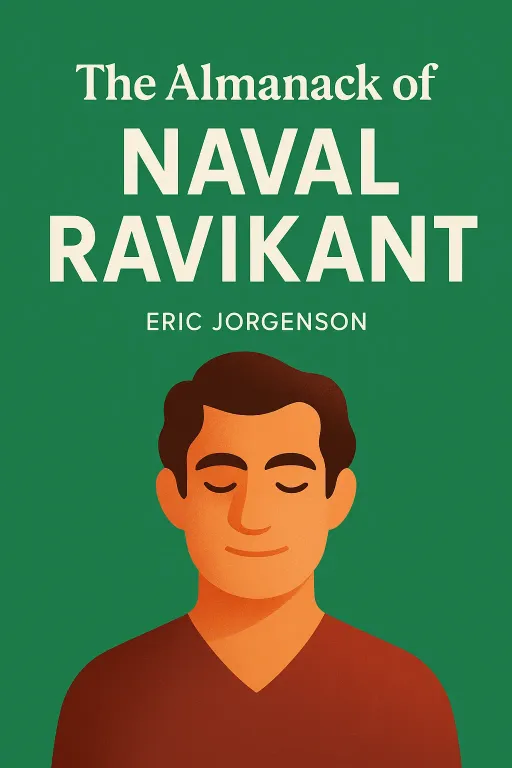
Nova: What if the most important skills for a good life—things like wisdom, happiness, even creating value in the world—aren't things we're born with, but skills we can learn, just like a language? It's a powerful idea, and it's at the heart of a book that's become a modern classic:. It’s less a 'how-to' guide and more a philosophical toolkit for building a richer life.
Nova: Today we'll dive deep into this from two powerful perspectives. First, we'll explore how to build what Naval calls 'Specific Knowledge'—your own unique intellectual superpower that society can't just train someone else to do. Then, we'll pivot to the internal world and discuss his radical, yet practical, approach to learning happiness as a skill, not as a reward.
Nova: And I am so thrilled to be exploring this with our guest today, Tahira Mubeen. Tahira is a graduate student in English literature and linguistics, a child labor activist, a polyglot in the making, and a yoga enthusiast. Her life is a testament to the power of continuous learning, which makes her the perfect person to unpack these ideas with. Welcome, Tahira!
Tahira-Mubeen: Thank you for having me, Nova. I'm so excited. That opening question is exactly what drew me to this book. The idea of learnable life skills is something I think about constantly, both in my research and my personal life.
Deep Dive into Core Topic 1: The Power of Specific Knowledge
SECTION
Nova: I'm so glad. So let's start with that first idea, Tahira: 'Specific Knowledge.' Naval argues that we shouldn't just aim to be the best, but to be the. He has this fantastic quote: "Specific knowledge is knowledge that you cannot be trained for. If society can train you, it can train someone else, and replace you." What does that even mean in practice? It sounds a little intimidating.
Tahira-Mubeen: It does, it sounds like you have to be a born genius. But I don't think that's what he means. It seems more about authenticity.
Nova: Exactly. And he tells this wonderful story about his own life that makes it so clear. When he was a teenager, around 15 or 16, he was dead set on becoming an astrophysicist. He was passionate about science. One day, he's in the kitchen talking to a friend about his grand plans, and his mother, who was busy cooking, just calls out without even looking at him, "You're going to go into business."
Tahira-Mubeen: Oh, the wisdom of mothers. I can just picture that scene.
Nova: Right? And he just dismissed it completely. He thought, 'What does she know? She doesn't understand my passion for science.' But years later, after he had become a successful entrepreneur and investor, he realized she had seen something he hadn't. She had seen his. She saw that he had this natural analytical mind, that he was good at sales and persuasion, and that he loved tinkering with technology. It wasn't one single skill. It was the unique combination, his personal stack of talents, that made him perfectly suited for the world of business. He couldn't have been 'trained' for that specific combination.
Tahira-Mubeen: That's so powerful. It reframes 'talent' not as a single gift, but as a unique intersection of interests. It’s not about being the best at one thing, but about being the only one at the intersection of several things you're passionate about.
Nova: Yes! The only one with your specific stack.
Tahira-Mubeen: It makes me think about my own field. In linguistics, we see this with polyglots. You know, people who speak multiple languages. It's not just about having a good memory for vocabulary. True polyglots have a specific knowledge built from a love of pattern recognition, a deep cultural curiosity, and a high tolerance for ambiguity and making mistakes. You can't just 'teach' that entire package in a classroom. It's cultivated.
Nova: That is the perfect analogy. It's a cultivated stack of skills and passions. And you're building such a fascinating one yourself—linguistics, literature, your activism for education, your art, learning Arabic and French. How do you see those different pieces giving you a form of leverage that someone who, say, studied linguistics might not have?
Tahira-Mubeen: That's a great question. I think they constantly inform each other. For example, my activism work is fundamentally about giving a voice to the voiceless, advocating for children's right to education. My linguistics research is about understanding the power structures embedded within language itself—how certain languages become 'power languages' and create barriers. So, they're not separate pursuits; they're two sides of the same coin.
Nova: Wow, say more about that.
Tahira-Mubeen: Well, it means I can analyze the language of an educational policy for its hidden biases and exclusionary effects, but I can also stand up and advocate for change in a way that connects with people emotionally. One skill is analytical, the other is humanistic. The combination of the two is my specific knowledge. It's a form of leverage, just as Naval talks about, but the 'profit' I'm seeking is social change, not financial.
Nova: That's a brilliant connection. So this isn't just a blueprint for entrepreneurs. It's a blueprint for anyone who wants to make a unique impact. You essentially 'productize' your unique perspective, whether that product is a company, a social movement, a piece of art, or a new way of thinking.
Tahira-Mubeen: Exactly. It’s about finding what you are uniquely qualified to contribute, and that comes from the intersection of all the things you genuinely love to learn.
Deep Dive into Core Topic 2: Hacking Happiness as a Skill
SECTION
Nova: And this idea of building an authentic life on the outside connects so perfectly to Naval's philosophy for the inside. This might be his most radical idea. He makes this bold claim: "Happiness is a choice you make and a skill you develop." This feels so counter to the 'if-then' model of happiness we're all sold: I get the degree, I'll be happy. I get the promotion, I'll be happy.
Tahira-Mubeen: It's a hamster wheel. The 'then' never truly arrives, or if it does, it's fleeting.
Nova: It's so fleeting! Naval says happiness is actually our default state. It's what's left over when you remove the feeling that something is missing from your life. And the thing that creates that feeling of 'missing' is desire. He has this killer quote: "Desire is a contract you make with yourself to be unhappy until you get what you want."
Tahira-Mubeen: Wow. That is... incredibly direct. And incredibly true. It’s a self-imposed state of suffering.
Nova: It is! And he speaks from experience. He tells this very vulnerable story about how, ten years ago, despite all his financial success, he was deeply unhappy. He rated his happiness a 2 or 3 out of 10. He just didn't value it. But over the next decade, he decided to make it his single most important project. He systematically studied it, practiced it through meditation, philosophy, and changing his habits. And he says he's now a 9 out of 10. He literally to be happy.
Tahira-Mubeen: That story is so hopeful. Because it means we're not stuck. It means our inner state isn't just a reaction to our outer world. And it resonates so deeply with my yoga practice.
Nova: I was hoping you'd say that! How so?
Tahira-Mubeen: In yoga, the goal isn't really to achieve a perfect, pretzel-like pose. The real work is to be fully present in the struggle and discomfort of the pose you're in. To just be with your breath. Naval's idea that "a busy mind accelerates the passage of time" is something you feel physically on the mat. When my mind is racing, thinking about my to-do list, a one-minute pose feels like an eternity of torture. But when I can quiet my mind and just be present with the sensation and my breath, there's a sense of peace, even in the discomfort.
Nova: Peace, not just joy! That's another key distinction he makes. He says happiness is more about peace than it is about ecstatic moments of bliss. It's the quiet mind.
Tahira-Mubeen: Yes. And that peace comes from hard choices. It reminds me of another one of his brilliant lines: "Easy choices, hard life. Hard choices, easy life."
Nova: Oh, that one is a game-changer. How do you see that playing out, maybe in the discipline of learning a new language or in your activism?
Tahira-Mubeen: Oh, absolutely, every single day. With language, the 'easy choice' is to skip my practice for the day, to scroll on my phone instead of doing 30 minutes of Arabic drills. That's easy right now. But the 'hard life' is the regret, the slow progress, the inability to connect. The 'hard choice' is to show up, do the work, and feel the mental strain. But the 'easy life' that comes from that is the joy of being able to walk into a café and connect with someone in their native tongue. It's freedom.
Nova: And in activism?
Tahira-Mubeen: In activism, the easy choice is to stay silent when you see injustice. It avoids conflict. It's comfortable. The hard choice is to speak up, to advocate, to face opposition and criticism. It can be exhausting. But the 'easy life'—or maybe the better word is the life—comes from living by your values. And Naval talks about that, too. That living in alignment with your own principles is the ultimate life hack.
Nova: Living by your values. That's the ultimate 'hard choice' that simplifies everything else. You've just connected all the dots so beautifully, Tahira. It's all one system.
Synthesis & Takeaways
SECTION
Nova: So, as we wrap up, we've really covered two huge, life-altering ideas from Naval's Almanack. First, this concept of building your unique 'specific knowledge' stack, not by chasing trends, but by following your genuine, authentic curiosity.
Tahira-Mubeen: And that it's not just for entrepreneurs. It’s for activists, artists, scientists—anyone who wants to create unique value in the world.
Nova: Exactly. And second, this radical reframe of happiness. Treating it not as a prize to be won at the end of a long struggle, but as a skill to be practiced daily, through presence, managing our desires, and making those hard choices that lead to an easier, more meaningful life.
Tahira-Mubeen: They are both such empowering ideas. They put the locus of control back in our own hands.
Nova: They really do. And for everyone listening, who might be feeling inspired but also a bit overwhelmed, what's one small, practical step someone could take to start applying these principles in their own life?
Tahira-Mubeen: I think a wonderful, practical way to start is with Naval's advice on reading, which is the foundation for everything else. He says, "Read what you love until you love to read." So my challenge to everyone listening is this: for the next week, put down the book you feel you be reading for self-improvement or for work. Instead, pick up something that sparks pure joy or curiosity. It could be poetry, a graphic novel, a book on gardening, anything. The goal isn't to be productive. It's to reconnect with the pure love of learning itself. That, I think, is the very first step to building your own specific knowledge.
Nova: A beautiful and fitting challenge. Reconnecting with joy as the engine of growth. Tahira, thank you so much for bringing such incredible insight and connecting these ideas in ways I never would have seen. This was fantastic.
Tahira-Mubeen: The pleasure was all mine, Nova. It was a wonderful conversation.









