

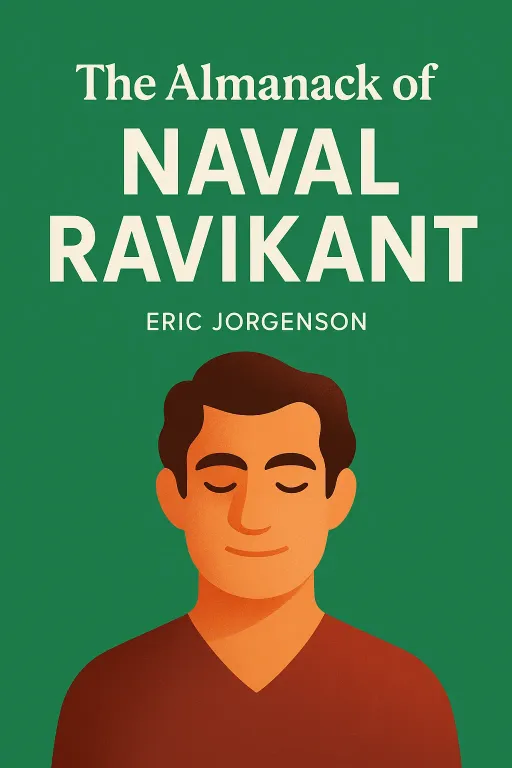
The Architect's Code: Naval Ravikant's Blueprint for Entrepreneurs
Golden Hook & Introduction
SECTION
Nova: What if I told you that getting rich has very little to do with how hard you work? Naval Ravikant, one of Silicon Valley's most respected thinkers, says you don't get rich by renting out your time. You get rich by owning assets that earn while you sleep. For any entrepreneur, any leader, that's a paradigm-shifting idea. It forces us to ask: are we building a job for ourselves, or are we building a true wealth-generating engine? That's the question we're tackling today with education entrepreneur Kejia Li, using 'The Almanack of Naval Ravikant' as our guide. Kejia, welcome. It’s so great to have you here to unpack these powerful ideas.
kejia li: Thanks for having me, Nova. It's a topic I think about constantly. That distinction between activity and building an asset is everything for an entrepreneur.
Nova: Exactly. And for our listeners, Kejia is the perfect person for this conversation. As an entrepreneur and leader in the education space, he lives at the intersection of building systems, cultivating talent, and making high-impact decisions. So today, we'll dive deep into this from two perspectives. First, we'll explore how to architect that system for wealth by moving beyond simply 'working hard' and embracing what Naval calls specific knowledge and leverage. Then, we'll discuss how to forge the high-impact judgment required to lead and make decisions in a world where one right choice can change everything.
Deep Dive into Core Topic 1: Architecting Wealth
SECTION
Nova: So, Kejia, let's start with that foundational idea. Naval distinguishes between wealth, money, and status. He says, 'Seek wealth, not money or status.' From your perspective as a builder, what does that distinction mean in practice?
kejia li: It's a crucial distinction. In the world of education, for example, chasing 'status' could mean pursuing prestigious university partnerships or focusing on rankings. Chasing 'money' might mean just maximizing enrollment numbers for short-term revenue. But chasing 'wealth,' in the Naval sense, means building an educational asset—a curriculum, a platform, a reputation—that delivers such profound and lasting value to students that it generates returns long into the future. It's about creating a system that works because it delivers real, compounding value.
Nova: That's a perfect framing. It's about building the engine, not just fueling the car for a single trip. And Naval gives us the core components for that engine. He says you need a combination of three things: Specific Knowledge, Accountability, and Leverage. Let's start with Specific Knowledge. He says it's knowledge you cannot be trained for. It's found by pursuing your own genuine curiosity and passion, not by following what's hot.
kejia li: Hmm, it's almost an anti-credentialist viewpoint.
Nova: It is! He has a great personal story about this. When he was a teenager, he wanted to be an astrophysicist. But his mother, watching him, just said, "No, you're going to go into business." He dismissed it at the time, but she had observed his 'specific knowledge' in action—a natural talent for understanding systems, for sales, for tinkering with technology. It wasn't something a class could teach him; it was innate. He was obsessed with it. It felt like play to him, but it looked like work to others. That's the litmus test.
kejia li: That's fascinating because our traditional education system is often built on the opposite principle—creating fungible, trainable workers with standardized skills. Naval's idea challenges us, as educators, to build models that help people their specific knowledge. It's a shift from 'instruction' to 'facilitation of discovery.' But how does he suggest one discovers it if it's not immediately obvious?
Nova: He says to follow your intellectual curiosity. Read voraciously, not just what's assigned, but what genuinely fascinates you. The things you find yourself exploring on a Saturday morning for fun—that's where your specific knowledge lies. It's the unique intersection of your skills and obsessions. And once you have that, you need to amplify it. That's where Leverage comes in.
kejia li: The force multiplier.
Nova: Exactly. He talks about three kinds: labor, which is other people working for you; capital, which is money; and the most powerful, permissionless leverage. This is code and media. Things with no marginal cost of replication. You can write a piece of software or create a podcast episode like this one, and it can serve a million people without you doing any more work. It’s the leverage of the newly rich. He illustrates this with a simple idea: think of a skilled programmer versus a lottery winner.
kejia li: Right. One has a system, the other has a one-time event.
Nova: Precisely. The lottery winner gets a huge influx of cash but has no system to replenish it. They often lose it all. The programmer, with her specific knowledge of coding, can use the leverage of software to build products that earn money while she sleeps. She can build a business, sell it, and then build another one. She has a repeatable skill combined with infinite leverage. She will almost always end up wealthier in the long run.
kejia li: That's the core of the EdTech revolution, isn't it? Moving from the low-leverage model of a single teacher in a classroom, which is limited by time and space, to the high-leverage model of a digital platform. It's how you scale impact and, in turn, create wealth. You're not just teaching; you're building an asset that teaches.
Deep Dive into Core Topic 2: Forging Judgment
SECTION
Nova: And scaling impact with leverage is incredibly powerful, but it also raises the stakes on every single decision. This brings us to our second pillar: judgment. Naval says, 'In an age of leverage, one correct decision can win everything.' That's both exciting and terrifying, right?
kejia li: It's absolutely terrifying. And it's the part of leadership that keeps you up at night. You can have the best team, the best product, but one poor strategic judgment can unwind years of hard work. I've seen it happen where a seemingly small decision about market positioning or a key hire had massive, unforeseen consequences down the line. It really is a double-edged sword.
Nova: It is. And because it's so critical, Naval doesn't treat judgment as some mystical art. He treats it as a skill you can forge with practical tools. He offers a set of mental models, or heuristics, to guide clear thinking. Let's talk about two of my favorites. The first is: "If you can't decide, the answer is no."
kejia li: I love that one. It's a powerful filter.
Nova: It really is. He says this applies to big, hard-to-reverse decisions—choosing a career, a city, a spouse, an investment. If you find yourself making a giant spreadsheet of pros and cons, agonizing over it, it means it's not a clear 'hell yes!' And if it's not a 'hell yes,' it should be a 'no.' The right opportunities, he argues, are often obvious. They pull you in.
kejia li: We use a version of this in hiring senior leaders. If the hiring committee is split, if we have to have multiple debates and create complex scorecards to justify the choice, it's almost always a sign to pass. The right candidate creates conviction. The wrong one creates confusion. This heuristic just crystallizes that feeling into a clear rule. It saves so much time and prevents so many future headaches.
Nova: It's about conserving your energy for the things that truly excite you. The second heuristic is a great counterpoint: "When you're finally faced with a truly difficult choice, one where you're evenly split, take the path that's more painful in the short term." He calls it 'running uphill.'
kejia li: Ah, the short-term pain for long-term gain principle.
Nova: Exactly. Your brain is wired to avoid immediate discomfort. So if two paths look equally good on paper, the one that involves short-term sacrifice—like starting a workout routine instead of sleeping in, or having a difficult conversation instead of avoiding it—is often the one with the better long-term payoff. You're essentially betting against your own lazy instincts.
kejia li: That resonates deeply in the context of building a business, especially in education. The easy path is to create a curriculum that's entertaining and popular, giving students a feeling of progress without real rigor. That's the short-term win. The 'uphill' path is to build a more challenging, demanding curriculum that requires real work but delivers far better, transformative outcomes for students in the long run. It's a harder sell upfront—more painful—but it's what builds a lasting reputation and real impact.
Nova: And that's a perfect example of judgment. Choosing the harder path because you understand the long-term compounding benefits. It’s not just about being smart; it’s about being wise.
Synthesis & Takeaways
SECTION
Nova: So, as we bring this all together, we have these two powerful, interconnected ideas from Naval's Almanack. First, architecting a wealth engine using your specific knowledge and the incredible power of leverage. And second, steering that engine with clear, principle-based judgment.
kejia li: And what's beautiful is that they feed each other. Better judgment helps you identify your specific knowledge and apply leverage more effectively. And as you successfully apply leverage, you get more feedback, which sharpens your judgment. It's a virtuous cycle. It’s the operating system for a modern entrepreneur.
Nova: I love that—'the operating system.' It's not just a collection of tips; it's a fundamental way of seeing the world.
kejia li: Exactly. It's about designing your life and your business with intention, based on first principles.
Nova: So, for everyone listening, especially those building something of their own, we'll leave you with Naval's challenge. He would ask you: What is the one thing you know, that you're passionate about, that feels like play to you but looks like work to others? That's your specific knowledge. The question then becomes, as Kejia put it, how do you apply leverage to scale its impact?
kejia li: That's the question. And it's a lifelong exploration. Thank you, Nova. This was a fantastic conversation.
Nova: Thank you, Kejia. It was a pleasure.









