

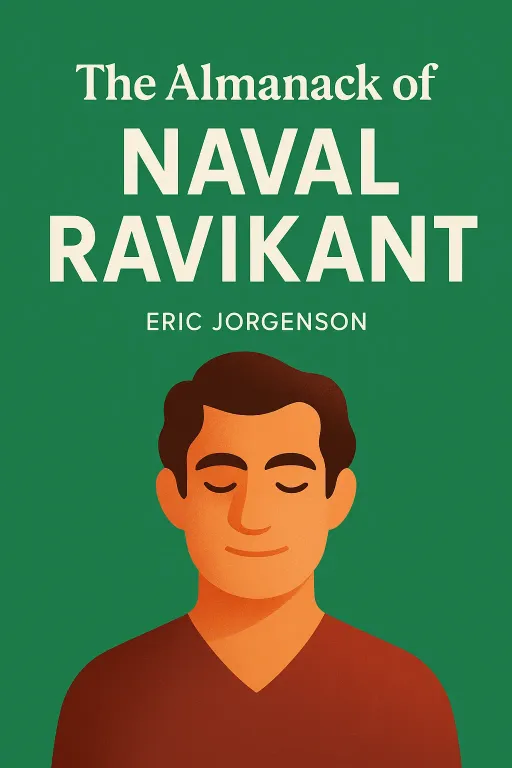
The Architect's Almanack: Deconstructing Life, Wealth, and Happiness
Golden Hook & Introduction
SECTION
Albert Einstein: What if I told you that getting rich has almost nothing to do with hard work? And that being happy isn't about achieving your goals, but about canceling them? It sounds like nonsense, doesn't it? A paradox.
Himanshu: It's certainly counter-intuitive. Most of us are wired to believe that effort equals reward, and achievement equals happiness.
Albert Einstein: Precisely! But our guest book today, "The Almanack of Naval Ravikant," throws these assumptions into a particle accelerator and smashes them to bits. Welcome, everyone, to 'The Architect's Almanack.' Today, we're exploring the radical ideas of Naval Ravikant, a philosopher-investor who treats life's biggest questions like engineering problems. We'll dive deep into his philosophy from two distinct angles. First, we'll dissect the mechanics of wealth creation, treating it like a science.
Himanshu: And then, we'll shift our focus inward and explore the art and science of cultivating happiness as a learnable skill.
Albert Einstein: I'm so glad to be exploring this with you, Himanshu. As a healthcare professional, your work involves understanding some of the most complex systems of all: human beings. I feel your perspective will be invaluable.
Himanshu: I'm looking forward to it, Albert. The idea of applying a systematic, almost clinical, approach to these traditionally 'soft' subjects is fascinating to me.
Deep Dive into Core Topic 1: The Physics of Wealth
SECTION
Albert Einstein: Wonderful. So, Himanshu, let's start with that first heresy. Naval says, 'Seek wealth, not money or status.' To an analytical mind, that distinction is crucial. What does that even mean?
Himanshu: It's a diagnostic question, really. It forces you to define your terms. Money is what you use to buy groceries. Status is how you rank against your neighbors. They're both relative and, often, fleeting. But wealth... wealth sounds more fundamental.
Albert Einstein: Exactly! Naval defines wealth as. It's the business that generates profit while you're on vacation. The investment that compounds. The book that sells copies for years. It's a system. And he argues you can build this system with a formula, almost like E=mc². He says true wealth is a product of three things: Specific Knowledge, Accountability, and Leverage.
Himanshu: A formula for wealth. That's a bold claim. Let's break it down. What's 'Specific Knowledge'?
Albert Einstein: Ah, this is the beautiful part. It's knowledge that cannot be easily taught but can be learned. It's your unique combination of talents, curiosities, and passions. There's a wonderful story in the book: when Naval was a teenager, he wanted to be an astrophysicist. But his mother, watching him, just said, "You're going to go into business." He was annoyed, but she was right. She saw his specific knowledge—a blend of tech obsession, salesmanship, and analytical thinking—that society would eventually pay a fortune for. He wasn't just another kid who liked stars; he was a unique intersection of skills.
Himanshu: That's a powerful framework. It reframes a career not as a ladder, but as a portfolio of assets. In healthcare, a doctor's salary is 'renting out time.' It's just money. But their reputation, their unique surgical technique, or a medical device they invent— is the equity, the asset that can generate wealth. The specific knowledge isn't just the medical degree; it's the niche you carve within it, the thing you're obsessed with that others find boring.
Albert Einstein: Yes! You've grasped it perfectly. And what about leverage? Naval says fortunes require leverage. In my day, it was capital or labor. But today, he says the most powerful forms are 'permissionless'—code and media. You can write a piece of software or record a podcast, and it can work for you, serving millions, while you sleep. How do you see leverage in a field like healthcare, which seems so dependent on one-on-one time?
Himanshu: It's everywhere, but often invisible. A senior consultant's opinion has leverage; it influences the actions of an entire team of doctors and nurses. A published research paper has immense leverage; it can change clinical practice for thousands of doctors you'll never meet. A well-designed patient protocol is a form of leverage; it scales best practices without the original designer needing to be in every room. The challenge, as Naval implies, is to stop just the work and start consciously building these systems of leverage around your specific knowledge.
Albert Einstein: And the final piece is Accountability. Taking risks under your own name.
Himanshu: Which is terrifying. But it's also where the rewards are. If a protocol fails, the person who designed it is accountable. But if it saves thousands of lives, they get the credit, the reputation, the equity. It's the same principle. No risk, no reward.
Deep Dive into Core Topic 2: The Homeostasis of Happiness
SECTION
Albert Einstein: This idea of building systems is the perfect bridge to our second topic, which is even more radical. If we can engineer wealth, can we engineer happiness? Naval argues yes, but the method is subtraction, not addition.
Himanshu: You mean we don't find happiness by adding more things—more money, more success, more achievements?
Albert Einstein: Precisely the opposite. He says, "Happiness is the default state." It's what's left over when you remove the sense that something is missing from your life. And what creates that sense of 'missing'? Desire. His most chilling quote is, "Desire is a contract you make with yourself to be unhappy until you get what you want."
Himanshu: Wow. That... that's a tough pill to swallow. But it makes a strange kind of sense. The moment you want something—a promotion, a new car, a different life—you've introduced a state of lack. You've defined your present as insufficient.
Albert Einstein: You've created a gap. And you live in that gap. Naval tells his own story of being young, successful, and miserable. He had everything he thought he wanted, but he was a 2 out of 10 on the happiness scale. He spent the next decade learning happiness as a skill, and he says the key wasn't gaining more, but wanting less.
Himanshu: This resonates deeply with the concept of homeostasis in medicine. The body is always trying to return to a baseline—a stable temperature, a stable pH level. It seems Naval is saying our minds have a happiness baseline, a state of peace, but we constantly disrupt it with the 'fever' of desire or the 'acid' of envy. The goal, then, isn't to chase moments of euphoria, which are like sugar spikes, but to maintain a healthy, stable inner state.
Albert Einstein: What a perfect analogy! So, as a 'doctor of the mind,' what's the prescription? Naval suggests it's all about habits. He says, "Happiness is built by habits." Things like daily meditation, regular exercise, cutting out things that spike and crash your mood like social media arguments or too much sugar. And he has this wonderful, simple rule: "Easy choices, hard life. Hard choices, easy life."
Himanshu: Absolutely. It's preventative care for the soul. In medicine, we know it's harder to convince someone to change their diet to a heart attack than it is to treat them after they've had one. Making the hard choice to exercise daily is what leads to the 'easy life' of good health later. It seems the same logic applies to mental well-being. The hard choice is to sit with your thoughts in meditation, to face your envy and let it go, to choose acceptance over frustration.
Albert Einstein: And to choose your desires very, very carefully. He suggests you should pick one, all-consuming desire in your life—your family, your art, your science—and let the rest go. Don't have a hundred little contracts out on your own happiness.
Himanshu: It's a form of triage. In an emergency room, you have to decide which patient needs your attention most. You can't fix everything at once. Naval is saying we need to apply that same ruthless prioritization to our own desires. What is the one thing that is truly worth being unhappy for in the short term? For most of the little things we chase, the answer is probably nothing.
Synthesis & Takeaways
SECTION
Albert Einstein: So, it seems the grand unified theory here is that both wealth and happiness are not things you, but systems you. One is an external system of value, built on your unique contributions. The other is an internal system of peace, built by managing your internal state.
Himanshu: And the common thread is taking radical responsibility. Naval's core message, under everything, is "Save yourself." He says doctors won't make you healthy, teachers won't make you smart, and mentors won't make you rich. They can guide you, but you are the architect of these systems. No one is coming to save you, but the tools are available to everyone. This book is essentially a blueprint.
Albert Einstein: A brilliant summary. So for our listeners, here's the challenge, inspired by Naval: Look at your life today. What is one 'desire contract' you're currently honoring—one 'I'll be happy when...' statement—that is actively making you unhappy now? And what would happen if you simply chose to cancel it?
Himanshu: A thought experiment with real-world consequences. A perfect way to end.
Albert Einstein: Indeed. Thank you so much for your insights today, Himanshu. You've brought these ideas to life.
Himanshu: The pleasure was all mine, Albert. It's given me a lot to think about.









