

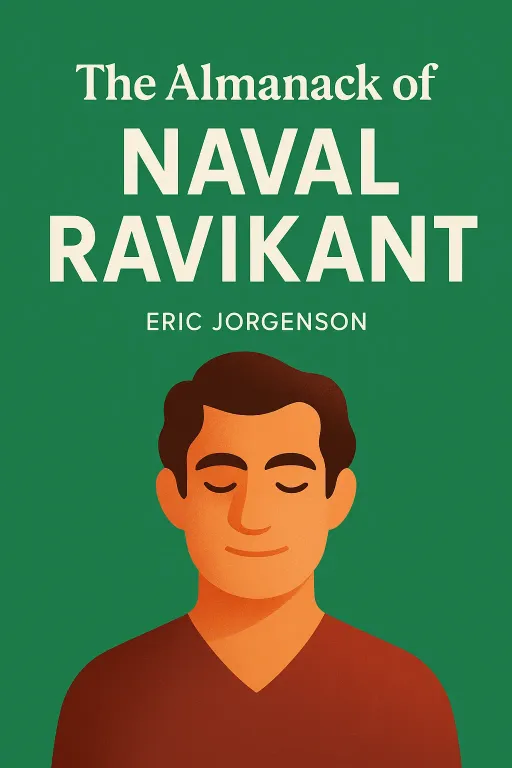
The Architect of You: Building a Life of Wealth and Purpose with Naval Ravikant's Blueprint
Golden Hook & Introduction
SECTION
Albert Einstein: What if you're standing at a crossroads in life, with no map, no confidence, and the nagging feeling that you're playing a game you can't win? You're told to work hard, get a good job... but what if that's the wrong game entirely?
Eniola Olanisebe: That question hits very close to home. It feels like the central question of my generation, especially for those of us still in school, looking out at the world and feeling… unprepared for the game everyone else seems to be playing.
Albert Einstein: Precisely. And that's why today, we are not just discussing a book. We are looking at a blueprint for a self-made life, "The Almanack of Naval Ravikant." I'm so glad you're here, Eniola, because you are a fellow seeker of first principles.
Eniola Olanisebe: I'm excited to be here. I've been looking for a different kind of map, so this feels timely.
Albert Einstein: Wonderful. Because today, we're diving into Naval's work to find a new compass. We'll tackle this from three angles. First, we'll explore how to escape the trap of trading your time for money. Then, we'll discuss how to discover your personal superpower using Naval's ideas of Specific Knowledge and Accountability. And finally, we'll focus on the most fundamental skill of all: learning how to be happy.
Deep Dive into Core Topic 1: Redefining the Game: Wealth vs. Time
SECTION
Albert Einstein: So let's begin there, Eniola. As a college student, the world tells you your primary asset is your future time, which you must rent out for a salary. But Naval offers a radical alternative. He says, "Seek wealth, not money or status." What does that distinction even mean to you?
Eniola Olanisebe: Honestly, it sounds like a luxury. When you're an indigent student, money is everything. It's rent, it's food. The idea of 'wealth' feels abstract, like something for other people. I've only ever thought about how to get more money.
Albert Einstein: And that is the trap! Naval would say money is just the tool we use to transfer time and wealth. Status is just our place in the social hierarchy, a game where for you to win, someone else must lose. But wealth... ah, wealth is different. Imagine you work a four-hour shift at a coffee shop. You get paid for those four hours. Now, imagine you own a single vending machine in a busy hallway.
Eniola Olanisebe: Okay...
Albert Einstein: That vending machine is working for you while you sleep. It's working while you're in class. It's working right now. That is wealth. It's having assets that earn for you, independent of your time. Naval's core argument is that you will never be truly free if you are renting out your time.
Eniola Olanisebe: So you're saying my goal shouldn't be to get a better-paying job, but to own a 'vending machine,' metaphorically speaking.
Albert Einstein: Exactly! Let me tell you a story from the book's analysis to make this concrete. Imagine two people in 2010, Alice and Bob. Bob wins a million dollars in the lottery. He has money. Alice is a skilled programmer who starts at a tech company. She has very little money.
Eniola Olanisebe: I'm with Alice.
Albert Einstein: As you should be. Bob buys a mansion, fancy cars. He spends the money. Alice, meanwhile, spends her time building her skills. She becomes a lead developer. She uses her salary to live, but her real work is getting better, building her expertise. She eventually takes a small part of her salary and invests in another promising startup. A decade passes. Bob, having spent the money and made poor investments, is broke. His money is gone. But Alice? Her skills have compounded. The startup she invested in is now a huge success. She owns equity. She has assets that are earning for her, while she sleeps. She built wealth. Bob only ever had money.
Eniola Olanisebe: Wow. That reframes everything. My whole life has been about how to money, not how to wealth. It feels like I've been trying to get better at carrying buckets of water from a river, and Naval is saying, 'Why not build a pipe?'
Albert Einstein: A perfect analogy!
Eniola Olanisebe: But here's the real question for me, and for anyone starting out. For someone with no money to build a pipe, what's the first step? What is the first piece of that pipe made of?
Deep Dive into Core Topic 2: Finding Your Superpower: Specific Knowledge and Accountability
SECTION
Albert Einstein: That's the perfect question, Eniola, because it leads directly to Naval's most powerful idea for someone starting from scratch. The first pipe you build isn't with money, it's with your mind. He calls it 'Specific Knowledge.'
Eniola Olanisebe: Specific knowledge. What is that, exactly? Is it like learning to code or getting a certification?
Albert Einstein: No, and this is the crucial part. Naval says specific knowledge is knowledge that you cannot be trained for. It's the thing you are a natural at. It's found by pursuing your genuine, obsessive curiosity. As he says, "If society can train you, it can train someone else, and replace you." Specific knowledge is your unique superpower.
Eniola Olanisebe: So it's not about what's popular or what pays well right now. It's about something innate.
Albert Einstein: Precisely. Let me tell you another story. When Naval was a teenager, he wanted to be an astrophysicist. He was passionate about science. One day, he's talking to a friend in the kitchen, and his mother, who is cooking, overhears him and says, "No, you're going to go into business." He dismissed it completely. What did his mother know about his dreams?
Eniola Olanisebe: Right, of course.
Albert Einstein: But years later, he realized she was right. She had seen his specific knowledge in action. He was always analyzing things, he was good at sales, he loved tinkering with technology and systems. He had the of an entrepreneur. His mother saw the pattern he was too close to see. Your specific knowledge is often something that feels like play to you, but looks like work to others.
Eniola Olanisebe: That is a game-changer for my indecisiveness. The pressure to 'pick' a career is immense. But this suggests the answer is already inside me, like a data set I just need to analyze. It's not about forcing myself into a box, but about identifying my own natural obsessions, the things I do for fun that others find difficult.
Albert Einstein: Yes! And once you identify it? You must embrace the second part of the formula: Accountability.
Eniola Olanisebe: Which means...
Albert Einstein: Taking public risks under your own name. Don't hide. Start a blog, build a project, create a podcast, and put your name on it. It's scary, but it's the only way to build a reputation. Accountability is the leverage that allows your specific knowledge to generate wealth.
Eniola Olanisebe: That's terrifying. As someone who lacks confidence, the idea of 'failing in public' is a nightmare. But... I see the logic. Hiding means no one can find you to give you opportunities. Taking accountability, even on a small scale, is how you signal your value to the world. It's the only way to prove the worth of that specific knowledge.
Deep Dive into Core Topic 3: Mastering the Inner Universe: Happiness as a Learnable Skill
SECTION
Albert Einstein: Exactly. And building that reputation, taking those risks, requires a foundation of inner strength. A resilience. Which brings us to the bedrock of Naval's entire philosophy: Happiness. Most people think happiness is the prize you get you become successful. Naval says this is backwards.
Eniola Olanisebe: He thinks you need to be happy first? How does that work when you're struggling?
Albert Einstein: He argues that happiness is not a result, it is a. It's something you learn and practice, like nutrition or exercise. And the core of this skill is understanding desire. He has this quote, and I want you to really think about it: "Desire is a contract you make with yourself to be unhappy until you get what you want."
Eniola Olanisebe: ... Wow. Say that again.
Albert Einstein: "Desire is a contract you make with yourself to be unhappy until you get what you want."
Eniola Olanisebe: That... that hits hard. It perfectly describes the cycle of addiction. You're always chasing the next thing, believing it will make you happy, but the 'wanting' itself is the source of the misery. The craving is the suffering.
Albert Einstein: Yes! You see it. So, the skill of happiness isn't about getting everything you want. It's about wanting less. It's about breaking those contracts. And this isn't just a theory for him. Naval tells a story about his own life. Ten years ago, he was deeply unhappy. On a scale of one to ten, he was a two or a three. He had success, but he was miserable.
Eniola Olanisebe: So what did he do?
Albert Einstein: He decided that his own happiness was the most important thing, and he started to on it. He treated it like a skill. He meditated, he read philosophy, he changed his habits, he surrounded himself with happy people. Today, he says he's a nine out of ten. He to be happy. The money and success were a very small part of it. The real change was internal.
Eniola Olanisebe: The idea that I can destructive desire and to be content... that's the most hopeful thing I've heard. It's not about using willpower to fight a craving, but about understanding the nature of the craving itself so it loses its power. That feels like a solvable problem for an analytical mind. It's a system I can work on.
Synthesis & Takeaways
SECTION
Albert Einstein: And that is the perfect synthesis. Naval's work isn't a list of tasks, it's a new operating system for the mind. So, we have a three-part blueprint. First, change the goal from earning money to building wealth—from carrying buckets to building a pipe.
Eniola Olanisebe: Second, find your unique superpower by analyzing your innate curiosities—your Specific Knowledge—and then have the courage to attach your name to it through Accountability.
Albert Einstein: And third, build your entire life on a foundation of inner peace by treating happiness as a skill you can learn, primarily by understanding and managing desire.
Eniola Olanisebe: For me, the biggest takeaway is that this isn't a to-do list. It's a shift in perspective. It gives me permission to stop trying to fit in and start figuring out what makes me, me.
Albert Einstein: A beautiful way to put it. So, as we close, what is the one question or idea you are taking away from this?
Eniola Olanisebe: The question I'm leaving with isn't 'What should I do?' anymore. It's 'What am I genuinely, obsessively curious about?' I think for anyone feeling lost, indecisive, or lacking confidence, that's the only place to start. Don't look for a map. Start building your own compass.









