

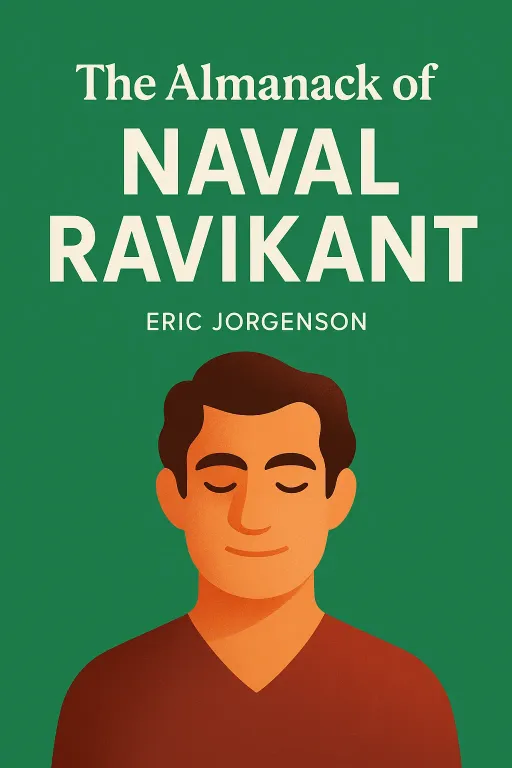
Leverage & Life's Code: A Software Engineer's Guide to Naval Ravikant's Almanack
Golden Hook & Introduction
SECTION
Dr. Celeste Vega: In the world of software, a single line of code can impact millions of people. It’s the ultimate form of leverage. But what if you could apply that same powerful thinking not just to your work, but to your entire life—to build wealth, and maybe more importantly, to build happiness?
samuel: That's a fascinating premise, Celeste. As an engineer, we're obsessed with scalability and efficiency. The idea of applying that to life itself is... well, it's the ultimate optimization problem.
Dr. Celeste Vega: Exactly. And that's why I'm so excited to dive into with you today, Samuel. For our listeners, this book is less of a traditional narrative and more of a user manual for the modern world, compiled from the wisdom of entrepreneur and philosopher Naval Ravikant. And Samuel, as a software engineer working with AI in healthcare, you are living at the very intersection of leverage, technology, and human well-being.
samuel: It’s a wild intersection, that’s for sure. I’m really curious to see how Naval’s principles map onto it.
Dr. Celeste Vega: Perfect. Today, we're going to tackle this book from two different angles. First, we'll explore Naval's wealth equation: how to build financial freedom using specific knowledge and leverage. Then, we'll pivot to an even more important topic: debugging our own happiness and treating it as a skill we can all learn.
Deep Dive into Core Topic 1: The Wealth Equation
SECTION
Dr. Celeste Vega: So let's start with wealth. As an engineer, you live and breathe leverage. But Naval makes this really sharp distinction between just working and actually creating wealth. He has a famous quote: "You’re not going to get rich renting out your time." Samuel, from your perspective just starting your career, what does that feel like?
samuel: It feels incredibly true, and a little daunting. You know, you get your degree, you get a job, and you're paid a salary. You are, by definition, renting out your time. Your impact is tied to the hours you put in. The dream, the thing we talk about in tech, is to break that link. You want to build something once that provides value to many, over and over, without your direct involvement.
Dr. Celeste Vega: That is the perfect description of Naval's core idea. He says, "Seek wealth, not money or status. Wealth is having assets that earn while you sleep." And he provides a powerful example from his own life with the creation of AngelList.
samuel: Oh yeah, AngelList is legendary in the startup world.
Dr. Celeste Vega: It is, but let's break down for our listeners. Before AngelList, around 2010, if you were a startup founder, getting funding was this opaque, frustrating process. It was all about who you knew in Silicon Valley, getting warm introductions, and navigating a very closed network. You were essentially renting out your time just to and get meetings.
samuel: A very inefficient system.
Dr. Celeste Vega: Exactly. So what did Naval do? He didn't just work harder within that broken system. He and his co-founder built a new one. They used code to create a platform—AngelList—where startups could connect with investors directly. They created leverage. That one platform scaled to serve thousands of companies and investors. It wasn't just a job; it was an asset that earned while they slept. It’s a masterclass in what Naval calls "permissionless leverage"—using code or media, which anyone can access, to build something with no marginal cost of replication.
samuel: That's it. That's the core of software engineering. You're not building a thousand individual cars; you're designing the factory that can build a million. AngelList is the factory. In my world, if I build a custom AI model for one hospital, I'm renting my time. But if I build a platform or an API that allows a hundred hospitals to build their models, that's leverage. That's an asset.
Dr. Celeste Vega: And to build that asset, Naval says you need "specific knowledge." He defines it as knowledge you can't be trained for. It's found by pursuing your genuine curiosity. How do you see that playing out in your field of AI in healthcare?
samuel: It's everything. You can find thousands of programmers who know Python. But how many know Python, understand the intricacies of medical imaging data, are familiar with the regulatory compliance of healthcare systems? That intersection is where specific knowledge lives. It's not a course you can take; it's a unique stack of skills you build out of genuine interest. But here's a question that brings up for me, Celeste. In a field like AI, 'specific knowledge' has a very short half-life. The hot new model today is a relic in two years. How does Naval's framework account for that constant, brutal need for re-learning?
Dr. Celeste Vega: That is such a critical point. I think Naval would argue that the specific knowledge isn't the tool itself—it's not knowing a particular framework. The specific knowledge is the of being a perpetual learner. It's the deep, foundational understanding of mathematics, logic, and human needs that allows you to pick up the next new tool quickly. The knowledge is your ability to learn, which is timeless, even if the applications change.
samuel: So the specific knowledge is the engine, not the fuel. I like that. It’s about building the capacity to adapt.
Dr. Celeste Vega: Precisely. It’s about building yourself into the kind of person who can spot opportunities and build those leveraged systems.
Deep Dive into Core Topic 2: Debugging Happiness
SECTION
Dr. Celeste Vega: But it's fascinating, Samuel, because that intense drive to constantly learn, build, and create leverage is exactly what can lead to burnout. We see it all the time in high-achievers. And this is where Naval's philosophy takes a sharp, unexpected turn. He argues that the very success we chase, the wealth we build, doesn't actually us happiness. He says it's a completely separate skill.
samuel: That feels... counter-intuitive. The whole narrative is that success brings happiness. You ship the product, you get the promotion, you feel good.
Dr. Celeste Vega: Right? But Naval’s own story is the perfect counter-example. He talks about a period in his life where, by all external measures, he was incredibly successful. He had made money, he was a respected figure in tech. Yet, he rated his own happiness at a 2 or 3 out of 10. He was miserable.
samuel: Wow. So the external scorecard was an A+, but the internal one was an F.
Dr. Celeste Vega: A total F. And he realized he had to treat happiness not as a reward for his work, but as a skill to be learned, just like he learned business or investing. He spent a decade working on it, reading philosophy, meditating, changing his habits. He says the fundamental mistake we make is summed up in this killer quote: "Desire is a contract you make with yourself to be unhappy until you get what you want."
samuel: Okay, that... that hits hard. "A contract to be unhappy." As an engineer, our entire job is to identify a problem, a gap, a 'desire' for a feature, and then work tirelessly to fulfill it. We live in a state of manufactured dissatisfaction.
Dr. Celeste Vega: Tell me more about that. That's a brilliant connection.
samuel: Well, you look at a system, and your brain is trained to find what's wrong, what's missing, what could be better. That's how you improve things. But Naval is saying we apply that same problem-finding mindset to our own lives. We look at our life and think, "I'm missing a promotion," "I'm missing a bigger house," "I'm missing a faster car." And by identifying that 'bug' in our life, we've just signed that contract to be unhappy until we 'ship the fix.'
Dr. Celeste Vega: And once you ship it, the satisfaction is fleeting, and you're already looking for the next bug to fix. It's the "hedonic treadmill."
samuel: Exactly. It’s a never-ending sprint. It also makes me think of my industry, healthcare. So much of it is focused on 'fixing' illness—on reacting to problems. But there's a growing movement towards 'wellness,' which is about cultivating a state of health proactively. It sounds like Naval is advocating for a 'wellness' model for the mind. Happiness isn't a feature to be shipped; it's about cultivating a stable, default state of peace.
Dr. Celeste Vega: That is the perfect analogy. He says happiness is our natural, default state when we remove the sense that something is missing. It's not about adding positive thoughts; it's about subtracting negative judgments and desires. It’s about achieving inner peace. For a mind trained to solve and achieve, that's a radical refactor of your mental model.
samuel: It really is. It means the goal isn't to achieve happiness, but to uncover it. It's already there, just buried under a pile of our own desires and expectations.
Synthesis & Takeaways
SECTION
Dr. Celeste Vega: So, as we wrap up, we're left with these two powerful, almost opposing ideas from Naval's Almanack. On one hand, you have this intense, focused drive to build unique value and amplify it with leverage. It's about action, creation, and ambition.
samuel: The 'Wealth Equation.' It's about playing the great game of creating things society wants.
Dr. Celeste Vega: And on the other hand, you have this gentle, internal process of letting go. Of canceling those 'contracts of unhappiness' by reducing desire and finding peace in the present moment.
samuel: The 'Happiness Algorithm.' It's about stepping away from the game entirely and realizing the real scorecard is internal. It's like having a dual-core processor for life. One core is for building and competing in the external world, and the other is for cultivating peace and well-being in the internal world. You need both to run the system effectively.
Dr. Celeste Vega: A dual-core processor for life. I love that. It perfectly captures the balance. So, Samuel, what's the one thought or question you'd want to leave our listeners with today?
samuel: I think it comes down to applying both of those cores. So maybe the question for everyone listening, especially for the builders and thinkers out there, is this: What is the one piece of specific knowledge you are uniquely building, the thing that feels like play to you but looks like work to others? And, at the same time, what is the one desire, that one 'contract to be unhappy,' that you can cancel today to find a little more peace right now?
Dr. Celeste Vega: A powerful challenge. Build your unique value, and find your inner peace. Samuel, thank you so much for helping us decode Naval's wisdom today.
samuel: This was fantastic, Celeste. It’s given me a lot to think about.









