

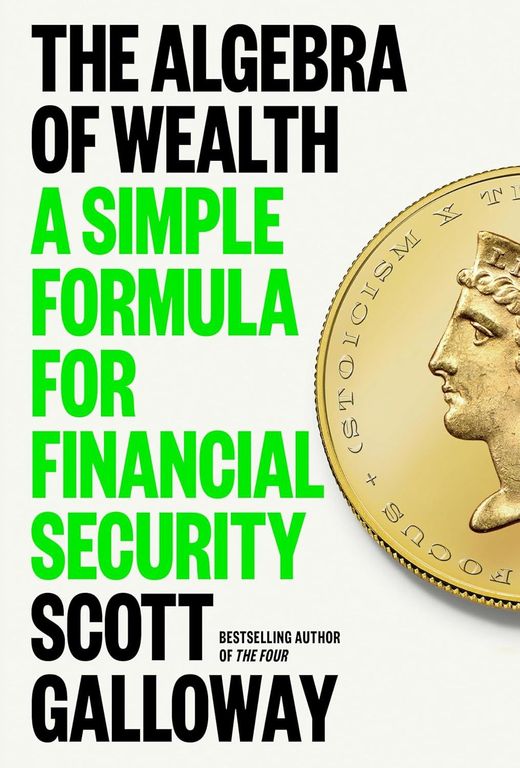
The Algebra of Wealth
A Simple Formula for Financial Security
Introduction
Nova: Most people think of wealth as a number in a bank account, or maybe a garage full of Italian sports cars. But Scott Galloway, the NYU professor and serial entrepreneur, defines it differently. He says wealth is actually the absence of economic anxiety. It is the moment when your passive income exceeds your lifestyle expenses.
Nova: Exactly. And in his book, The Algebra of Wealth, Galloway argues that building this security is not a matter of luck or catching the next meme stock. He actually breaks it down into a literal formula: Wealth equals Focus plus Stoicism times Time times Diversification.
Nova: Oh, there is plenty of grit. Galloway is famous for his blunt, sometimes harsh realism. He is not here to tell you that you are special or that everything will just work out. He is here to give you the algebra of how the world actually works today, especially in an era of AI and massive economic shifts. Today, we are going to break down that formula and see how we can actually apply it to our lives.
Key Insight 1
The Power of Focus
Nova: Let's start with the first part of the equation: Focus. Galloway has some very controversial advice here. He tells young people, point-blank: do not follow your passion.
Nova: Because, as he puts it, passion is what you do on the weekends. If you love fly-fishing, don't try to make a living at it because there are a million other people who love it too, which drives the wages down to zero. Instead, he says you should follow your talent.
Nova: Precisely. He suggests looking for industries with high margins and high barriers to entry. His rule of thumb is to look for a career with a 90 percent or higher employment rate. If you become great at something that the world values and pays well for, the passion will follow because you will be successful, you will be able to provide for your family, and you will have the respect of your peers.
Nova: It is also about where you live. Galloway is a big believer that your zip code is one of the biggest predictors of your wealth. He argues that young people should move to 'high-velocity' cities—places like New York, San Francisco, or London—where the concentration of capital and talent is highest. You want to be where the 'economic weather' is most favorable.
Nova: It really is. He also emphasizes that focus means saying no to distractions. In your 20s and 30s, he says you should be focused on your 'earn.' This is the time to work harder than everyone else to establish your trajectory. He often says that if you want to be in the top one percent of earners, you cannot have a balanced life in your 20s. You have to be obsessed.
Nova: It is, and Galloway acknowledges that. But he argues that the 'balance' comes later. You trade some of your youth for the security that allows you to have a balanced, anxiety-free life for the next fifty years.
Key Insight 2
Stoicism and the Burn
Nova: Now we move to the next part of the formula, which is Stoicism. And he is not talking about just reading Marcus Aurelius; he is talking about your relationship with consumption.
Nova: It is much deeper than that. Galloway defines Stoicism in this context as the ability to separate your ego from your spending. He points out that most people increase their spending the moment they start making more money. He calls this lifestyle creep, and it is the ultimate wealth killer.
Nova: Exactly. He uses a great term called 'The Burn.' Your wealth is not determined by your income, but by the gap between what you earn and what you spend. If you make a million dollars but spend 1.1 million, you are poor. If you make fifty thousand but spend forty thousand, you are on the path to wealth.
Nova: He suggests a few practical things. First, realize that nobody actually cares what car you drive or what watch you wear. Most of the things we buy to impress others are just 'badges of insignificance.' Second, he talks about the 'character' of wealth. Wealthy people, in his view, are those who have the discipline to delay gratification.
Nova: That is a great way to put it. He also mentions that Stoicism applies to your emotions in the market. When the stock market crashes, a Stoic doesn't panic and sell. They realize that market volatility is the price you pay for long-term returns. They keep their head while everyone else is losing theirs.
Nova: Precisely. He says that the most expensive thing you can buy is 'status,' and it usually has a terrible return on investment. If you can master your ego, you have mastered a huge part of the algebra of wealth.
Key Insight 3
The Magic of Time and Diversification
Nova: The last two parts of the formula are Time and Diversification, and these are where the math really starts to work in your favor. Galloway calls Time the 'heavy lifter' of the equation.
Nova: It is, but he puts some staggering numbers behind it. He points out that if you start investing early, even small amounts, the 'tail' of the curve—the last few years of your life—is where almost all the wealth is created. He often uses the example of Warren Buffett, noting that over 90 percent of Buffett's wealth was created after his 65th birthday.
Nova: Exactly. And that leads into Diversification. Galloway is very anti-gambling. He thinks trying to pick the next 'hot' stock or timing the market is a fool's errand. He advocates for what he calls 'low-cost, broad-based index funds.'
Nova: Yes. He says your goal should be to be 'average' in the market, because the average return of the S&P 500 over the long term is actually incredible. He warns against 'concentration risk.' A lot of people get rich by concentrating their bets—like starting a business—but they stay rich by diversifying.
Nova: Right. He also talks about diversifying your income streams. In today's economy, relying on a single employer is risky. He encourages people to have 'side hustles' or investments that generate passive income, so if one pillar falls, the whole house doesn't come down.
Nova: That is the formula in a nutshell. It is not about a single 'liquidity event' or winning the lottery. It is about a consistent, decades-long application of these four principles.
Key Insight 4
The Modern Economic Landscape
Nova: We can't talk about this book without mentioning Galloway's take on the current state of the world. He is very vocal about the fact that it is harder for young people today than it was for the Boomer generation.
Nova: Yes, he is very empathetic to the 'enrage' that many young people feel. He points out that in 1970, the average house cost about three times the average annual salary. Today, it is more like eight or ten times. But his message isn't just 'the system is rigged, so give up.' It is 'the system is harder, so you have to be smarter.'
Nova: He believes AI is going to be a massive productivity multiplier, but it will also lead to a 'thinning' of the middle class in many professional services. His advice is to become 'AI-adjacent.' Don't try to compete with the machine; learn to use the machine to do your job ten times faster.
Nova: Exactly. He also has a very interesting take on taxes. He argues that our current system favors capital over labor—meaning you get taxed less on your investments than you do on your hard work. His takeaway for the individual? You need to move from being a 'laborer' to being a 'capitalist' as quickly as possible.
Nova: Precisely. Because the government and the economy are set up to reward owners. He is very blunt about the fact that nobody is coming to save you. Not the government, not your employer. You have to build your own safety net using the algebra he provides.
Nova: It is. He often says, 'I'm not telling you how the world should be; I'm telling you how it is.' And in the world as it is, the people who understand the relationship between focus, stoicism, time, and diversification are the ones who end up with the freedom to live life on their own terms.
Conclusion
Nova: To wrap things up, Scott Galloway's The Algebra of Wealth isn't a book about how to get rich quick. It is a book about how to build a life that is free from the crushing weight of financial worry. It is about making smart, often difficult choices early on so that you can have options later.
Nova: And the most important takeaway is that the best time to start was yesterday, but the second best time is today. Whether it is choosing a more lucrative career path, cutting your 'burn' rate, or just opening that first index fund account, every small action compounds.
Nova: It is a pragmatic, powerful philosophy for a complicated age. If you can master the algebra, you can master your future.
Nova: As we all should. Thank you for joining us for this deep dive into Scott Galloway's insights. This is Aibrary. Congratulations on your growth!