

The Art of Speculation: Mastering Market Cycles and Price Discovery
Golden Hook & Introduction
SECTION
Nova: Atlas, I want you to imagine something for a moment. You’re watching a movie, a thriller, and the protagonist makes a move that seems completely illogical based on the information have. But, the audience, know something they don't. That’s kind of how George Soros sees the markets, and it’s a mind-bending concept we’re diving into today.
Atlas: Whoa, that’s a great analogy. You're saying the market isn't just reacting to facts, but to how people about the facts? That’s going to resonate with anyone who’s ever felt like they’re playing chess against an invisible opponent in the trading world.
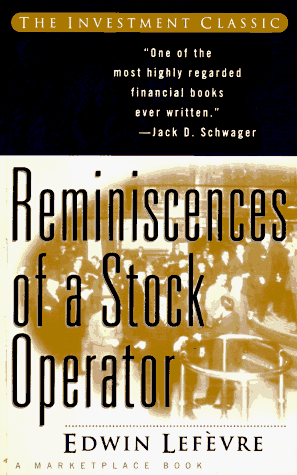
Nova: Exactly! Today, we’re cracking open the minds behind two seminal works: Edwin Lefèvre’s timeless classic,, and George Soros’s groundbreaking. Lefèvre’s book, published in 1923, is a fictionalized biography of the legendary trader Jesse Livermore, and it’s fascinating because it was written by a journalist who spent years covering Wall Street. It’s a narrative that feels as fresh today as it did a century ago, revealing the eternal dance between human nature and market cycles.
Atlas: Oh, I like that. So, we’re talking about old wisdom meeting new theory. It’s not just about charts and numbers, but about the messy, emotional, and often irrational human element. I’m curious, how do these two, separated by decades, actually connect?
Nova: They connect at the very heart of what drives markets: human behavior. Lefèvre, through Livermore, shows us the raw, visceral psychology of the speculator—the greed, the fear, the discipline, or lack thereof. Soros, on the other hand, gives us a sophisticated theoretical framework for those human biases create feedback loops that fundamentally alter reality.
Atlas: So basically, you’re saying one gives us the vivid, lived experience of market psychology, and the other gives us the intellectual architecture behind it. That’s a powerful combination for anyone looking to refine their trading approach.
The Speculator's Mindset – Echoes of Human Nature
SECTION
Nova: Absolutely. Let's start with. Jesse Livermore's story isn't just about making and losing fortunes; it’s a deep dive into the speculator's mindset. Livermore, despite living in an era of ticker tape and chalkboards, understood market psychology with an almost eerie prescience. He observed that patterns repeat because human nature remains constant.
Atlas: That makes sense. I imagine a lot of our listeners, especially those who’ve been in the game for a while, feel that deja vu when they see certain market movements. It’s like, ‘haven't I seen this movie before?’ But what did Livermore actually with that understanding? Can you give an example?
Nova: He recognized that markets often overreact. A stock would go down, and the fear would cause it to plummet further than fundamentals dictated. Or, euphoria would drive it up far past any reasonable valuation. He famously said, “There is nothing new in Wall Street. There can’t be, because speculation is as old as the hills. Whatever happens in the stock market today has happened before and will happen again.” His genius was in waiting for confirmation of these psychological shifts, rather than trying to predict them.
Atlas: So he wasn't trying to be a prophet; he was waiting for the crowd to show its hand, then joining the validated trend. That’s a powerful distinction. But wasn’t he also known for some pretty spectacular failures?
Nova: He was, which is precisely why his story is so instructive. His biggest failures often came when he deviated from his own rules or let emotion—like ego or stubbornness—override his disciplined observations. For instance, after making a fortune shorting the market in the 1907 Panic, he later lost significant capital by holding onto positions too long, convinced he was right even when the market disagreed. This is a common pitfall for even the most brilliant traders: the human tendency to double down on a losing bet.
Atlas: That’s actually really inspiring, in a strange way. It tells us that even the very best struggled with the same human foibles we all do. It’s not about being emotionless, but about acknowledging and managing those emotions. So, how does this old-school wisdom translate to something more contemporary, like Soros’s reflexivity?
The Alchemy of Finance – Soros and the Reflexive Loop
SECTION
Nova: That’s where Soros steps in with. While Lefèvre gives us the ground-level view of market psychology, Soros provides the aerial perspective, the theoretical framework for those psychological dynamics are so powerful. He introduces his theory of reflexivity, which is a game-changer.
Atlas: Okay, so what exactly is reflexivity? In plain English, what does that mean?
Nova: In essence, reflexivity is a two-way feedback loop. It challenges the traditional economic idea that markets are efficient and objective, simply reflecting an underlying reality. Soros argues that market participants don't just reality; their biased perceptions and expectations and that reality.
Atlas: So basically, you’re saying it’s not just A causes B, but A causes B, which then causes A to change, which then causes B to change even more? Like a self-fulfilling prophecy?
Nova: Exactly! Take an example: a currency pair. If enough speculators believe a currency is going to strengthen, they start buying it. This increased demand the currency. That strengthening then reinforces their belief, attracting even more buyers, creating a positive feedback loop. This can lead to booms that go far beyond what fundamentals would suggest.
Atlas: I can see how that would lead to booms, but also busts. If everyone believes it’s going up, and it does, then the reverse must also be true. If enough people believe it’s going down, they start selling, and it plummets. It’s a vicious cycle. So, how did Soros use this theory in his own trading?
Nova: His most famous application was against the British pound in 1992, an event often called "Black Wednesday." Soros believed the pound was overvalued and that the British government's policy of keeping it pegged to the German Deutschmark was unsustainable. He saw a reflexive dynamic at play: the market's perception that the pound was weak would force the government's hand.
Atlas: Oh, I remember hearing about that. He basically broke the Bank of England. What did he actually do?
Nova: His Quantum Fund aggressively shorted the pound, betting billions that it would fall. As more and more traders followed suit, the selling pressure became immense. The British government tried to defend the pound by raising interest rates, but it wasn’t enough. The collective belief, fueled by Soros’s actions and the market’s reaction, created a reality where the pound had to devalue. He made over a billion dollars in a single day, proving reflexivity in action.
Atlas: Wow, that’s an incredible story. It’s like he didn’t just trade the market; he understood how to it with collective psychology. That makes me wonder, how might recognizing this reflexive relationship between market sentiment and fundamentals change an approach to identifying turning points in forex pairs?
Nova: It’s crucial for forex. Instead of just looking at economic data, you also have to gauge the around a currency. What’s the prevailing sentiment? Is there a strong consensus forming around its strength or weakness? Because that consensus, if strong enough, can become a self-reinforcing force, temporarily overriding fundamentals. A turning point often comes when that reflexive bubble bursts, or the narrative shifts dramatically.
Atlas: So, it’s about watching the numbers, but also listening to the whispers and the shouts in the market. It’s a more holistic, and frankly, more human way of looking at it.
Synthesis & Takeaways
SECTION
Nova: Absolutely. These two books offer a profound understanding that markets aren't purely efficient machines. They are complex systems driven by human interaction, collective biases, and often, collective illusion. Lefèvre shows us the timeless psychological battles, and Soros gives us the intellectual ammunition to understand those battles create the booms and busts we see.
Atlas: That’s a powerful synthesis. It tells me that mastery in trading isn't just about having the best algorithms or the most advanced technical analysis. It’s about understanding the human animal, both within ourselves and in the collective market.
Nova: Exactly. It's about developing a nuanced and adaptive approach. Trust your process, but always be aware of the underlying currents of human emotion and how they can create reflexive loops. Journal your trades, reflect on your emotional responses, because understanding yourself is often the first step to understanding the market.
Atlas: So, the next edge isn't just external; it's also internal. It’s in that blend of historical insight, theoretical understanding, and self-awareness. That’s a truly high-value insight.
Nova: Indeed. The market is ultimately a reflection of us. And understanding that reflection, both its beauty and its distortions, is the true art of speculation.
Atlas: An art worth mastering. This is Aibrary. Congratulations on your growth!