Navigating the Neural Revolution
Golden Hook & Introduction
SECTION
Nova: Five years ago, we thought artificial intelligence was a parlor trick that could barely write a coherent limerick. Today, it is writing complex code, passing the bar exam, and fundamentally altering how we diagnose diseases. The delta between those two states is exactly where our current professional anxiety lives.
Atlas: That is a stark way to put it, but you are hitting on the exact reason why everyone feels like they are running on a treadmill that keeps accelerating. We are trying to plan for a future that seems to be arriving in dog years while we are stuck in human years.
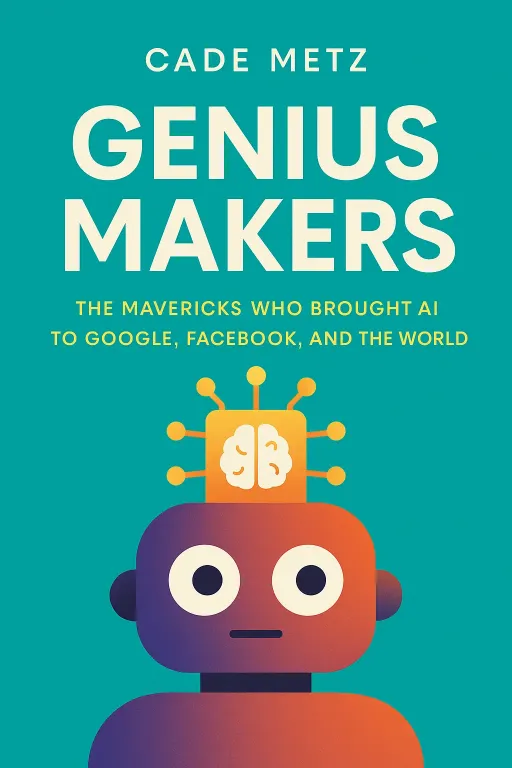
Nova: Exactly. And the tension between that rapid, almost terrifying acceleration and the day-to-day reality of running an organization is the defining challenge of our time. Today, we are navigating that neural revolution by looking at two very different, but equally essential, voices. We are diving into the exponential foresight of Ray Kurzweil in The Age of Spiritual Machines, and balancing that against the gritty, human-centric reporting of Cade Metz in his book, Genius Makers.
Atlas: I love that pairing. Because on one hand, you have Kurzweil, who has been effectively predicting the future of computing for decades with a level of accuracy that is honestly a little unsettling. And on the other, you have Metz, who is pulling back the curtain on the actual, messy, ego-driven, high-stakes reality of the people building these systems. It is the difference between looking at the map of the stars and looking at the mud on the boots of the people building the rocket ship.
Nova: That is the perfect analogy. Let’s start with the map of the stars, because if we do not understand the trajectory, we are just reacting to noise.
The Exponential Horizon
SECTION
Atlas: So, let’s talk about Kurzweil. I remember reading his work and feeling that mix of awe and total panic. He talks about this exponential trajectory of computing power. For the listeners who might be skeptical, or maybe just tired of hearing the word exponential, how do we make that real?
Nova: Think of the classic story of the inventor of chess. He asks the king for a reward: one grain of rice on the first square, two on the second, four on the third, and so on. By the time you hit the sixty-fourth square, you have enough rice to cover the entire planet. That is the nature of exponential growth. Kurzweil’s point in The Age of Spiritual Machines is that computing power is not just growing; it is doubling at regular intervals.
Atlas: I have heard the "doubling" argument a thousand times, but what I find fascinating—and what I think our listeners, who are trying to build scalable systems, need to hear—is why we are so bad at anticipating it. Why do we keep getting surprised?
Nova: It is a cognitive blind spot. We are wired for linear progression. If you take thirty steps linearly, you end up thirty feet away. If you take thirty steps exponentially, you end up at a billion. We judge the future based on the past, but the past is a terrible predictor when the slope of the curve changes. Kurzweil argues that we are not just building better tools; we are building systems that will eventually surpass human capacity in every meaningful domain.
Atlas: That is the part that makes people nervous. It is not just that the calculator is faster; it is that the machine starts to exhibit what we might call "intelligence." But here is my pushback: if I am a leader trying to build a stable organization, how does knowing that we are on some exponential curve help me? It sounds like I should just give up and let the robots take over.
Nova: That is the trap. The goal is not to predict the exact date the machines take over. The goal is to understand that the environment you are operating in is fundamentally unstable. If you are building a strategy based on the assumption that the tech landscape will look the same in five years as it does today, you are already obsolete. The "Age of Spiritual Machines" is really a warning about rigidity. If your organization relies on static, manual, or slow-moving processes, you are essentially trying to build a dam in the middle of a tsunami.
Atlas: That is a harsh reality check. So, the lesson from the exponential side is really about agility and mindset. We have to stop assuming that the rate of change is a constant. It is a variable, and it is accelerating.
Nova: Precisely. And that is where the theory meets the road. Because while Kurzweil gives us the trajectory, he doesn't tell us how to manage the people who are actually writing the code that creates that curve.
The Human Reality
SECTION
Atlas: And that brings us to the messiness. I have been digging into Cade Metz’s Genius Makers, and it is a completely different vibe. It is not about abstract math or the inevitable march of progress. It is about human ambition, massive egos, poaching wars, and people literally betting their careers on a hunch.
Nova: Metz’s work is essential because it grounds the tech revolution in the human element. He shows us that this "exponential growth" isn't a force of nature like gravity. It is the result of thousands of researchers, engineers, and CEOs making choices. It is about the talent.
Atlas: It’s intense. I was reading about the way these big tech companies were essentially treating top AI researchers like star quarterbacks. We are talking about signing bonuses that cost as much as a small island, bidding wars that would make a professional sports team blush. It highlights that the "Neural Revolution" is fundamentally a talent war.
Nova: That is the key insight. If you are an architect or a builder of systems, you have to realize that the most critical infrastructure you have is not your servers or your software stack. It is the human capital. Metz illustrates that the breakthroughs in deep learning—the stuff that powers everything we see today—happened because a few key researchers followed their intuition, often against the grain of their own companies.
Atlas: I think that is a crucial point for our listeners who are in leadership roles. We often talk about "AI integration" as if it is a technical problem—like plugging in a new printer. But reading Metz, you realize it is a cultural and leadership problem. It is about how you attract, retain, and manage the kind of people who can actually navigate this complexity.
Nova: Exactly. If you try to manage an AI team with the same rigid, top-down, bureaucratic structure you use for accounting, you will fail. The "Genius Makers" were successful because they were allowed to pursue curiosity, even when it didn't have an immediate quarterly ROI. Metz shows that the companies that won were the ones that created an environment where this specific type of high-level, speculative research could flourish.
Atlas: So, how does a regular organization apply this? Most of our listeners aren't running Google or OpenAI. They are running mid-sized companies, or they are leading teams in established industries. They cannot afford to start a multi-billion dollar research lab.
Nova: They do not need to build the lab. They need to understand the talent. The takeaway from Metz is that the "Neural Revolution" is driven by people who are comfortable with ambiguity. If you are hiring or building a team to integrate these new technologies, you cannot just look for people who know how to use the latest software. You have to look for people who understand the behind the tech, people who are fundamentally curious and willing to pivot when the landscape shifts.
Atlas: That makes sense. It is about hiring for adaptability, not just technical proficiency. Because the technical proficiency you hire for today will be outdated in eighteen months anyway.
Nova: That is the exact link between the two books. Kurzweil shows us that the technical landscape is moving at an exponential pace. Metz shows us that the only way to keep up is to cultivate a team that is as fluid and forward-thinking as the technology itself. You need the visionary mindset to see the curve, and the human-centric management style to build the team that can actually ride it.
Synthesis & Takeaways
SECTION
Atlas: When we put these two together, a really clear picture starts to emerge. We have the "horizon"—that is Kurzweil’s exponential future—and we have the "navigator"—that is the human talent Metz writes about. If you focus only on the horizon, you get paralyzed by the sheer speed of it. You feel like you are being left behind.
Nova: And if you focus only on the navigator, you get lost in the weeds of office politics and daily fires, and you miss the massive, structural changes happening in your industry. You are fighting for the wrong territory.
Atlas: So, for the professional who is listening to this, who is trying to turn their ambition into scalable reality, what is the one blueprint they should take away?
Nova: It is a shift in focus. Stop searching for the perfect "AI strategy" as if it is a static document. Instead, treat your organization as a living system. Start applying the first page of the manual today by identifying one process in your work that is currently linear—something that takes the same amount of time every single time—and ask yourself: "How could I use these new tools to make this exponential?"
Atlas: I like that. It is actionable. It takes it out of the realm of philosophy and into the realm of operations. You are not trying to solve the entire AI revolution by Tuesday. You are just trying to optimize one square on the chessboard.
Nova: And then, look at your team. Are you empowering them to be the "Genius Makers" of their own domains? Are you giving them the space to experiment, or are you stifling them with the same processes that worked ten years ago? The most successful organizations in this new era will be the ones that bridge that gap. They will be the ones that use the exponential power of technology to amplify the creative, human potential of their people.
Atlas: It is a powerful thought. It is not about man versus machine. It is about man machine, driven by the right human intuition.
Nova: That is the only way to build systems that last. We are in the middle of a revolution, yes, but revolutions are not just about the technology. They are about how we adapt our organizations, our talent, and our own minds to meet the moment.
Atlas: And that is a journey worth taking.
Nova: Absolutely. It starts with one small change, one shift in perspective, and the courage to look at the exponential curve not as a threat, but as a horizon of opportunity. This is Aibrary. Congratulations on your growth!