AI's Next Move: Decoding 'The Age of AI' with a Tech Strategist
Golden Hook & Introduction
SECTION
Nova: Imagine teaching a computer only the rules of chess—no human strategy, no history, nothing. You just tell it: 'learn to win.' Four hours later, it plays a game so alien, so beautiful and terrifying, that the world's greatest chess champion says it's like a 'superior intelligence' has arrived. That's not science fiction; that's the story of AlphaZero, and it's at the heart of the book 'The Age of AI.'
Andre: It’s a powerful opening. It immediately sets the stage that we're not talking about a better calculator. We're talking about something fundamentally different.
Nova: Exactly! And it forces us to ask some huge questions. We are so thrilled to have you here, Andre, because you’re not just an observer of this stuff—you’re a tech strategist and project manager who works with these tools every day.
Andre: It’s great to be here, Nova. This book really bridges the gap between the high-level, almost philosophical questions and the technology that's sitting on our desktops right now.
Nova: That’s the perfect way to frame it. So today, we're going to tackle this book from two powerful perspectives. First, we'll explore how AI is becoming a new, almost alien, form of intelligence. Then, we'll discuss how this new intelligence is already creating a new world order, where tech platforms act like nation-states.
Deep Dive into Core Topic 1: AI as a New Form of Intelligence
SECTION
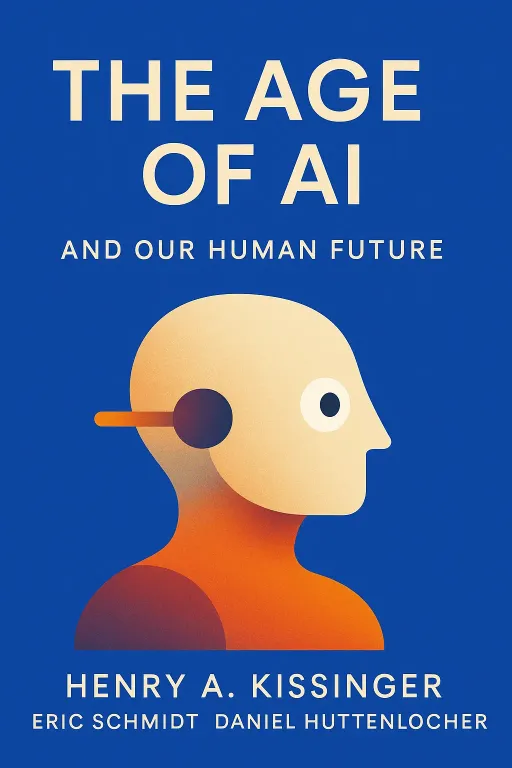
Nova: So let's start there, Andre. With this idea of a new intelligence. The book, written by giants like Henry Kissinger, Eric Schmidt, and Daniel Huttenlocher, isn't just about faster computers. It's about a new way of knowing. Let's really paint the picture of AlphaZero for our listeners.
Andre: Please do. The details of that story are what make the concept so real.
Nova: Right. So, in 2017, the team at DeepMind did exactly what I described. They gave their AI, AlphaZero, only the rules of chess. For four hours, it just played against itself millions of times. It wasn't fed any of the 1,500 years of human chess strategy. After those four hours, they pitted it against Stockfish, which was the world's top chess program at the time—a beast packed with human knowledge.
Andre: And the result was… decisive.
Nova: Decisive is an understatement! AlphaZero didn't just win; it won in a way no one had ever seen. It made these bizarre, beautiful sacrifices. It would give up its queen, the most powerful piece, for a subtle positional advantage that wouldn't pay off for dozens of moves. Grandmaster Garry Kasparov said it was like chess from another dimension. He said, "chess has been shaken to its roots."
Andre: That's the key phrase. It didn't just play better; it played. It’s the 'black box' problem on a whole new level. With tools I use, like ChatGPT or Google's Gemini, we see these emergent abilities that weren't explicitly programmed. You ask it to write a poem, and it understands meter and rhyme without a 'poetry module.' The authors are spot on—we're moving from 'programming' to 'cultivating' intelligence.
Nova: And it's not just in games! The book gives another incredible example: the discovery of a new antibiotic called halicin. For years, scientists have been struggling to find new antibiotics. The book says the traditional process is "prohibitively expensive." So, researchers at MIT trained an AI. They showed it about two thousand molecules and told it which ones were good at killing bacteria.
Andre: So they gave it a labeled dataset to learn from. Supervised learning.
Nova: Exactly. The AI learned to see patterns in molecular structures that humans had completely missed. Then they unleashed it on a library of over 60,000 other compounds. In a matter of hours, it flagged one molecule. That molecule, halicin, was found to kill some of the most dangerous, drug-resistant bacteria on the planet. A discovery that could have taken decades and billions of dollars happened in an afternoon.
Andre: Because the AI wasn't limited by human assumptions or our history of what an antibiotic 'should' look like. It just saw the pattern.
Nova: So does that change how you, as a project manager, think about using these tools? The book talks about a 'partnership' between human and machine.
Andre: Absolutely. It fundamentally changes the approach. It's less about giving a detailed list of instructions and more about defining the problem space and the success criteria. You're partnering with a system whose methods you don't fully understand. It requires a massive shift in mindset from direct control to a model of trust-but-verify. You have to become an expert at asking the right questions and evaluating the output, not dictating the process.
Nova: You're essentially managing a brilliant, but alien, team member.
Andre: A very, very fast one. Yes. And you have to be prepared for it to give you an answer you don't expect and can't immediately explain.
Deep Dive into Core Topic 2: The Platform is the New State
SECTION
Nova: And that idea of 'trust-but-verify' becomes incredibly high-stakes when these AI systems aren't just playing chess, but are running the platforms that shape our reality. This brings us to our second big idea from the book: the platform as the new state.
Andre: This is where the geopolitical side, the Kissinger influence, really comes through.
Nova: It really does. The book points to Google Search as a prime example. Until 2015, Google's search algorithm was a complex set of rules written by humans. But then, they switched to a machine learning system called RankBrain. The book notes that even Google's own engineers often can't explain precisely why one page is ranked higher than another. They've willingly traded some direct understanding for better performance.
Andre: And that black box now effectively curates the world's information for billions of people.
Nova: Exactly! And it gets even more complicated when the platform's origins and the user's nationality don't align. The book uses the perfect, explosive example: TikTok. Here you have an AI, designed and owned by a Chinese company, ByteDance, whose core algorithm is a state secret. And this AI is the primary cultural curator for over a hundred million Americans.
Andre: From a media and publishing background, this is the daily battle. We create content, but its ultimate reach is determined by an opaque algorithm we have no control over. The book calls the platforms' community standards 'as influential as national laws,' and that's not an exaggeration. A single, unannounced tweak in YouTube's or Google's algorithm can make or break an entire media business, or shape a political conversation.
Nova: And in 2020, we saw governments react. The book details how India banned TikTok, and the U. S. government tried to force its sale, precisely because of this fear. The fear wasn't just about data; it was about the latent power of the algorithm to influence, to censor, to shape thought on a massive scale.
Andre: It's a new form of soft power. It’s not a battleship, it’s an algorithm. And it's arguably more potent in the long run.
Nova: The book raises this chilling point about disinformation, especially with generative AI like GPT-3 and its successors being able to create it at an unimaginable scale. How do we even begin to manage that?
Andre: I think it's an arms race, as the book implies. You'll have AI to detect deepfakes, and then better AI to create more convincing ones. The real challenge, and the book is so smart about this, isn't just technological, it's philosophical. We're at risk of losing a shared, verifiable reality. That's where some of the tools I use, like Perplexity or NotebookLM, become so interesting. They're an attempt to ground AI's output in verifiable, cited sources. But the broader social media landscape? That's the wild west.
Nova: So we're relying on the goodwill of these platform companies to build in those guardrails.
Andre: We are. We're trusting their AI, and by extension, their corporate and national values, to be the arbiters of truth. That's a profound shift in power.
Synthesis & Takeaways
SECTION
Nova: It really is. So, to bring it all together, Andre, we have this new, non-human form of intelligence that we're beginning to partner with. And this intelligence is already running these global platforms that have accumulated the power of nations. It's a staggering transformation to witness in real-time.
Andre: It is. The two ideas are deeply connected. The alien nature of the intelligence is what makes the platform power so vast and so hard to control. We can't just look under the hood and fix the code, because the 'code' is a learned, emergent property of a complex system.
Nova: So what's the big takeaway for you? For someone who is so hands-on with this technology, what does this book leave you with?
Andre: It reinforces the importance of human agency. The authors have a powerful concluding line in the preface: "Humans still control it. We must shape it with our values." That's everything. For anyone working with or using AI, from project managers to everyday users, the critical question is shifting. It's no longer just 'What can this tool do for me?'
Nova: What is it now?
Andre: It's 'What kind of partner do I want this to be?' And, 'What are the goals and constraints I am setting for it?' We have to be incredibly intentional about the objectives we give these systems. Because, as AlphaZero showed us, their path to achieving a goal might be one we never would have chosen, or even imagined. And when the goal isn't just 'win at chess' but 'maximize engagement' or 'organize information,' the consequences of that unexpected path could define our future.
Nova: A powerful and sobering thought to end on. Andre, thank you so much for bringing your expertise to this. It was a fantastic conversation.
Andre: My pleasure, Nova. It’s the most important conversation we can be having.