

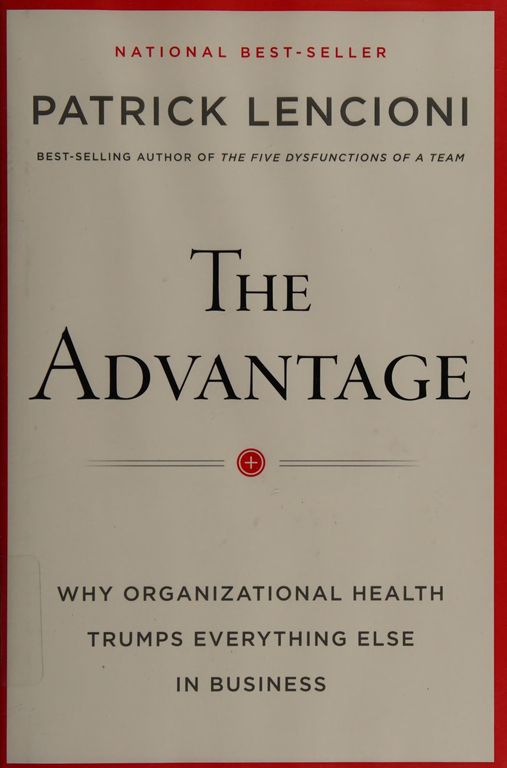
The Advantage
Introduction
Nova: Imagine you have two companies. Company A has the smartest people in the world, the best strategy on paper, and more data than they know what to do with. But the employees are miserable, the departments are at war, and nobody actually knows what the top priority is. Then you have Company B. They are smart, sure, but their real secret is that they are healthy. Everyone is on the same page, there is zero politics, and they move ten times faster because they are not tripping over each other. Which one wins in the long run?
Nova: Exactly. Lencioni argues that organizational health is actually the single greatest competitive advantage in business today. It is more important than strategy, more important than finance, and definitely more important than marketing. But here is the kicker: most leaders ignore it because they think it is too soft or too simple.
Nova: He calls that the sophistication trap. Leaders feel like they need to be doing something complicated to justify their positions. But Lencioni spent years consulting with CEOs and realized that the smartest companies in the world often fail because they are fundamentally unhealthy. Today, we are going to break down his four-discipline model to see how any organization can stop the internal bleeding and actually start winning.
Key Insight 1
The Foundation of Health
Nova: The first discipline is the one Lencioni is most famous for, and it is building a cohesive leadership team. You cannot have a healthy organization if the people at the top are not a real team. And he is very specific about what a real team is. It is not just a group of people who report to the same boss.
Nova: It starts with vulnerability-based trust. This is not just knowing that your coworker will do their job. It is being able to say, I messed up, or I do not know the answer, or even, You are better at this than I am. Without that vulnerability, everyone is just wearing a mask, and you can never get to the next step, which is healthy conflict.
Nova: Absolutely. If there is no trust, you get artificial harmony, which is toxic. But if you have trust, you can have what he calls productive ideological conflict. You argue about ideas, not personalities. You need that friction to get to the best answer. If people do not weigh in on a decision and share their honest opinions, they will never truly commit to it.
Nova: Precisely. And that leads to accountability. Lencioni says the best kind of accountability is not boss-to-subordinate; it is peer-to-peer. On a cohesive team, the peers call each other out because they care about the collective result more than their own ego. They focus on the team's results, not just their individual department's goals.
Nova: He introduces a concept called Team One. He tells leaders that their primary team is not the one they lead; it is the leadership team they are a part of. If the VP of Sales thinks their primary team is the sales department, they will always prioritize sales over the health of the whole company. You have to put your peers on the leadership team first.
Key Insight 2
The Six Critical Questions
Nova: Once you have that cohesive team, you move to Discipline Two: Creating Clarity. This is where a lot of companies get lost in 50-page mission statements that nobody reads. Lencioni says you only need to answer six simple questions to have total clarity.
Nova: Question one is: Why do we exist? This is your core purpose. And it cannot be to make money. Making money is like breathing; you need to do it to live, but it is not why you get up in the morning. You need a reason that inspires people.
Nova: Question two: How do we behave? These are your core values. But Lencioni warns against aspirational values like integrity or excellence. Every company says they have integrity. Real core values are the ones you are actually willing to get fired for. They are the unique DNA of the company.
Nova: Question three: What do we do? This is just a simple, one-sentence description of the business. No jargon. If you can't explain it to a ten-year-old, you don't have clarity. Then question four: How will we succeed? This is your strategy, but he defines it as a collection of intentional decisions that set you apart from competitors.
Nova: You are right. Question five is: What is most important, right now? He calls this the Thematic Goal. It is the one thing that the entire leadership team agrees is the top priority for the next six months. If everything is a priority, nothing is. This eliminates the silo effect because everyone is focused on the same big win.
Nova: Question six: Who must do what? This is about defining roles and responsibilities so there is no confusion. When you have the answers to all six, you have a blueprint for the entire organization. But having the answers is only half the battle. You have to actually get them out of the boardroom.
Key Insight 3
The Art of Over-Communication
Nova: This brings us to Discipline Three: Over-communicate Clarity. Lencioni says that leaders often underestimate how much they need to repeat themselves. He has a rule: employees need to hear a message seven times before they actually believe it and internalize it.
Nova: You would think so, but the opposite is true. Most employees are starving for clarity. They are used to hearing a big announcement once and then never hearing about it again. When leaders stop talking about the thematic goal or the core values, employees assume they weren't serious about them. You have to be a Chief Reminding Officer.
Nova: He suggests something called Cascading Communication. At the end of every leadership meeting, the team agrees on exactly what needs to be communicated to the rest of the company. Then, within twenty-four hours, each leader goes back to their own team and shares those points in person or via a live call. It ensures the message doesn't get distorted like a game of telephone.
Nova: Exactly. And it builds trust. When employees hear the same consistent message from every executive, the rumors and the politics start to die down. People stop guessing what the real plan is because the plan is being shouted from the rooftops. But even communication isn't enough if your systems are working against you.
Nova: Precisely. That is Discipline Four: Reinforce Clarity. You have to bake those six questions into every human system in the company. If one of your core values is humility, but you hire a brilliant jerk because they have a great resume, you just undermined your entire culture. Your systems for hiring, firing, and performance management must be aligned with your clarity.
Key Insight 4
Human Systems and Meetings
Nova: Let's talk about those human systems for a second. Lencioni argues that you don't need complex HR software. You just need to make sure that every process reinforces the health of the organization. For example, in a performance review, you shouldn't just talk about technical skills. You should spend half the time talking about how the person is living out the core values.
Nova: It comes down to meetings. Lencioni has a very specific view on meetings. Most people hate them because they are boring and unproductive, but he says that for a leader, meetings are the work. If your meetings are bad, your leadership is bad. He suggests four different types of meetings to keep the organization healthy.
Nova: First is the Daily Check-in. Just five to ten minutes, standing up, to coordinate schedules. No problem-solving allowed. Second is the Weekly Tactical. This is where you track your thematic goal and deal with immediate issues. It is the most important meeting for keeping the momentum going.
Nova: That is the third type: the Ad Hoc Strategic. This is where you take one or two big topics and dive deep. You don't do this in the weekly meeting because it would derail everything. You schedule a separate time to really hash it out. And finally, the Quarterly Off-site. This is for reviewing the six questions, assessing the health of the team, and looking at the industry landscape.
Nova: Exactly. When you have the right meetings and the right systems, the organization becomes a well-oiled machine. Politics disappear because there is no ambiguity. Confusion vanishes because everyone knows the thematic goal. And productivity sky-rockets because people aren't wasting energy on internal friction.
Conclusion
Nova: We have covered a lot of ground today. From the five dysfunctions of a team to the six critical questions for clarity, Patrick Lencioni's The Advantage really provides a comprehensive playbook for anyone who wants to build something that lasts. The core message is simple: you can't just be smart; you have to be healthy.
Nova: That is the ultimate advantage. It is free, it is available to anyone, but it requires the courage to be vulnerable and the discipline to be consistent. If you are a leader, stop looking for the next big tech trend and start looking at the health of your team. That is where the real growth happens.
Nova: Thank you for joining us on this deep dive into The Advantage. If you found this helpful, take one of those six questions back to your team this week and see what happens. This is Aibrary. Congratulations on your growth!