The Agile Professional Portfolio
Golden Hook & Introduction
SECTION
Nova: The career ladder is a broken metaphor. It implies that if you just climb high enough, you reach a stable platform where you can finally stop moving. But the reality is that the higher you climb, the faster the floor beneath you is shifting.
Atlas: That is a terrifying image, but unfortunately, it feels accurate. We are all essentially standing on a moving walkway that keeps speeding up, and we are trying to do math while balancing on a unicycle.
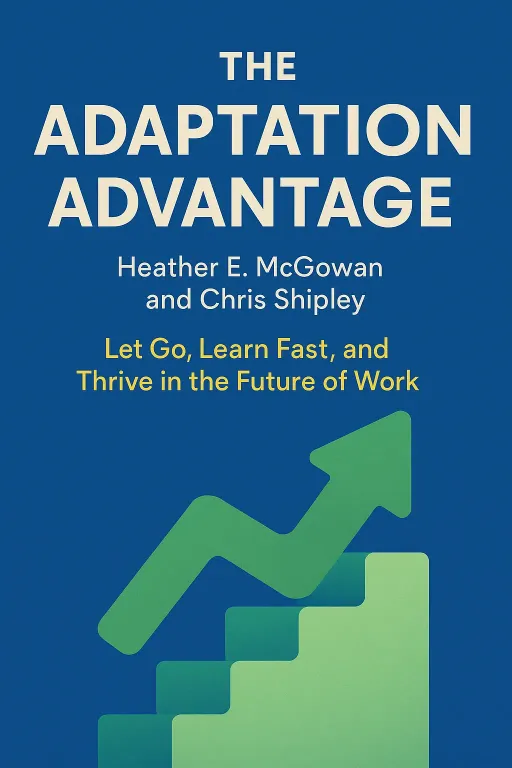
Nova: Exactly. And that feeling of instability isn't a bug in the system; it is the feature of the modern professional landscape. Today, we are looking at two essential works that dissect this phenomenon. We are diving into The Adaptation Advantage by Heather E. McGowan and Chris Shipley, and we are pairing that with The Rules of Adaptability by Max McKeown.
Atlas: I have heard these titles floating around in every leadership seminar for years. McGowan and Shipley are well known for basically telling us that the industrial age blueprint for a career is dead. And McKeown is the guy who treats adaptability like a hard science, right?
Nova: You nailed it. McGowan and Shipley approach this from the perspective of the human element—the psychological friction of unlearning. McKeown is more of a strategist, focusing on the structured mechanics of recognizing shifts and executing corrections. Together, they provide a roadmap for the modern professional who wants to stop just surviving the churn and start using it as an engine for growth.
Atlas: I am ready to dig into this. I think a lot of our listeners are tired of hearing the word adaptability thrown around as a vague corporate buzzword. They want to know what it actually looks like on a Tuesday morning when your industry is pivoting and you feel like your skills are depreciating by the hour. Let’s break down why the ladder is a lie and what we are supposed to be doing instead.
The Death of the Ladder and the Cycle of Unlearning
SECTION
Nova: Let us start with that first big shift. McGowan and Shipley argue that we are moving from a linear career path to a continuous cycle. In the old world, you went to school, learned a trade, and applied that trade for forty years. You were an expert because your knowledge had a long shelf life. Today, the half-life of a learned skill is shorter than ever.
Atlas: I can see that in my own circle. I know developers who learned a coding language ten years ago that is now essentially a relic. They spent years mastering it, and now they are in this weird position where they have to essentially reset their status to beginner. That is a massive ego hit.
Nova: That is the crux of the issue. The Adaptation Advantage is not just about learning new tech; it is about the emotional labor of unlearning. The authors highlight that our identity is often tied to what we know. When you have to unlearn something, you are not just shedding information; you are shedding a version of yourself that felt competent and secure.
Atlas: That makes me think about the psychological barrier here. Most people avoid upskilling not because they are lazy, but because they are afraid of being bad at something again. We spend our twenties and thirties getting good at things so we can be respected. The idea of going back to being the person in the room who does not know the answer is painful.
Nova: It is painful, but it is also the only way to stay relevant. McGowan and Shipley suggest that we need to stop viewing our careers as a collection of static achievements and start viewing them as a portfolio of experiences. Think of it like a venture capitalist managing a portfolio. You do not bet everything on one company. You keep the portfolio diverse, you prune the underperforming assets, and you invest in new ideas.
Atlas: That is a great analogy. I imagine a lot of our listeners who are in leadership roles feel this pressure. They have built their reputation on knowing exactly how the machine works. If the machine changes entirely, their reputation feels like it is on the line.
Nova: And that is where the danger lies. If you define yourself by your current expertise, you become fragile. If you define yourself by your capacity to learn, you become antifragile. The authors emphasize that the goal is not to be the smartest person in the room. The goal is to be the most curious person in the room, because curiosity is the only thing that leads to the unlearning required for the next phase.
Atlas: I have been thinking about how this plays out in a high-pressure team environment. If I am a lead, and I admit I don't know how to use the new AI tools we are integrating, does that erode trust, or does it build it?
Nova: The research suggests it builds it, provided you frame it correctly. If you try to fake it, your team will see right through you. If you model the behavior of a learner, you give them permission to do the same. This is where the shift happens. You are not a static leader; you are a facilitator of growth.
Atlas: That is such a vital distinction. It is not about knowing the answers; it is about building the environment where the answers can be found. But let us push this further. If we accept that the ladder is gone and we are in this cycle, how do we actually manage the speed of it? Because the pace of change feels like it is accelerating, not slowing down.
The Rules of Adaptability and Strategic Execution
SECTION
Nova: That is exactly where Max McKeown’s work, The Rules of Adaptability, becomes essential. If McGowan and Shipley give us the mindset—the acceptance of the cycle—McKeown gives us the radar. He argues that adaptability is not a personality trait; it is a discipline. You do not just wait for the market to force you to change. You build systems to detect the change before it becomes an emergency.
Atlas: I appreciate that framing. I have met people who pride themselves on being "adaptable," which usually just means they are reactive. They wait until the ship is sinking and then scramble to find a life raft. That is not adaptability; that is crisis management.
Nova: Spot on. McKeown talks about recognizing shifts. It is about looking at the periphery. What are the signals that you are ignoring because they are inconvenient? Maybe it is a new competitor using a different business model, or a shift in consumer behavior that seems small today but will be massive in three years.
Atlas: How do we actually do that? I am busy. I have deliverables. I do not have time to be a market analyst on top of my day job.
Nova: You do not need to be a full-time analyst. It is about creating a habit of observation. McKeown suggests structured rules for executing corrections. One of the most effective strategies is the "pre-mortem." Before you launch a project or even before you commit to a long-term goal, you ask: If this failed in a year, why would it have failed?
Atlas: Oh, I love that. It forces you to look for the cracks in the foundation while you are still laying the bricks. It turns the anxiety of "what if" into a strategic exercise.
Nova: Exactly. And it ties back to the idea of the agile portfolio. When you do a pre-mortem, you are essentially stress-testing your current strategy. If you identify a high probability of failure because of, say, a technological shift, you have now identified the exact area where you need to start your unlearning process. You are no longer waiting for the crisis; you are preempting it.
Atlas: That makes the whole "adaptability" concept feel much less overwhelming. It is not about changing everything at once. It is about small, deliberate course corrections.
Nova: Right. McKeown emphasizes that massive, sudden changes are usually a sign of failure to adapt gradually. The most successful professionals are the ones who make tiny, iterative adjustments. It is the difference between steering a ship by small degrees versus slamming the rudder hard to avoid an iceberg.
Atlas: I think that is the key for a lot of people. We associate "pivot" with "panic." We think it means quitting your job and moving to a farm. But it could just mean shifting your focus by ten percent this quarter to learn a new tool or explore a new market segment.
Nova: And that is the bridge between the two books. McGowan and Shipley give you the permission to pivot—to let go of the old identity. McKeown gives you the methodology to steer. It is a powerful combination.
The Practical Audit and Synthesis
SECTION
Atlas: So, let’s get into the weeds. We have covered the theory of the cycle and the mechanics of the radar. But for someone listening who is sitting at their desk, feeling the pressure of their industry changing, what is the first step? How do they stop the paralysis and start the process?
Nova: The takeaway is actually quite simple, and it comes from the idea of the "Tiny Step." Audit your current skill set today. Do not look at your resume and think about what you want to be in five years. Look at what you are doing right now and identify one technical or soft skill that is rapidly changing.
Atlas: Just one?
Nova: Just one. If you try to overhaul your entire skill set, you will burn out. Pick one thing. Maybe it is a new software, maybe it is a shift in how your team communicates, maybe it is a change in the regulatory environment of your industry. Identify that one thing, and schedule thirty minutes this week to research its latest developments.
Atlas: I love that. It takes the pressure off. Thirty minutes is nothing. Anyone can find thirty minutes. But what do you do in that thirty minutes? Do you just read a blog post?
Nova: You go deeper. You look for the "why" and the "how." If it is a new tool, don’t just read the manual. Read the critique of the tool. Read what people are saying about its limitations. That is where the real insight lives. You want to understand the trajectory, not just the current state.
Atlas: That is a great point. It moves you from a passive consumer of information to an active evaluator. You are not just learning the tool; you are learning how to judge the tool.
Nova: And that is the ultimate competitive advantage. In a world where AI can do the rote tasks, the human value is in the judgment, the synthesis, and the strategic direction. That is the "Strategic Visionary" mindset we want to cultivate. You are not just a cog in the machine; you are the architect of your own relevance.
Atlas: This has been incredibly grounding. I feel like we started this conversation talking about the instability of the modern career, and we ended on a note of empowerment. It is not about the ladder anymore. It is about the portfolio.
Nova: And that portfolio is entirely within your control. You are enough, and your potential is not a race. It is a journey. Every thirty-minute audit, every small course correction, is an investment in that portfolio.
Atlas: That is a perfect place to land. For everyone listening, take that thirty minutes this week. Don't let the fear of the "new" stop you from building the "next."
Nova: It has been a pleasure diving into these ideas with you, Atlas. The future belongs to the learners.
Atlas: And the adaptable. Thanks for listening, everyone.
Nova: This is Aibrary. Congratulations on your growth!