The Agile Professional Playbook
Golden Hook & Introduction
SECTION
Nova: The five-year career plan is essentially a fairy tale we tell ourselves to sleep better at night.
Atlas: That is a brutal way to start, Nova. But, honestly, I think you are right. We spend so much energy building these elaborate roadmaps, and then the world shifts underneath us, and suddenly that map is just a piece of paper for a territory that doesn't exist anymore.
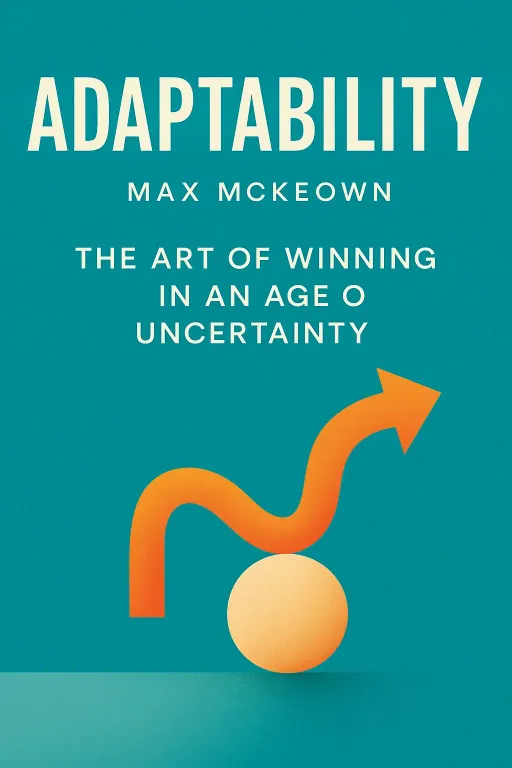
Nova: Exactly. We are talking about the core tension between static planning and fluid reality. Today, we are pulling insights from two heavy-hitting perspectives. First, Max McKeown’s work in The Rules of Adaptability, which argues that adaptability isn't just a soft skill, it is the ultimate competitive advantage. And we are balancing that against The Adaptation Advantage by Heather E. McGowan and Chris Shipley, who break down how AI is forcing us to stop defining ourselves by our job titles and start defining ourselves by our ability to evolve.
Atlas: So, we are moving from being planners to being navigators. I am ready to dig into this, because for anyone who loves efficiency, the idea of throwing away a rigid plan feels like chaos, but I suspect it is actually the key to staying relevant.
The Illusion of Static Planning
SECTION
Nova: It is not about abandoning structure, Atlas. It is about abandoning the illusion that the future is predictable. McKeown makes a really compelling point. He suggests that people who rely on static planning are essentially setting themselves up for failure because they are optimizing for a version of the world that has already passed.
Atlas: Wait, hold on. I need to push back on that slightly. If I am an architect, or a developer, or a project manager, I need to plan. If I do not plan, I am just reacting to fires all day. Are you saying we should stop planning altogether?
Nova: Not at all. Think of it like this. A static plan is like a paper map. It is great if the terrain never changes. But the modern professional landscape is more like a GPS system. A GPS doesn't tell you to drive in a straight line regardless of the road conditions. It constantly recalculates based on traffic, accidents, and road closures. The goal—the destination—stays the same, but the route is in constant flux.
Atlas: That makes sense. So, the efficiency seeker’s trap here is that we get so attached to the route we mapped out that we refuse to take the detour, even when the detour is clearly faster.
Nova: Precisely. The people who outperform are the ones who treat their strategy as a living document. They are constantly auditing their environment. They ask themselves, what has changed this week that makes my previous assumptions invalid? It is a shift from efficiency of execution to efficiency of adaptation.
Atlas: I like that distinction. Efficiency of execution is doing the task right. Efficiency of adaptation is doing the right task, even when the task list changes. But how do you do that without getting whiplash? I imagine most of our listeners feel like they are already running at full speed. How do you pivot without just burning out?
Nova: You build in the pivot time. It is an intentional pause. If you are constantly running, you never see the cliff until you are falling off it. The most adaptable professionals I have studied treat their weekly review not as a chore, but as a strategic reconnaissance mission. They look at the external signals, not just their internal to-do list.
The Human-Centric Pivot
SECTION
Atlas: That leads me to the other side of this, which is the fear factor. Everyone is talking about automation. Everyone is worried that their specific technical role is going to be swallowed up by AI. Does this adaptability mindset actually protect you, or is it just a nice way of saying we are all replaceable?
Nova: That is the big question. McGowan and Shipley address this directly in The Adaptation Advantage. They argue that if your value is tied solely to a static skill set—like knowing how to code in a specific legacy language or perform a very narrow, repetitive administrative task—then yes, you are vulnerable. But that is because you have defined your value as a function, not as a human capability.
Atlas: Okay, break that down for me. What is the difference between a function and a human capability?
Nova: A function is something a machine can learn to do better than you. It is predictable, repetitive, and data-driven. A human capability is what happens at the intersection of complex problem solving, empathy, and synthesis. It is the ability to look at a system, understand the human motivations behind it, and then apply technical knowledge to solve the underlying problem.
Atlas: So, it is about moving up the stack. Instead of being the person who writes the code, you become the person who designs the system that solves the human problem, which happens to be implemented by code.
Nova: Exactly. And the fascinating thing is that many professionals feel like they are "too technical" to do that. They think, I am an engineer, I don't do "human-centric" stuff. But the smartest architects and developers I know are the ones who understand that the technical solution is useless if it doesn't fit the human context.
Atlas: I have seen this in my own work. You can build the most elegant, efficient software in the world, but if the end-user finds it unintuitive or if it doesn't solve their actual workflow bottleneck, nobody uses it. It’s technically perfect and functionally useless.
Nova: That is the perfect example. That is where the adaptability comes in. If you are only focused on the technical perfection, you are rigid. If you are focused on the outcome—the human experience—you are adaptable. You can change the code, you can change the UI, you can change the approach, because your goal is the solution, not the script.
The 15-Minute Audit
SECTION
Atlas: Okay, I am sold on the philosophy. But we know our listeners want the blueprint. They want to know exactly what to do on Monday morning. How do we turn this "adaptability" into a daily habit?
Nova: It starts with an audit. This is the tiny step that changes everything. You need to look at your current technical skill set, the things you do every day, and be brutally honest. Ask yourself, which of these skills is at risk of being automated or commoditized in the next three years?
Atlas: That is a tough exercise. It requires a lot of ego-management.
Nova: It does. But once you identify that vulnerable skill, you don't panic. You don't quit your job. You just dedicate 15 minutes a week to learning an adjacent, human-centric skill.
Atlas: 15 minutes? That seems... small. Is that enough?
Nova: It is the perfect amount of time for a start. If you try to overhaul your entire career in a day, you will fail. But 15 minutes a week? That is 13 hours a year of targeted growth in a new direction. Think about system design, or cross-functional communication, or storytelling with data. These are the skills that machines struggle to replicate.
Atlas: I see the strategy. It is about compounding interest. You are not trying to become an expert in a new field overnight. You are just building a bridge. You are taking your existing expertise and adding a layer of human-centric, high-level thinking on top of it.
Nova: Precisely. If you are a developer, spend those 15 minutes studying product management frameworks. If you are an accountant, study how to communicate financial data to non-finance stakeholders. You are essentially making yourself a hybrid professional. And hybrid professionals are the hardest ones to replace.
Atlas: I love that. It takes the pressure off. You are not abandoning your current identity; you are just upgrading the software.
Nova: That is exactly it. You are not changing who you are; you are expanding the scope of what you can do. The goal is to become a T-shaped professional. Deep expertise in your core area, but with a broad, adaptable understanding of how that fits into the wider human and business ecosystem.
Synthesis & Takeaways
SECTION
Atlas: We have covered a lot of ground here. We started by dismantling the myth of the five-year plan, talked about shifting from execution to navigation, and then dove into the necessity of upgrading our identity from functional worker to human-centric problem solver.
Nova: And the beauty of this is that it gives you back your agency. When you stop relying on a static plan and start relying on your own capacity to adapt, you stop being a victim of change and start being the driver of it.
Atlas: It is a shift from "Will my job survive?" to "How can I evolve my role to be more valuable than ever?" And that is a much more empowering place to be.
Nova: It really is. Remember, the world is moving faster than ever, but that just means there are more opportunities for those who are willing to pivot. Take that 15 minutes this week. Audit your skills. Pick one area to expand into. You will be surprised at how much momentum you can build with such a small, intentional investment.
Atlas: I am definitely going to do that audit. It is time to stop planning for a world that doesn't exist and start navigating the one we are actually living in.
Nova: That is the path forward. Keep questioning, keep auditing, and keep evolving. This is Aibrary. Congratulations on your growth!