Navigating the Future of Work with Agility
Golden Hook & Introduction
SECTION
Nova: Most of what you put on your resume today is likely already obsolete. It is a harsh reality, but it is the defining characteristic of our current professional landscape.
Atlas: That is a terrifying thought. I spent years building that resume, crafting the perfect bullet points, and climbing the ladder. If you are telling me that the ladder itself is being dismantled, I need to know what we are supposed to be climbing instead.
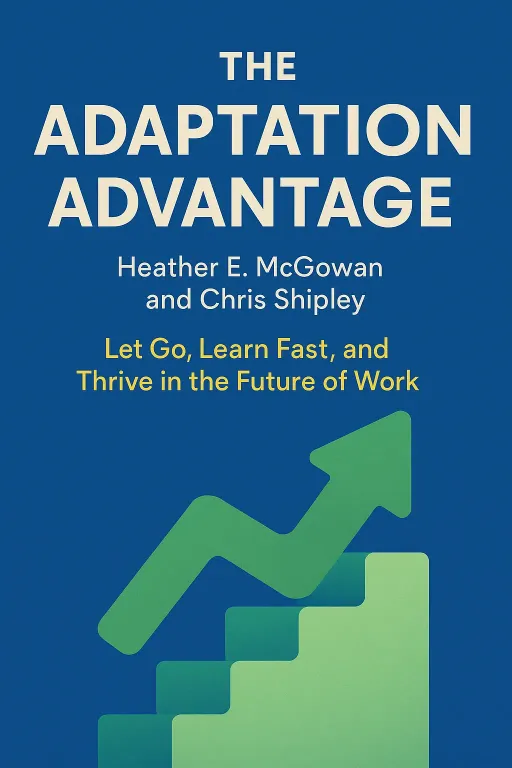
Nova: That is exactly the question we are tackling today. We are diving into The Adaptation Advantage by Heather E. McGowan and Chris Shipley. This book is a masterclass in navigating the Fourth Industrial Revolution. It moves past the traditional idea of a career as a linear climb and instead paints it as an ongoing, fluid process of evolution. Heather McGowan and Chris Shipley wrote this to address the massive shifts in how we live and work, essentially arguing that our ability to adapt is the only sustainable competitive advantage we have left.
Atlas: It is interesting that you mention the Fourth Industrial Revolution. We hear that term thrown around in boardrooms constantly, but it often feels like abstract jargon. When the authors talk about this, are they just referring to robots taking our jobs, or is it something more fundamental?
Nova: It is much deeper than just automation. Think of it as the blurring of lines between the physical, the digital, and the biological. McGowan and Shipley highlight that we are moving away from an era where efficiency was the primary goal. In the past, you were hired to be a cog in a machine, to perform a specific, repeatable task perfectly. Today, that machine can be programmed. The book suggests that the value of the human worker is shifting from productivity to adaptability.
Atlas: That makes sense, but it is a massive pivot for most people. We are conditioned from school age to specialize. We are told to pick a lane, become an expert, and stay there. If the authors are saying that specialization is a trap, they are essentially telling us to unlearn a lifetime of societal conditioning.
The Death of the Fixed Identity
SECTION
Nova: You have hit on the central tension of the book. The authors argue that we are suffering from a crisis of identity. We often define ourselves by our job titles. We say, I am an accountant, or I am a marketing manager. But the moment you define yourself by your output or your specific role, you become fragile. If the world changes and that role disappears, you feel as though you have disappeared with it.
Atlas: I can relate to that. When I introduce myself at a party, the first thing I say is my job title. It is the shorthand for who I am. If I stop being that thing, I have to figure out how to explain myself to the world. It is an existential crisis wrapped in a business card. How do they suggest we reframe that?
Nova: McGowan and Shipley propose moving toward what they call an adaptive identity. Instead of identifying as the thing you do, you identify as a learner. You are not a marketing manager; you are a person who solves problems through communication and strategy. When you detach your self-worth from the static role, you gain the freedom to pivot when the environment demands it.
Atlas: That sounds empowering, but I have to play devil’s advocate here. If I am just a generalist who is always learning, do I lose the ability to actually get things done? There is a certain comfort in having a deep, narrow expertise. Does the book suggest we throw away our skills in favor of being a jack-of-all-trades?
Nova: It is not about abandoning depth; it is about changing your relationship with that depth. You still need to be excellent at what you do, but you must treat your skills like software. You update them, you patch them, and eventually, you replace them. The authors point out that we often treat our skills like physical architecture—something built to last forever. They argue that we need to adopt a software mindset where obsolescence is a feature, not a bug.
Atlas: That is a sharp analogy. I have seen so many people hit a wall because they refused to update their professional operating system. They keep trying to run 2024 problems with 1999 software. But how do we actually make that shift? Is it just a matter of reading more books, or is there a structural way to build this into our lives?
Nova: It starts with curiosity. The authors emphasize that the agile learning mindset is fueled by a desire to understand, not just a desire to perform. They discuss the concept of unlearning, which is perhaps the hardest part. You have to actively identify the mental models that served you in the past but are now holding you back. It is like clearing out the closet before you can buy new clothes. You cannot fit new, adaptive strategies into a mind that is already cluttered with outdated assumptions about how success is supposed to look.
Atlas: Unlearning feels painful, though. It is like admitting you were wrong for a decade. How do we make that process less ego-bruising?
The Art of Unlearning and Human Capabilities
SECTION
Nova: That is the crux of the emotional work involved. McGowan and Shipley touch on this by highlighting that resilience is not just about bouncing back; it is about moving forward. To do that, you have to embrace the discomfort of being a beginner again. Think about the most successful people you know. They are often the ones who are most comfortable asking questions that might make them look uninformed. They have replaced the need to be right with the need to be effective.
Atlas: I think that is a lesson for anyone, regardless of their industry. I imagine a lot of our listeners are thinking about the rise of artificial intelligence and how that changes the equation. If we are talking about being adaptive, does the book give us a roadmap for what actually remains uniquely human?
Nova: That is a vital part of their argument. As machines get better at the predictable, technical aspects of work, the premium on human capabilities skyrockets. The authors focus heavily on creativity, empathy, and complex problem-solving. These are the things that are inherently difficult to automate. An algorithm can analyze data, but it cannot navigate the emotional complexities of a team negotiation or the nuanced, creative leaps required to design a new product that resonates with human desire.
Atlas: So, we are moving from being the calculator to being the conductor.
Nova: Exactly. You are the one setting the vision, managing the emotional temperature of the room, and synthesizing information that comes from disparate sources. That is where the, quote-unquote, human edge lies. The book suggests that the most future-proof organizations are the ones that prioritize these human-centric skills over pure technical output. They are building cultures where it is safe to experiment, safe to fail, and safe to iterate.
Atlas: I want to dig into that organizational piece. It is one thing for an individual to have an adaptive mindset, but if you are working in a rigid, top-down structure that punishes failure, you are dead in the water. Does the book offer advice for people who want to lead this change but are stuck in traditional environments?
Nova: They do. They talk about leading adaptive organizations as an exercise in removing barriers. Leaders need to act as gardeners, not architects. You don't build a team like a static structure; you create the conditions—the light, the water, the soil—where your people can adapt and grow on their own. This means decentralizing decision-making. If you are the only one making decisions, you are the bottleneck. By pushing agency down to the front lines, you increase the speed of adaptation across the entire organization.
Atlas: That sounds fantastic in theory, but I can hear the managers in our audience cringing. Giving up control is terrifying. What is the argument for why this doesn't lead to total chaos?
Nova: The argument is that the chaos is already here. Trying to control everything in a rapidly shifting, complex environment is an illusion. The authors make a compelling case that transparency and shared purpose are the new control mechanisms. When everyone understands the, quote, why, behind the mission, you don't need to micromanage the, quote, how. You trust that your team has the agency and the intelligence to adapt the, how, in real-time as the situation demands.
Atlas: It is a massive shift from command-and-control to context-and-clarity. I like that. It feels less like managing resources and more like aligning energy.
The Future of Resilience and Purpose
SECTION
Nova: That is a perfect way to put it. Aligning energy. And that brings us back to the core of the user profile we are speaking to today. The Explorer, the Cultivator, the Seeker. This is not just about productivity hacks or career advancement. It is about purpose. When you stop clinging to a fixed identity, you open up the possibility of living a life that is aligned with your deepest values rather than just your current paycheck.
Atlas: That resonates deeply. It connects back to the idea of resilience. If my purpose is tied to my ability to learn and solve problems, then a setback in my job isn't a failure of my existence. It is just data. It is a signal that I need to adapt. That changes the entire emotional weight of a career shift.
Nova: That is the, Adaptation Advantage, in a nutshell. It is the realization that your ability to change is not a sign of instability; it is the ultimate form of stability. In a world that is constantly in flux, the only thing that remains solid is your capacity to evolve.
Atlas: I am thinking about the practical application for our listeners this week. If someone is listening to this and feeling that sting of, oh no, I have been clinging to my old identity, what is one small thing they can do?
Nova: Start by auditing your vocabulary. Pay attention to how you describe yourself. Next time someone asks you what you do, try answering with the problem you are currently obsessed with solving, rather than your job title. It sounds like a small shift, but it forces you to acknowledge that your value is in your curiosity and your problem-solving, not in the label on your office door.
Atlas: That is a great challenge. I am going to try that at my next meeting. Instead of, I am the project lead, I will say, I am currently exploring ways to make our team communication more efficient. It immediately changes the conversation from a static status update to a dynamic process.
Nova: Exactly. It invites the other person to engage with your ideas rather than just your hierarchy. It opens the door for collaboration instead of just reporting.
Atlas: This has been an incredibly grounding conversation. It is easy to get swept up in the anxiety of the future, but reframing it as a series of adaptations rather than a series of threats makes it feel manageable. It turns the fear of the unknown into the thrill of discovery.
Nova: That is the explorer’s mindset. The future isn't something that happens to you; it is something you participate in creating. The authors remind us that we have more agency than we think. We are not just passengers on this ship of technological and societal change. We are the ones steering it, provided we are willing to learn how to handle the wheel.
Atlas: I love that. It is a reminder that we are the architects of our own adaptability. Thank you for walking us through this. It really shifted how I am thinking about my own trajectory.
Nova: It has been a pleasure. Remember, the goal is not to reach a final destination where you finally have it all figured out. The goal is to keep the journey going, to keep learning, and to enjoy the process of becoming something new.
Atlas: I am ready to start unlearning. Let's see what happens next.
Synthesis & Takeaways
SECTION
Nova: We have covered a lot of ground today. We started by dismantling the myth of the static career identity and explored why clinging to a job title is a recipe for professional fragility in the Fourth Industrial Revolution. We moved into the uncomfortable but necessary work of unlearning—clearing out our mental clutter to make space for new, adaptive ways of thinking. And finally, we discussed how focusing on uniquely human capabilities like empathy and creativity is the best hedge against an uncertain, automated future.
Atlas: The biggest takeaway for me is that resilience isn't about hardening yourself against change; it is about becoming fluid enough to move with it. If we can treat our skills like software and our identities as works-in-progress, we stop being victims of change and start being the architects of our own evolution.
Nova: That is the perfect summary. Whether you are an Explorer, a Cultivator, or a Seeker, the path forward is the same: stay curious, stay open, and never be afraid to be a beginner again. We hope this conversation has given you a framework to not just survive the future, but to shape it.
Atlas: And for everyone listening, try that experiment we mentioned. Change the way you introduce yourself this week. See how it changes the conversations you have. It might just be the first step in your own adaptation journey.
Nova: Thank you for joining us in this exploration. This is Aibrary. Congratulations on your growth!