Navigating the Future of Technology and Work
Golden Hook & Introduction
SECTION
Nova: The half-life of a learned professional skill is now estimated to be about five years. That means whatever you spent four years getting a degree in, or ten years mastering in your career, has a terrifyingly short expiration date before it becomes obsolete or automated.
Atlas: Five years? That is a sobering reality. It makes the traditional career path feel more like a race against a clock that is ticking faster than we can run. We used to talk about career stability as the gold standard, but that term sounds like a relic from another century.
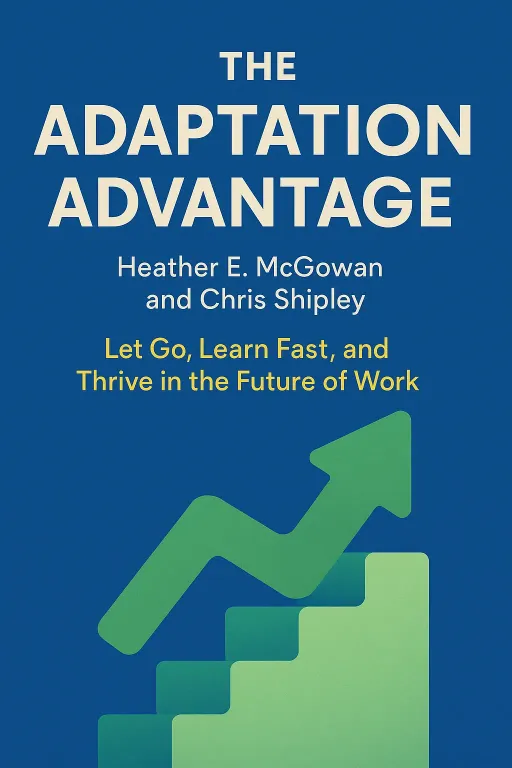
Nova: Exactly. And that is the tension we are living in. Today, we are unpacking two essential blueprints for navigating this reality. We are looking at The Fourth Industrial Revolution by Klaus Schwab, which maps out the systemic velocity of our world, and The Adaptation Advantage by Heather E. McGowan and Chris Shipley, which acts as the operating manual for our personal survival in that environment.
Atlas: I have always found Klaus Schwab’s perspective fascinating. He is, of course, the founder of the World Economic Forum, and he has this unique vantage point where he sees the global machinery of industry, government, and technology all colliding at once. He does not just write about gadgets; he writes about the fundamental structure of how we live and work.
Nova: He really does. And when you pair that macro-view with the work of McGowan and Shipley, you get this complete picture of the challenge. The Adaptation Advantage is widely praised for shifting the conversation from what we do to how we learn. It is less about your specific job title and more about your ability to unlearn and relearn on the fly.
Atlas: So, we are looking at the collision of systemic speed and the need for personal agility. It sounds like a formula for either complete burnout or incredible opportunity, depending on how you handle it.
The Convergence of Worlds
SECTION
Nova: That is the perfect way to frame it. Schwab’s argument in The Fourth Industrial Revolution is that we are not just seeing a shift in tools. We are seeing a blurring of the lines between the physical, digital, and biological worlds. Think about it. We have sensors in our manufacturing plants, we have AI making clinical diagnoses, and we have people integrating technology directly into their daily lives.
Atlas: I see that every day. It feels like the walls between these silos are dissolving. But for the listener who is sitting at their desk, managing a team or trying to advance their career, how does that global, systemic shift actually show up in their inbox?
Nova: It shows up as pressure. The pressure to be faster, to be more integrated, and to be more responsive. Schwab points out that the velocity of change is exponential, not linear. Our institutions, our schools, and even our corporate structures are still designed for a linear world. We are trying to solve exponential problems with linear thinking, and that is where the friction comes from.
Atlas: That explains the constant feeling of being behind. If the world is moving exponentially and I am operating at a linear pace, I will naturally feel like I am always losing ground. It is not necessarily that I am failing; it is that the baseline for success has moved.
Nova: That is the insight. And this is where the conflict arises. We cling to our legacy skills because they provided us with our past success. We think, I have been a great accountant for twenty years, or I have been a great project manager for fifteen years. But the skills that made you successful in that linear past are often the very things that anchor you in a world that is shifting toward automation and cognitive intelligence.
Atlas: You are hitting on a sensitive point. People tie their identity to their expertise. If I have spent a decade mastering a specific software or a specific management methodology, and suddenly that is being automated or rendered obsolete, it feels like I am losing a part of myself. How do we separate our identity from our output?
Nova: McGowan and Shipley address this directly in The Adaptation Advantage. They argue that we have to shift our identity from static expertise to continuous learning. They call this the transition from the expert mindset to the learner mindset. The expert mindset says, I know the answer. The learner mindset says, I know how to find the answer, even if the question changes tomorrow.
Atlas: That sounds liberating, but also risky. If I tell my boss, I do not know the answer but I am great at learning, that might not land well in a high-stakes meeting. How do we make that transition without losing our professional credibility?
Nova: The credibility comes from the speed of your learning. If you can demonstrate that you can take a new, complex problem, break it down, and find a solution faster than someone who is relying on a static, outdated toolkit, you become the most valuable person in the room. It is about becoming a high-leverage cognitive worker.
The Identity Shift and the Legacy Trap
SECTION
Atlas: Okay, let's drill down into that. If I am a leader, I am looking at my team and I see a mix of people. Some are clinging to their legacy skills like a life raft. Others are embracing the shift. How do I help the people who are stuck in the legacy trap without demoralizing them?
Nova: That is the core of the deep question we need to ask: How much of your team's current productivity is tied to legacy skills that will be automated? And more importantly, how can you facilitate their transition to higher-leverage cognitive tasks? It starts with a shift in the way we evaluate performance.
Atlas: Instead of evaluating them on what they produced yesterday, we evaluate them on how they adapted to the challenge they faced this morning.
Nova: Precisely. You have to create a psychological safety net that allows for the discomfort of the learning curve. If your team is terrified that they will be fired the moment they admit they do not know how to use a new AI tool or a new data platform, they will hide their gaps. They will double down on the legacy skills they know, even as those skills become less relevant.
Atlas: It creates a culture of stagnation. People prioritize safety over growth.
Nova: And stagnation is the biggest risk in a world of exponential change. The organizations that thrive are the ones that treat learning as a core competency. McGowan and Shipley highlight that companies which foster this culture are not just surviving; they are setting the pace. They are the ones defining the new reality rather than reacting to it.
Atlas: I can see how that applies to the macro level of a company, but what about the individual? The listener who is feeling that pressure right now. They know they need to adapt, but they are exhausted. They are already working fifty or sixty hours a week. Where does the room for this new learning come from?
Nova: This is where the strategy needs to be intentional. You do not need to overhaul your entire life overnight. You need a daily habit. The recommendation here is to commit to one twenty-minute session every single day. That is it. Twenty minutes of dedicated learning time that is not about your current project, not about your immediate to-do list, but about your future self.
Atlas: Twenty minutes. That feels manageable. It is about the consistency, not the intensity.
Nova: Exactly. If you try to do a four-hour deep dive once a week, you will burn out. But twenty minutes a day, every day, compounds. It is like compound interest for your brain. You spend twenty minutes reading about a new industry trend, experimenting with a new tool, or studying a new cognitive framework. Over a year, that is over one hundred hours of deliberate learning.
Atlas: That is significant. It changes the trajectory. It is the difference between being a passive recipient of change and being an active participant in it.
The Strategic Pivot
SECTION
Nova: Let’s talk about the strategic pivot. When we look at the intersection of Schwab’s systemic velocity and the personal adaptation advantage, we see that the people who succeed are the ones who can bridge the gap between data and human impact. The machines can handle the data. They can handle the processing, the pattern recognition, and the rote tasks.
Atlas: But they cannot handle the human impact. They cannot navigate the nuance of a high-stakes negotiation, the empathy required to lead a team through a crisis, or the creative leap required to solve a problem that has no historical precedent.
Nova: You hit the nail on the head. That is the higher-leverage cognitive task. We are moving away from the era of information hoarding—where knowledge was power—into the era of information synthesis. Power now lies in your ability to take the massive, overwhelming amount of data that the Fourth Industrial Revolution produces and synthesize it into something that actually matters to humans.
Atlas: That makes me think about the role of a leader today. It is less about being the smartest person in the room and more about being the most effective synthesizer of information. You are the conductor of the orchestra, not the soloist.
Nova: That is a beautiful analogy. The soloist is the expert who knows every note by heart and plays it perfectly. But the conductor understands the entire piece, knows how every instrument contributes to the whole, and directs the tempo and the emotion. If the tempo of the world is accelerating, the conductor has to be more agile than ever.
Atlas: I wonder how many leaders are still trying to be the soloist. They are in the weeds, trying to perfect their specific part, while the rest of the orchestra is playing at a different speed.
Nova: A lot of them. And that is where the anxiety comes from. They feel the pressure of the accelerated tempo, but they are using the techniques of a slower age. They are trying to micromanage the notes instead of directing the performance.
Atlas: So, if I am that leader, or even an individual contributor, how do I start this transition? We talked about the twenty-minute daily session. Is there a way to audit where we are?
Nova: Start by looking at your calendar. Look at the last week. How much of your time was spent on tasks that were repetitive, predictable, or focused on maintaining the status quo?
Atlas: That is a painful audit.
Nova: It is, but it is necessary. The tasks that are repetitive, predictable, and maintain the status quo are the ones most likely to be automated or rendered irrelevant. Now, look at the other side of your calendar. How much time was spent on tasks that required judgment, creativity, empathy, or complex problem-solving?
Atlas: I suspect for most people, the ratio is heavily skewed toward the former.
Nova: And that is the gap we need to close. You don't have to eliminate the repetitive tasks today. But you do need to start consciously shifting that ratio. Can you delegate one of those repetitive tasks to an automated process? Can you use that twenty-minute learning session to figure out how to automate it?
Atlas: I love that. You are using the learning time to create more time. It is a virtuous cycle.
Synthesis & Takeaways
SECTION
Nova: It is the ultimate leverage. You are investing in your own obsolescence, but in the best possible way. You are making your current, repetitive self obsolete so that your future, higher-value self can emerge.
Atlas: That is a powerful way to look at it. It is not about being replaced; it is about evolving. It is the difference between being a victim of the Fourth Industrial Revolution and being an architect of it.
Nova: And that brings us back to the core of everything we discussed. Schwab shows us the environment we are in—this interconnected, high-velocity, systemic reality. McGowan and Shipley give us the tool to thrive in it—the ability to learn, unlearn, and relearn. The final step is ours. It is the decision to stop clinging to the safety of legacy expertise and to start embracing the discomfort of the unknown.
Atlas: It is about choosing growth over comfort. I think that is the hardest part. Comfort is seductive. It feels like stability. But as we have discussed, that stability is an illusion. The only real stability is in your ability to adapt.
Nova: It is true. And it is not just about professional success. It is about longevity. It is about ensuring that you remain relevant, that you remain engaged, and that you continue to contribute in meaningful ways throughout your entire career.
Atlas: This has been an eye-opening conversation. It makes me want to go back and audit my own calendar, my own skill set, and my own identity. I think we all need to ask ourselves that deep question: What am I holding onto that is actually holding me back?
Nova: That is the perfect question to end on. If you take one thing away from this episode, let it be that. Identify one legacy skill that you are protecting, and ask yourself if it is time to let it go in favor of something that adds more value to your future.
Atlas: And don't forget the twenty-minute rule. It is a small investment, but the returns are compounding.
Nova: Absolutely. Start small, stay consistent, and focus on the synthesis of information rather than the hoarding of it. That is how you navigate the future of work.
Atlas: Thank you for this. It has been a pleasure to break this down with you.
Nova: The pleasure was mine. Keep learning, keep adapting, and keep leading. This is Aibrary. Congratulations on your growth!