Navigating the AI-Driven Economic Horizon
Golden Hook & Introduction
SECTION
Atlas: We need to retire the question, What do you do? It is the default opening line at every networking event, dinner party, and first date, but it is becoming a relic of a dying era.
Nova: I agree completely. That question assumes that your identity is fixed to a specific set of tasks, a static job title, or a defined role in an organization. But in a world where AI is rapidly learning to do the very things we once defined ourselves by, that question is becoming a trap.
Atlas: That hits hard. Because if my answer is, I am a data analyst, or I am a graphic designer, and an AI can do those things significantly faster and cheaper, then I have just defined myself by something that is potentially obsolete.
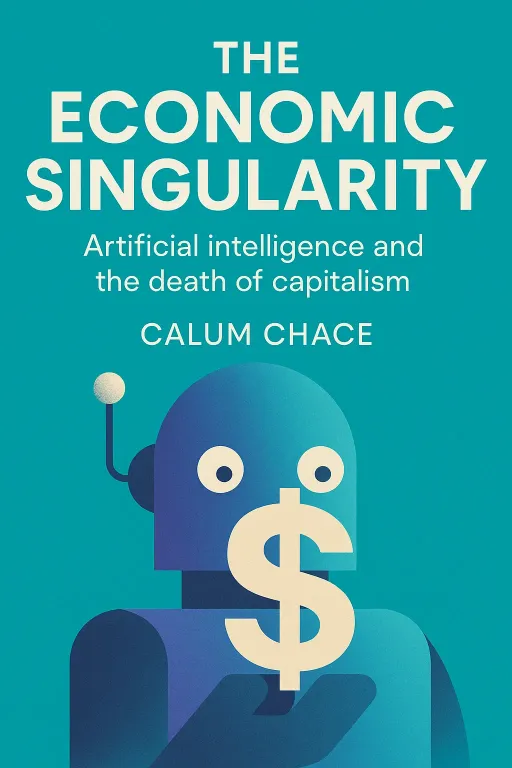
Nova: Exactly. Today, we are looking at how to survive and thrive in this shifting landscape by analyzing two vital perspectives. We are diving into The Economic Singularity by Calum Chace, which lays out the structural shifts AI is forcing upon our labor markets, and The Adaptation Advantage by Heather E. McGowan and Chris Shipley, which provides the playbook for how we, as individuals, can actually navigate this.
Atlas: I have heard Calum Chace’s work described as a cold shower for the modern workforce. He spent years in the tech industry, so he has seen the machinery from the inside. And McGowan and Shipley, they are essentially the architects of this new mindset. They are looking at the workplace not as a ladder to climb, but as a dynamic ecosystem.
Nova: That is the perfect way to frame it. Chace provides the macro view—the structural reality of why our old economic models are breaking—and McGowan and Shipley provide the micro view—the personal strategy for how you stay relevant. We are going to stitch these together to figure out how to stop clinging to job titles and start building portfolios of adaptability.
The Structural Reality of the Economic Singularity
SECTION
Atlas: Okay, let’s start with the macro view. Calum Chace uses the term The Economic Singularity. It sounds like something out of a science fiction novel, but he is dead serious. What does he actually mean by that?
Nova: He is looking at the point where artificial intelligence and robotics are capable of performing the vast majority of human labor, both physical and cognitive. For most of history, technological shifts replaced our muscles. We moved from plows to tractors. We moved from manual assembly lines to automated ones. But Chace argues that this time, we are automating the brain. When AI can write code, diagnose diseases, and manage supply chains, we are talking about a fundamental restructuring of the economy.
Atlas: That sounds like a terrifying prospect for the average person. If the cognitive heavy lifting is being handled by algorithms, what is left for the humans?
Nova: That is the central tension. Chace suggests that we are heading toward a scenario where the link between labor and income is broken. If machines do the work, they generate the value, but they do not pay taxes or spend money like humans do. This leads him to argue for radical economic policies, like Universal Basic Income, not just as a safety net, but as a necessity to keep the economy functioning.
Atlas: Wait, that is a huge leap. You are saying he believes the current system of trading time for money is fundamentally unsustainable?
Nova: He does. He points out that our current economic system is predicated on the idea that humans are the primary drivers of productivity. If that driver is replaced by software, the demand for human labor drops. And if the demand drops, wages drop, or jobs vanish entirely. He is not saying this will happen overnight, but he is tracking the trajectory. The Singularity, in his view, is the moment when this transition becomes inevitable.
Atlas: I see the logic, but that feels like a bleak outlook. Does he offer any hope, or is it just a countdown to obsolescence?
Nova: He is actually quite pragmatic. He sees it as a challenge of transition. He argues that we have a window of time to rethink our social contract. The danger is not the technology itself; the danger is the lag between the technology’s arrival and our ability to update our social and economic institutions to match it.
Atlas: That makes sense. It is the classic technological lag. We have the tools of the twenty-first century, but we are still operating on the economic software of the twentieth.
Nova: Precisely. And that is where the anxiety comes from. People feel the ground shifting, but they do not see the new floor being built. They just see the cracks in the old one.
The Personal Pivot: From Job Title to Learning Portfolio
SECTION
Atlas: So, if the macro environment is shifting under our feet—if the very nature of work is being disrupted—how do we survive that as individuals? That is where McGowan and Shipley come in, right?
Nova: They do. In The Adaptation Advantage, they argue that the biggest mistake we make is holding onto our identity as a fixed thing. They talk about the shift from a static identity, where you are a lawyer or a salesperson, to a dynamic identity, where you are a lifelong learner.
Atlas: I love that, but I have to play devil’s advocate here. We live in a world that demands specialization. If I go to a doctor, I want someone who has spent twenty years specializing in cardiology, not someone who is just a great learner. How do we reconcile the need for deep expertise with the need for this constant, fluid adaptation?
Nova: That is the crucial nuance. McGowan and Shipley are not saying expertise is dead. They are saying expertise is temporary. The half-life of a learned skill is shrinking. What you learned in university five years ago might already be outdated. So, they advocate for a learning portfolio. Think of it like an investment portfolio. You have your core expertise, your anchor, but you are constantly diversifying into new areas, new technologies, and new ways of thinking.
Atlas: So it is less about being a generalist who knows a little bit about everything and more about being a specialist who is constantly refreshing their specialty?
Nova: Exactly. They describe it as shifting your identity from what you do to how you learn. If you define yourself by the task—I am an accountant—then when the task is automated, you are finished. If you define yourself by the capability—I am someone who solves complex financial problems by synthesizing data and human behavior—then when the tools change, you just pick up new tools. You are still the one solving the problems.
Atlas: That is a profound distinction. It changes the way you approach your day. Instead of thinking, I have to get through this list of tasks, you think, What am I learning today that will make my existing skills more valuable?
Nova: Yes, and they emphasize that soft skills, or what they call human-centric skills, are the ones that are hardest to automate. Empathy, complex problem-solving, strategic thinking, managing ambiguity—these are the things that AI struggles with. AI can analyze the data, but it cannot navigate the office politics or the emotional nuance of a client negotiation.
Atlas: I can see how that would be a relief to many. We are so focused on technical proficiency, the hard skills, that we neglect the very things that make us uniquely human.
Nova: And that is the trap. We think, I need to learn Python or I need to learn this new software to stay relevant. And while that is true, we also need to double down on our capacity to learn, to unlearn, and to connect with others. McGowan and Shipley call this the adaptation advantage. It is the ability to pivot your focus as the environment changes.
Synthesizing the Macro and the Micro
SECTION
Atlas: Okay, let’s bring these two worlds together. We have Calum Chace telling us the economic structure is going to fundamentally change—possibly making the traditional job market unrecognizable—and we have McGowan and Shipley telling us how to survive that change by becoming hyper-adaptable. How do those two ideas coexist?
Nova: They are two sides of the same coin. Chace is telling you the world is becoming more volatile and unpredictable. McGowan and Shipley are telling you how to be the anchor in that storm. The more the economic landscape shifts, the more valuable your ability to adapt becomes.
Atlas: So, if I am listening to this and I feel that familiar panic of, is my job going to be replaced by an AI in five years? What is the actionable takeaway?
Nova: The first step is to audit your own identity. Ask yourself: If the specific task I do every day were handed over to an automated system, would I still have value? If the answer is no, then you are relying on the task, not the capability.
Atlas: That is a tough question to answer honestly.
Nova: It is. But it is the most important one. Once you identify that, you start building your learning portfolio. You ask, what are the adjacent skills that will make me more effective, regardless of the tools I use? If you are in marketing, don't just learn the current ad platform. Learn the psychology of persuasion, learn data analytics, learn how to tell a story that resonates. Those are the enduring assets.
Atlas: And I think we also need to acknowledge the role of curiosity here. It is easy to stop learning once you hit a certain level of seniority. You think, I have arrived, I know my stuff. But in this new environment, that is the most dangerous mindset to have.
Nova: You are spot on. Complacency is the enemy. The people who will thrive in the era of the economic singularity are the ones who treat their career like a startup. They are constantly testing, iterating, and pivoting. They are not waiting for the market to tell them they are obsolete; they are proactively updating their own skill set.
Atlas: I also think there is a lesson here about empathy. We talked about how human-centric skills are the ones that are hardest to automate. If we are all running around like machines, trying to be more efficient, more precise, more data-driven, we are just competing with the machines on their home turf. We will lose that battle.
Nova: We absolutely will. AI can be efficient. It can be precise. It cannot be human. It cannot care. It cannot build trust. It cannot see the bigger picture of why a project matters to a community or a culture. Those human elements are where the value is moving.
Synthesis & Takeaways
SECTION
Atlas: This has been a fascinating conversation. We have gone from the structural, almost cold reality of the economic singularity to the deeply personal, almost philosophical shift of the adaptation advantage.
Nova: It is a journey from fear to empowerment. The economic singularity is a daunting prospect, but it is also an invitation to rethink what we value as humans. We are being pushed away from being cogs in a machine and toward being architects of our own professional destiny.
Atlas: If there is one thing I am taking away from this, it is that we need to stop asking, What do I do? and start asking, How do I solve problems, and what new things can I learn to solve them better?
Nova: That is the perfect summary. And remember, you do not have to do it all at once. The adaptation advantage is not a destination; it is a practice. It is about committing to that twenty-minute deep-dive session every day, learning one new thing, or looking at one problem from a different angle.
Atlas: Start small, stay curious, and keep building that portfolio.
Nova: Exactly. The future belongs to the learners, not the experts. Thank you for joining us on this exploration. This is Aibrary. Congratulations on your growth!