

Beyond the Canvas: The Strategic Power of Creative Thinking in Any Field
Golden Hook & Introduction
SECTION
Nova: Alright, Atlas, quick game. Five words. What's your honest, gut-level, five-word review of the idea that creativity is a "strategic power" that anyone can cultivate? No pressure.
Atlas: Huh. Okay, five words. "Less magic, more deliberate, powerful." Boom. Your turn.
Nova: Ooh, I like that! Mine would be: "Unlock potential, build better worlds." Because honestly, so many of us believe creativity is this mystical gift only bestowed upon a select few, right?
Atlas: Absolutely. It’s like a secret club you either get an invite to at birth, or you don't. And if you’re not in, well, tough luck.
Nova: Exactly! But what if that's fundamentally limiting our problem-solving potential? What if creative thinking isn't just for artists in their studios, but a strategic asset applicable to challenge, from business strategy to figuring out how to get a newborn to sleep through the night?
Atlas: Now that you mention it, that last one feels like it needs all the creativity you can possibly muster.
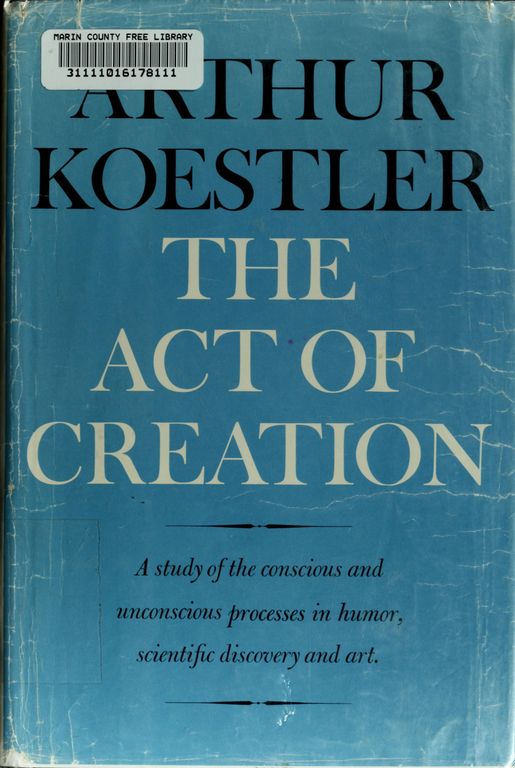
Nova: It certainly does! And today, we're diving into exactly that paradigm shift. We're looking at how to move beyond the canvas, literally, and harness the strategic power of creative thinking in any field. We're pulling insights from two incredible thinkers. First, Arthur Koestler, and his seminal work, "The Act of Creation." Now, Koestler wasn't just some academic; he was this fascinating Hungarian-British journalist, political activist, and also a deep philosopher of science. His incredibly diverse background gave him this unique, almost panoramic view of how human thought actually works.
Atlas: That's a really interesting starting point. Not who I would've expected to be a creativity guru.
Nova: Right? And then, we'll shift gears to Ed Catmull’s "Creativity, Inc.: Overcoming the Unseen Forces That Stand in the Way of True Inspiration." Catmull, as many know, co-founded Pixar. But before that, he was a pioneer in computer graphics, literally melding art and technology. He didn't just creative people; he helped a new creative medium, making him uniquely qualified to talk about fostering innovation in complex, high-stakes environments.
Atlas: So we're talking about the individual spark, and then how to build the bonfire. I can see the connection.
The Myth of Innate Creativity & The Power of Bisociation
SECTION
Nova: Precisely. Let's start with Koestler, because he really dismantles this myth of innate creativity. He says creativity isn't this lightning bolt from the heavens. Instead, it's a skill, a cognitive process he called 'bisociation.'
Atlas: Bisociation. Sounds like a fancy word for something I probably already do, or don’t do. What exactly does it mean?
Nova: It’s the mind's ability to connect two previously unrelated ideas or concepts, often from different 'planes' of thought, to produce a novel solution or insight. Think of it as intellectual cross-pollination. It's not just linear thinking, going from A to B. It's about taking A and suddenly linking it to Z, and realizing they're connected in a way no one saw before.
Atlas: Okay, so you’re saying it's not about being 'born creative,' but about deliberately mashing ideas together? Can you give me a more everyday example? Because my brain immediately goes to like, "Okay, so a shoe and a pineapple. What do I get?"
Nova: That’s a great question, and it's exactly the kind of thinking we need to break through! Let's take Gutenberg and the printing press. Before him, people used wine presses for, well, wine, and coin punches for making coins. No one thought to put them together. But Gutenberg, perhaps observing both, bisociated the durable, repeatable impression of the coin punch with the mechanical force of the wine press. The result? The printing press. He connected two unrelated technologies to create something revolutionary.
Atlas: Wow. So it wasn't a completely new invention, but a new between existing things. That’s a powerful distinction. It feels less intimidating.
Nova: Exactly! Or think about Archimedes in his bath, right? He's trying to figure out how to measure the volume of an irregularly shaped object, a crown, without melting it. He steps into the bath, the water overflows, and he bisociates the volume of water displaced with the volume of his own body. Eureka! It's that sudden, often unexpected, click between two previously separate frames of reference.
Atlas: So, this isn't just for inventors or ancient Greek mathematicians, but for anyone looking for a fresh perspective on a persistent challenge, even a family routine. I mean, if I'm trying to figure out a new way to streamline the morning chaos with kids, I could look at, say, airport security lines, or maybe even a restaurant kitchen?
Nova: Absolutely! That’s bisociation in action. You're taking the highly efficient, procedural thinking from airport security or a professional kitchen and applying it to the seemingly chaotic 'plane' of your home morning routine. You might suddenly realize, "Oh, we need a designated 'check-in' station for backpacks and shoes," or "We need a 'prep list' laid out the night before, just like a chef mise en place." That's how creative leaps happen outside of traditional creative fields. It’s about breaking out of the familiar thought patterns.
Atlas: That’s actually really inspiring. It feels like it gives me a tangible tool, not just a vague hope for inspiration to strike. So, the "cold fact" that creativity is a mystical gift? That’s really just a limiting belief.
Cultivating Creative Environments & Overcoming Obstacles
SECTION
Nova: It truly is. And while individual flashes of insight are powerful, what happens when you need an entire team, an entire organization, to be consistently innovative? That's where Ed Catmull comes in. He argues that even with all the brilliant, bisociating minds in the world, creativity can be suffocated by the wrong environment.
Atlas: I can definitely see that. I’ve been in places where new ideas just went to die. So, how did Pixar, a company known for constant innovation, manage to foster that? What's their secret sauce?
Nova: Catmull's insights from Pixar are profound because they're not about magic; they're about intentional design. He talks about building a culture where honest feedback is not just tolerated, but. For instance, they have something called the "Braintrust" at Pixar. Before a film is too far along, directors present their work to a group of their most trusted peers—other directors, writers, story artists. The Braintrust's job isn't to tell the director what to do, but to point out problems, ask hard questions, and offer candid, often brutal, feedback.
Atlas: That sounds amazing, but also incredibly difficult to implement. How do they overcome the natural human instinct to protect their ideas or avoid looking foolish? That’s a huge unseen force right there—the fear of judgment.
Nova: Exactly! That fear is one of the "unseen forces" Catmull talks about. Pixar overcomes this by building psychological safety. The Braintrust meetings are specifically designed to be about the, not the. The feedback is always framed as "plussing"—meaning, you add to an idea, you don't just tear it down. It's about making the work better, not proving someone wrong. They also understand that failure is a necessary part of the process. They embrace the idea that their films are "ugly babies" in the early stages and need nurturing, not immediate dismissal.
Atlas: Wow, that’s a completely different way of thinking about leadership and team dynamics. So, it's not just about hiring creative people, but about designing the system itself to be creative-friendly. It’s about cultivating an environment where those bisociations can actually be shared and refined, rather than hidden away for fear of ridicule.
Nova: Precisely. Catmull emphasizes that leaders have to be vigilant against fear. Fear of failure, fear of looking stupid, fear of being wrong—these are the real creativity killers. He talks about the need for candid communication, even when it's uncomfortable. It’s about letting the best ideas win, not the loudest voice or the most senior person. And that means creating structures, like the Braintrust, that institutionalize honest, constructive criticism.
Atlas: Honestly, that sounds like a blueprint for not just a creative company, but any healthy, thriving organization, or even a family. If you want foundational well-being, you need psychological safety and the ability to share ideas, even ugly ones, without fear.
Synthesis & Takeaways
SECTION
Nova: You've hit on the core synthesis, Atlas. Ultimately, Koestler shows us the individual mind makes those incredible creative leaps through bisociation. And Catmull shows us to build the launchpad and the supportive ecosystem for those leaps, both individually and collectively. It’s about understanding the mechanics of insight and then building the culture that nurtures it.
Atlas: It feels like we're moving creativity from a magical black box to a strategic, almost engineering-like discipline. That's incredibly empowering, especially if you're trying to build something lasting, like a strong family foundation, or a new business venture that needs to adapt constantly. It's not about waiting for inspiration, but actively designing for it.
Nova: Exactly. So, next time you face a challenge—whether it's a complex work problem or a personal dilemma—remember: you're not waiting for inspiration to strike. You're actively creating it. First, by consciously trying to connect the seemingly unconnected, like Koestler suggests. And then, by building a space, even if it's just in your own thinking process or within your immediate circle, where those connections can safely grow, be tested, and refined, just like Catmull teaches us. It’s about being a strategic creative, not just a hopeful one.
Atlas: That gives me so much to think about. It really reframes how I approach problems.
Nova: And that's the goal. This is Aibrary. Congratulations on your growth!