Engineering Your Effectiveness: A Developer's Guide to The 7 Habits
Golden Hook & Introduction
SECTION
Nova: Asoiso, as an engineer, you know that the most elegant user interface in the world can't save an application built on a buggy, unstable core. But how often do we apply that same thinking to ourselves? We try to adopt new productivity 'hacks'—the UI fixes—while our personal 'operating system' is full of legacy code and bad habits.
Asoiso: That's a powerful way to put it, Nova. It's something we see all the time in tech. We call it technical debt. You can keep adding shiny new features, but if the foundation is a mess, the whole system becomes slow, unpredictable, and eventually, it just collapses. You have to go back and fix the core.
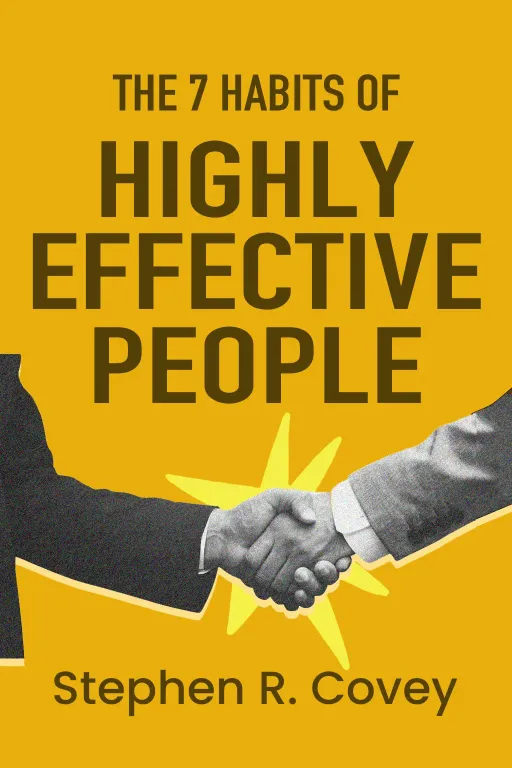
Nova: Exactly! And that's precisely what we're diving into today, using Stephen Covey's classic, 'The Seven Habits of Highly Effective People,' as our guide. This isn't just a self-help book; we're going to treat it as a blueprint for upgrading your personal operating system. Today we'll dive deep into this from two perspectives. First, we'll explore the foundational architecture of effectiveness—what Covey calls the 'Inside-Out' approach.
Asoiso: The core architecture. I like that.
Nova: Then, we'll get practical and discuss a powerful 'operating system' for your daily life: the Time Management Matrix. It’s about moving from being reactive to being the architect of your own life. Ready to start coding?
Asoiso: Let's do it. I'm ready to debug my own system.
Deep Dive into Core Topic 1: The 'Inside-Out' Architecture
SECTION
Nova: Alright, so let's start with that core architecture. Covey makes this brilliant distinction between what he calls the 'Character Ethic' and the 'Personality Ethic.' The Personality Ethic is all about the surface level—public image, communication skills, positive thinking. These are the quick fixes, the UI tweaks.
Asoiso: The 'hacks' you mentioned. Like learning a new keyboard shortcut to feel more productive, but you're still working on a flawed project.
Nova: Precisely. The Character Ethic, on the other hand, is about the deep stuff: integrity, humility, courage, justice. It's the 'Inside-Out' approach. Covey argues that lasting success can only be built on a foundation of solid character. You can't fake it. He tells a deeply personal story that really brings this to life.
Asoiso: I'm interested to hear it. Stories make principles concrete.
Nova: So, Covey and his wife were worried about their son. In his early years, he was really struggling. Academically, he was behind. Socially, he was awkward. Athletically, he was uncoordinated. He just wasn't meeting the 'milestones' they expected. As caring parents, they wanted to help him succeed.
Asoiso: Of course. That's a natural instinct.
Nova: So they tried the 'Personality Ethic' approach. They used positive mental attitude techniques. They'd tell him, "You can do it, son! We believe in you!" They'd praise any small success. But nothing worked. In fact, it almost made things worse. The boy would just put his head down, and they could feel they were communicating a sense of his inadequacy. It felt manipulative.
Asoiso: Because the underlying message was still, "You are not good enough, and we need to fix you." The 'UI' of positivity was covering up a 'bug' in their core perception of him.
Nova: You've nailed it. That was their paradigm shift. They realized the problem wasn't their son; it was their own perception. They were so focused on the outward comparison, the social mirror, that they were judging him against it. So they decided to change, from the inside-out. They stopped trying to 'fix' him. They started working on their own character, their own motives.
Asoiso: How did they do that?
Nova: They decided to see their son for his own uniqueness. They detached from his performance and just focused on loving and valuing him for who he was, right then and there. They stopped protecting him from ridicule and just let him be. It took weeks, then months. But slowly, a change began. The boy started to blossom. He gained confidence. Years later, he was excelling in all those areas he'd struggled in—academics, sports, social life. He became a leader.
Asoiso: Wow. So they had to refactor their own internal 'code' before they could see any change in the 'output.' That's profound. In engineering, we talk about how a manager's mindset can completely define a team's culture. If a manager sees their team as just 'resources' to be managed, the team acts that way. If they see them as creative partners, they become that. It's the same principle.
Nova: It's exactly the same. What you are, as Covey says, shouts so loudly that people cannot hear what you say. Your character is the source code. Everything else is just a compiled version of that. This is Habit 1: Be Proactive—taking responsibility for your own paradigms—and Habit 2: Begin with the End in Mind—deciding what character you want to build.
Asoiso: It makes sense. You have to write the design document for your own character before you can start implementing the features of your life.
Deep Dive into Core Topic 2: The Quadrant II Operating System
SECTION
Nova: And once you have that solid 'Inside-Out' foundation, the next question is, how do you operate day-to-day? This brings us to what might be the most famous idea from the book, and one I think engineers will absolutely love: the Time Management Matrix.
Asoiso: I've heard of this. The four quadrants, right?
Nova: That's the one. Covey divides all activities into four quadrants based on two factors: urgency and importance. Quadrant I is Urgent and Important—crises, deadlines, a production server on fire.
Asoiso: Got it. Firefighting mode.
Nova: Quadrant III is Urgent but Not Important. These are interruptions, some meetings, other people's minor issues. It feels productive, but it's not moving your own goals forward.
Asoiso: The constant Slack notifications and emails that pull you out of deep work.
Nova: Exactly. Quadrant IV is Not Urgent and Not Important. Trivial work, time-wasters, doomscrolling. And then there's the magic one: Quadrant II. This is Not Urgent, but it is deeply Important. This is where planning, prevention, relationship-building, learning, and creative thinking happen. Covey says effective people spend their time in Quadrant II.
Asoiso: That's our 'refactoring and R&D' sprint. It doesn't ship a new feature, but it's what prevents the entire system from becoming obsolete or unmaintainable in six months. It's the work that creates future velocity.
Nova: What a perfect analogy! And Covey gives this great scenario in the appendix called 'A Quadrant II Day at the Office.' Imagine you're a marketing director. You walk in, and your to-do list is a nightmare. The FDA is on the phone about a quality control issue—that's Quadrant I. Your boss wants to have lunch—could be Q1 or Q2. You have to prepare a media budget—Q1 deadline. And your 'IN' basket is overflowing with mail—mostly Q3.
Asoiso: That sounds like a typical Monday morning. The reactive approach is to just start with the first thing screaming at you.
Nova: Right. But the Quadrant II director pauses. Instead of just reacting, they think architecturally. For the overflowing 'IN' basket, they don't just process it; they spend an hour training their secretary on how to handle it, delegating and empowering them. That's a Q2 investment to prevent future Q3 interruptions.
Asoiso: They're building an automated filter for the noise.
Nova: Exactly. For the media budget, instead of doing it themselves, they delegate it to a team of associates, giving them 'completed staff work' guidelines. This empowers the team and frees up the director. For the lunch with the boss, they prepare an agenda to discuss long-range, strategic matters—turning a potential Q1/Q3 meeting into a powerful Q2 opportunity.
Asoiso: So they're not just the work; they're designing a to handle the work. That is an engineering mindset. The best senior engineers I've seen are masters of Quadrant II. They spend their time mentoring junior devs, improving the build process, or writing documentation. They make everyone else on the team more productive, which is a much higher-leverage activity than just writing one more feature themselves.
Nova: That's the heart of it. It's about working on the system, not just in the system. It's Habit 3: Put First Things First. And it requires the discipline to say 'no' to the urgent but unimportant things in Quadrants III and IV.
Asoiso: Which is hard. Those things are loud and they provide instant, though shallow, gratification. It feels good to clear 20 emails, even if none of them mattered. It's much harder to spend an hour on a design document that no one will see for a week.
Nova: But that one hour on the design doc prevents a month of rework later. That's the Quadrant II payoff.
Synthesis & Takeaways
SECTION
Nova: So, when we put it all together, it really feels like a two-step process for engineering your own effectiveness. First, you build a solid 'character' architecture with the Inside-Out approach. You focus on your principles, your integrity.
Asoiso: You build a stable core. No technical debt.
Nova: Then, you run your life on a Quadrant II 'operating system' that prioritizes long-term value, prevention, and strategic planning over short-term reactivity.
Asoiso: It's about being the architect of your own system, not just a user reacting to notifications. You're designing the life you want, not just responding to the one that happens to you.
Nova: Beautifully said. So for everyone listening, especially our fellow thinkers and builders, here's the challenge. It’s a small piece of code you can implement this week.
Asoiso: A single-line commit.
Nova: I love that. For one week, find and schedule just 30 minutes a day for one high-impact Quadrant II activity. Maybe it's learning a new API, documenting a complex part of your codebase, or taking a colleague out for coffee to build a better working relationship.
Asoiso: Something that's important for your long-term growth but has no immediate, urgent deadline.
Nova: Exactly. Put it in your calendar and protect that time like it's a critical deployment. Don't let the urgent interrupt the important. Just see what happens.
Asoiso: I think you'll find it's the best investment in your personal 'infrastructure' you can make. It doesn't just make you more productive; it makes you more capable.
Nova: A perfect place to end. Asoiso, thank you for helping us deconstruct these habits with such clarity.
Asoiso: My pleasure, Nova. It was a great refactoring session.