

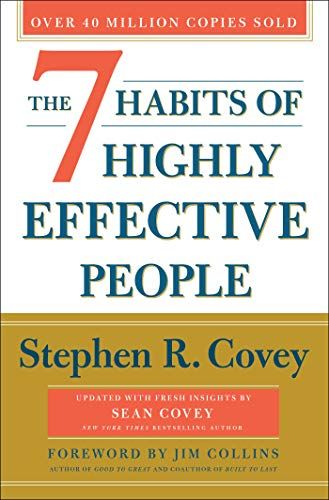
The 7 Habits of Highly Effective People
Introduction
Nova: Imagine you are standing at the back of a room at a funeral. You walk up to the casket, look inside, and realize you are looking at yourself three years from today. All your friends, family, and colleagues are there. What do you want them to say about you? What kind of character do they remember? What achievements actually mattered?
Nova: Exactly. This book isn't just another productivity guide. It has sold over 40 million copies since 1989 because it doesn't give you hacks or shortcuts. Covey actually spent years researching two centuries of success literature. He found a massive shift in how we define success, and he realized we have been looking at it all wrong for the last hundred years.
Nova: Even deeper than that. He calls it the shift from the Character Ethic to the Personality Ethic. And understanding that distinction is the key to why this book still tops bestseller lists decades after it was published.
Key Insight 1
The Foundation: Character vs. Personality
Nova: So, let's talk about that shift I mentioned. Covey found that for the first 150 years of American success literature, the focus was on things like integrity, humility, temperance, and justice. He calls this the Character Ethic. It is about who you are at your core.
Nova: Right after World War I, the literature shifted toward what he calls the Personality Ethic. Success became a function of public image, social skills, and positive mental attitude. It became about techniques—how to influence people, how to look the part, how to get what you want through charm.
Nova: That is the perfect analogy! Covey argues that if you don't have a foundation of character, all the personality techniques in the world are just band-aids. You can't fake integrity for long. He introduces this concept of the Inside-Out approach. If you want to change your situation, you have to change yourself. And to change yourself, you have to change your paradigms.
Nova: He defines a paradigm as a mental map. Imagine you are in Chicago and you have a map, but it is actually a map of Detroit. No matter how hard you try, how fast you walk, or how positive your attitude is, you are never going to find your destination. You are lost because your map is wrong.
Nova: Precisely. The 7 Habits are designed to shift your paradigm from a state of Dependence to Independence, and finally to Interdependence. He calls this the Maturity Continuum. Most people think independence is the ultimate goal, but Covey says life is inherently interdependent. We need to work with others to achieve the greatest results.
Key Insight 2
The Private Victory
Nova: The first three habits are what Covey calls the Private Victory. These are the habits that move you from dependence to independence. They are about self-mastery. Habit 1 is Be Proactive. This is the foundation of everything else.
Nova: Much more. He defines proactivity as the ability to choose your response. He tells the story of Viktor Frankl, a psychiatrist who survived Nazi concentration camps. Frankl realized that even in the most horrific circumstances, there is a tiny gap between a stimulus and your response. In that gap lies your freedom to choose how you feel and act.
Nova: Exactly. Reactive people are driven by feelings, circumstances, and the environment. Proactive people are driven by values. Covey suggests looking at your Circle of Concern versus your Circle of Influence. Reactive people focus on things they can't control—the weather, the economy, other people's mistakes. Proactive people focus on their Circle of Influence—the things they actually can do something about. As you focus on what you can control, your circle of influence actually grows.
Nova: Habit 2 is Begin with the End in Mind. That was the funeral exercise I mentioned earlier. It is based on the principle that all things are created twice. There is a mental creation, and then a physical creation. If you are building a house, you don't just start hammering nails. you have a blueprint first.
Nova: Spot on. It is about personal leadership. Habit 3 is where the physical creation happens: Put First Things First. This is the habit of personal management. This is where Covey introduces the famous Time Management Matrix.
Nova: Yes! Most people live in Quadrant I—the crises, the deadlines, the fires that need putting out. Or they waste time in Quadrant IV—mindless scrolling and escape activities. Covey says effective people spend the bulk of their time in Quadrant II. These are things that are important but not urgent. Things like building relationships, long-term planning, and personal growth.
Nova: It is! But if you ignore Quadrant II, your Quadrant I—the crises—will just keep getting bigger. Put First Things First is about having the discipline to say no to the unimportant so you can say yes to the things that align with your mission.
Key Insight 3
The Public Victory
Nova: Once you have achieved the Private Victory, you move into Interdependence. This is the Public Victory, habits 4, 5, and 6. But before you can succeed here, Covey says you have to understand the Emotional Bank Account.
Nova: Exactly. Every interaction you have with someone is either a deposit or a withdrawal. Deposits are things like keeping promises, being kind, and clarifying expectations. Withdrawals are things like breaking trust, being unkind, or ignoring people. You can't have an effective relationship if your account is overdrawn.
Nova: Habit 4 is Think Win-Win. It is not a technique; it is a philosophy of human interaction. Most of us are conditioned to think Win-Lose—if I win, you lose. Or Lose-Win—I'll just be a doormat so you're happy. Covey says Win-Win is the only sustainable option in the long run. If we can't find a solution that benefits both of us, we should agree to No Deal.
Nova: It does! It opens up the door for Habit 5, which is arguably the most famous: Seek First to Understand, Then to Be Understood. Most people listen with the intent to reply. They are preparing their response while the other person is still talking.
Nova: We all do it! Covey calls this autobiographical listening. We filter everything through our own experiences. Habit 5 is about empathic listening—listening with the intent to truly understand the other person's frame of reference. When you do this, the other person feels psychologically safe. They stop being defensive. Only then can you actually solve a problem together.
Nova: It is the foundation for Habit 6: Synergize. Synergy is the idea that the whole is greater than the sum of its parts. It is not just compromise. Compromise is 1 plus 1 equals 1.5. Synergy is 1 plus 1 equals 3 or 10 or 100. It happens when two people with different perspectives work together to create a third alternative that neither could have come up with alone.
Key Insight 4
Sharpening the Saw
Nova: Finally, we get to Habit 7: Sharpen the Saw. This is the habit of renewal. Covey tells a story about a man who has been sawing down a tree for five hours. He is exhausted, but he keeps going. Someone suggests he take a break to sharpen the saw, and he says, I don't have time to sharpen the saw, I am too busy sawing!
Nova: Exactly. And in this case, you are the tool. Sharpening the saw means taking the time to renew yourself in four dimensions: physical, spiritual, mental, and social-emotional.
Nova: It goes back to that Quadrant II we talked about. This is a Quadrant II activity. It is not urgent, but it is vital. Physical renewal is exercise and nutrition. Spiritual is your value system, maybe meditation or prayer. Mental is reading and learning. Social-emotional is the deposits you make in your relationships. Covey calls this the P/PC Balance.
Nova: It is based on the fable of the Goose and the Golden Egg. P stands for Production—the golden eggs. PC stands for Production Capability—the goose. If you focus only on the eggs and neglect the goose, eventually the goose dies and you get no more eggs. Habit 7 is about taking care of the goose.
Nova: Precisely. This is why the habits aren't just a list of things to do; they are an upward spiral of growth. As you practice them, you become more effective, which allows you to take on more, which requires more renewal. It is a continuous loop of improvement.
Nova: It is a fair question. Some of the examples might feel a bit dated, sure. But the principles? The principles are timeless. In an age of infinite distractions, the idea of Putting First Things First is more relevant than ever. In an age of social media polarization, Seeking First to Understand is a radical and necessary act. The 7 Habits aren't about managing your time; they are about managing your life based on universal principles.
Conclusion
Nova: We have covered a lot of ground today. From the shift between Character and Personality Ethics to the importance of moving from dependence to interdependence. The 7 Habits isn't a quick fix, it is a lifetime commitment to an inside-out approach to living.
Nova: If you want to start today, Covey would suggest picking just one habit to focus on. Maybe it is being more proactive in your next meeting, or truly listening to your partner tonight without interrupting. Small changes in your paradigms can lead to massive changes in your results over time. Success, as Covey sees it, isn't about what you have, it is about who you are and how you contribute to the world around you.
Nova: That is the essence of it. Thank you for diving into this with me. This is Aibrary. Congratulations on your growth!