

The Science of the Start: How Healthcare Entrepreneurs Outsmart Hesitation
Golden Hook & Introduction
SECTION
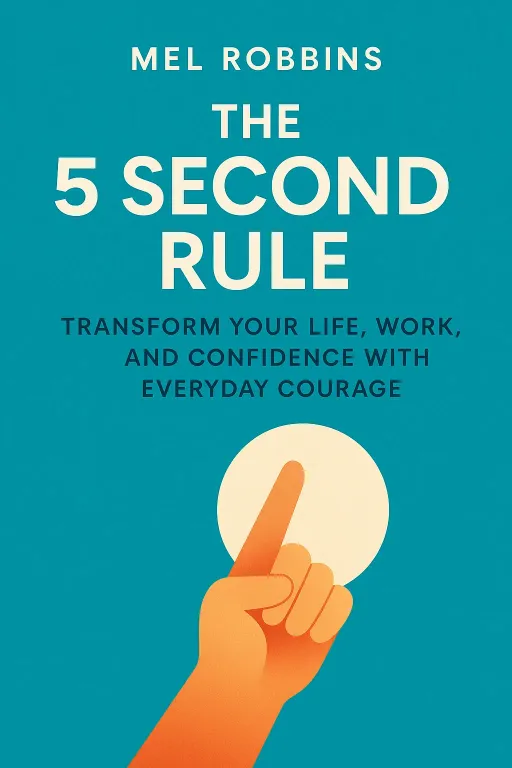
Prof. Eleanor Hart: You have an idea that could revolutionize patient care, or a critical email to send to a potential investor. Your hand hovers over the keyboard. And then... you hesitate. In that single, quiet moment of hesitation, your brain goes to work, building a fortress of excuses to keep you safe. But safety, as we know, is the enemy of progress. Welcome to the show. I'm Professor Eleanor Hart, and today we are exploring a deceptively simple tool that has transformed millions of lives: Mel Robbins'. Joining me is Faith, a healthcare entrepreneur who knows a thing or two about the high-stakes pressure of turning big ideas into reality. Faith, it is wonderful to have you here.
Faith: Thank you, Eleanor. It's an absolute pleasure. You know, that moment of hesitation you just described—it is so real, especially when you're starting out. In healthcare, we are trained to be incredibly analytical, to assess risks, and to plan meticulously. But as an entrepreneur, I've quickly realized that there's a massive gap between having a beautiful, empathetic vision and actually taking the terrifying first step to execute it.
Prof. Eleanor Hart: Exactly. And that is precisely what we are tackling today. We are going to look at this book from three distinct perspectives. First, we'll dive into the neurobiology of hesitation and why our brains are actually wired to stop us. Second, we'll dismantle the myth of motivation and talk about how to build what psychologists call an 'internal locus of control.' And finally, we'll focus on practical, science-backed strategies to reframe stress, anxiety, and procrastination into active, entrepreneurial progress.
Faith: I love that roadmap, Eleanor. As someone who naturally leans toward deep reflection and analysis, I'm constantly looking for the 'why' behind our behaviors. Does a simple countdown really work, or is it just a psychological gimmick? I think our listeners are going to be fascinated by the science behind it.
Deep Dive into Core Topic 1
SECTION
Prof. Eleanor Hart: Let's start at the very beginning, with the origin of the rule itself. It's 2009. Mel Robbins is forty-one years old, living in Boston, and her life is, by all accounts, falling apart. Her husband Chris's restaurant business is failing, they are in deep financial ruin, bouncing checks just to buy groceries, and their marriage is under immense strain. Mel is unemployed, struggling with a drinking problem, and has lost all her confidence. Every single morning, the alarm rings, and she hits the snooze button over and over again. It was her daily act of defiance against a reality she couldn't face.
Faith: It's a incredibly human starting point, isn't it? It wasn't born in a pristine laboratory or a corporate boardroom. It was born in the dark, cold reality of a Boston winter, out of sheer desperation.
Prof. Eleanor Hart: Yes, absolutely. And then, one night, she sees a television commercial. It shows a rocket launch. There's the dramatic countdown: five, four, three, two, one, and then... liftoff. Billowing smoke and fire. She has this sudden, intuitive instinct: 'Tomorrow morning, I am going to launch myself out of bed like a rocket. I won't let myself think.' The next morning, the alarm goes off. She feels the usual dread. But instead of hitting snooze, she counts backward: five, four, three, two, one. And she stands up. She doesn't overthink it. She just moves.
Faith: That is the crucial part—the physical movement. From a cognitive perspective, what Mel stumbled upon is a way to bypass what we call 'activation energy.' In chemistry, activation energy is the minimum amount of energy required to initiate a chemical reaction. In psychology, it's the same. The energy required to start a new behavior is vastly greater than the energy required to keep it going. When she counted backward, she didn't give her brain the time to generate excuses.
Prof. Eleanor Hart: Yes, and she calls hesitation 'the kiss of death.' The moment you hesitate, you signal to your brain that something is wrong, that there is a threat. Your brain is designed to protect you from things that feel difficult, scary, or uncertain. So, it immediately goes to work to stop you.
Faith: Right, and as an entrepreneur in healthcare, I see this constantly. If I need to make a cold call to a hospital administrator, my brain immediately says, 'They're too busy, you're not ready, you need to refine your pitch deck one more time.' That's the brain's defense mechanism. But counting backward—five, four, three, two, one—actually shifts the neural activity. It moves the focus from the amygdala, which is the fear and habit center, to the prefrontal cortex, which is responsible for planning, focus, and deliberate action. It's like a manual override for the brain.
Prof. Eleanor Hart: That is a perfect way to put it—a manual override. And Mel actually tested this on the most basic, daily hurdle: the snooze button. And the science behind why hitting the snooze button is so destructive to our productivity is fascinating. Scientists have discovered that when we hit snooze and drift back to sleep, we force our brain to start a new sleep cycle. These cycles take ninety to one hundred and ten minutes to complete.
Faith: Oh, yes! The phenomenon of 'sleep inertia.' When the alarm goes off fifteen minutes later, you are waking up in the middle of a deep sleep cycle. Your brain's cortical region is literally still asleep.
Prof. Eleanor Hart: Exactly! And research shows it can take up to four hours for that groggy, sleep inertia state to wear off, severely dragging down your cognitive function and decision-making abilities for the entire morning.
Faith: Think about the implications of that for an entrepreneur or a clinician. If you start your day by sabotaging your brain's executive function for the first four hours, you are playing catch-up the entire day. By using the five-second countdown to get up immediately, you aren't just showing discipline; you are protecting your cognitive capacity. You're giving your prefrontal cortex a clean start.
Prof. Eleanor Hart: It's a physical chain reaction. And it's not just about getting out of bed. Mel started using it for everything—forcing herself to go to the gym, to look for a job, to speak more kindly to her husband. It's about interrupting the default habit loops that keep us stuck.
Deep Dive into Core Topic 2
SECTION
Prof. Eleanor Hart: This brings us to our second core topic: the illusion of motivation. We live in a culture that tells us we need to 'feel' motivated before we can act. We wait for the perfect moment, the right mood, the spark of inspiration. But Mel makes a very bold statement in the book. She says, 'The moment it's time to assert yourself, you will not feel motivated. In fact, you won't feel like doing anything at all.'
Faith: That resonates so deeply with me, Eleanor. As an INFP, I highly value emotional alignment. I want my work to feel deeply authentic and meaningful, and I often find myself waiting until I 'feel' aligned to take action. But entrepreneurship has been a harsh teacher in this regard. If I only work when I feel motivated, my business will fail. The truth is, starting a business, pitching to investors, dealing with regulatory compliance—these things are uncomfortable. They are scary. You are never going to 'feel' like doing them.
Prof. Eleanor Hart: No, you won't. And Mel explains that our feelings are almost always aligned with our comfort zones, not our goals. When we make decisions based on how we feel in the moment, we default to what is easy and safe. To illustrate this, she shares the story of Christine, a marketing professional in Plano, Texas. Christine was sitting in a high-stakes meeting where her team was brainstorming ideas to close a massive consulting deal. She had this highly innovative, out-of-the-box idea to create a custom Snapchat geo-filter for the client. But immediately, self-doubt crept in. She thought, 'Is this too crazy? Why hasn't anyone else suggested it?'
Faith: Ah, the classic imposter syndrome. The window of opportunity is so small in those meetings. If you don't speak up within a few seconds, the conversation moves on, and your idea dies in your head.
Prof. Eleanor Hart: Exactly. Christine felt that five-second window closing. Her brain was fighting her. But she silently counted down: five, four, three, two, one. And she opened her mouth and shared the idea. Now, on the outside, nothing earth-shattering happened immediately—her boss listened, asked some questions, and thanked her. But on the inside, something monumental shifted. Christine realized she had the power to push past her fear. She proved to herself that she was capable of being a 'rock star' at work.
Faith: That is a beautiful example of building what Julian Rotter called an 'internal locus of control.' Rotter's research from 1954 shows that the more you believe you are in control of your life, your actions, and your future, the happier and more successful you will be. When Christine used the rule, she shifted her locus of control. She didn't wait for her boss to validate her or for her fear to disappear. She took control of her own voice.
Prof. Eleanor Hart: Yes, and that internal shift is what builds real confidence. Confidence isn't a personality trait; it's a skill. And it is built through acts of everyday courage. It's the willingness to start before you are ready. As Mel says, 'Don't prepare, begin.'
Faith: 'Start before you're ready.' That is a terrifying concept for an analytical thinker. We want to have all the data, all the answers, all the pathways mapped out. But in healthcare innovation, the landscape changes so rapidly that if you wait until you have perfect information, you are already obsolete. You have to build the plane while flying it, to use a common startup cliché. The 5 Second Rule is the tool that lets you jump off the cliff and start building.
Prof. Eleanor Hart: It really is. And it applies to historical movements as well. Mel draws a parallel to Rosa Parks in 1955. When the bus driver demanded she give up her seat, she didn't have a grand, pre-planned strategy to launch the Civil Rights Movement in that exact second. She was simply tired of being treated unfairly. She listened to her instinct, pushed past the fear of arrest, and refused. It was a single, five-second decision of everyday courage that sparked a revolution.
Faith: And then Dr. Martin Luther King Jr. was nominated to lead the Montgomery Bus Boycott. He later wrote that it happened so quickly he didn't have time to think it through. He said if he had had time to analyze the risks and the danger to his family, he likely would have declined. It's mind-blowing to think that some of the most pivotal moments in human history were the result of people acting on courageous instincts before their brains could talk them out of it.
Prof. Eleanor Hart: It shows that greatness is not this distant, unattainable thing. It is the sum of small, courageous decisions made in the moments that matter.
Deep Dive into Core Topic 3
SECTION
Prof. Eleanor Hart: Now, let's pivot to our third topic, which I know is highly relevant to anyone operating in high-pressure environments: managing stress, anxiety, and procrastination. Let's start with procrastination. We often view procrastination as a sign of laziness or poor time management. But the research tells a very different story.
Faith: Yes, Timothy Pychyl, a psychology professor at Carleton University, has done incredible work on this. His research shows that procrastination is actually a coping mechanism for stress. It has nothing to do with laziness. When we face a task that makes us feel stressed, insecure, or overwhelmed, our brain seeks immediate relief. Procrastination is a subconscious way to feel good by avoiding the stressful task.
Prof. Eleanor Hart: It's an emotional regulation problem, not a time management problem. And the tragedy is that avoiding the task only increases our stress in the long run, creating a vicious cycle. Mel offers a brilliant three-step method to break this cycle using the rule. First, you have to forgive yourself for procrastinating. Self-blame only increases the stress that caused the procrastination in the first place. Second, you envision your future self—how good it will feel to have this task finished. And third, you count down: five, four, three, two, one, and you just get started.
Faith: 'Just get started.' And the key is to make the starting point incredibly small. If I'm procrastinating on writing a complex grant proposal, I don't tell myself I have to write the whole thing. I count down: five, four, three, two, one, and I write one sentence. Once the activation energy is overcome, momentum takes over. It's incredibly liberating to realize you don't have to cure your stress to stop procrastinating; you just have to outsmart your hesitation.
Prof. Eleanor Hart: Absolutely. And what about anxiety? Many entrepreneurs and professionals suffer from chronic anxiety and panic attacks. Mel shares her own deeply personal struggle with severe anxiety. She discovered a powerful technique called 'anxiety reappraisal,' based on research by Alison Wood Brooks, a professor at Harvard Business School.
Faith: This research is groundbreaking, Eleanor. Brooks' studies show that physiologically, anxiety and excitement are almost identical. In both states, your heart rate increases, your cortisol spikes, your breathing becomes shallow, and your muscles tense. The body's physical response is exactly the same. The only difference is what your mind it.
Prof. Eleanor Hart: Yes! If your mind calls it 'fear' or 'anxiety,' your performance suffers, and you spiral into panic. But if you reframe those exact same physical sensations as 'excitement,' your performance actually improves. In Brooks' studies, participants who simply said 'I'm excited' before a stressful task—like public speaking or a math test—performed significantly better than those who said 'I'm anxious.'
Faith: It's a profound shift in perspective. When I have to pitch my healthcare startup to a room full of skeptical investors, my heart starts pounding, and my hands get cold. My default reaction used to be, 'Oh no, I'm terrified, I'm going to mess this up.' But now, I use the 5 Second Rule to interrupt that thought. I count down: five, four, three, two, one, and I tell myself, 'My body is getting ready for action. I'm not scared; I'm incredibly excited to share this vision.' It completely changes my energy and my presence.
Prof. Eleanor Hart: It's about using 'anchor thoughts' as well. Mel explains that when you feel fear taking over—say, during a turbulent flight—you can count down: five, four, three, two, one, and immediately focus on a vivid, positive anchor thought. For example, picturing yourself walking through the door of your destination and hugging your loved ones. You anchor your mind in a positive future reality, preventing the fear from hijacking your thoughts.
Faith: It's a way of reclaiming your mental sovereignty. We don't have to be passive victims of our brain's default programming. We can actively steer our thoughts, even in the midst of intense physiological stress.
Synthesis & Takeaways
SECTION
Prof. Eleanor Hart: We have covered some incredible ground today, Faith. From the neurobiology of the prefrontal cortex to the historical courage of Rosa Parks, and the practical psychology of anxiety reappraisal. If you had to synthesize the core message of our conversation today for our listeners, what would it be?
Faith: I think it comes down to this: change is not a massive, overwhelming event. It happens one five-second decision at a time. As Mel says, 'If you have the courage to start, you have the courage to succeed.' For anyone listening—whether you are trying to launch a business, improve your health, or simply find the courage to speak up in a meeting—the gap between the life you have and the life you want is only five seconds wide. You don't need to feel ready. You just need to count down and move.
Prof. Eleanor Hart: Beautifully said. The 5 Second Rule is a tool of everyday courage. It's a way to honor your instincts, quiet your self-doubt, and reveal the greatest version of yourself. And for our listeners, we want to leave you with a very practical challenge. Mel calls it the 'Wake Up Challenge.' Tomorrow morning, when your alarm goes off, do not hit the snooze button. The very second it rings, count silently in your head: five, four, three, two, one, and stand up. Start your day with an act of courage, and watch how that single decision creates a chain reaction of positive change throughout your entire day.
Faith: I highly encourage everyone to try it. It sounds simple, but it is truly life-changing. Thank you so much for this wonderful conversation, Eleanor. It has been incredibly inspiring.
Prof. Eleanor Hart: Thank you, Faith, for bringing your brilliant analytical mind and your entrepreneurial heart to this discussion. And to our listeners, thank you for tuning in. Remember, your life is waiting for you to discover the courage inside you. Five, four, three, two, one... go make it happen. Until next time, I'm Professor Eleanor Hart. Take care.









