Interrupting Stress and Emotional Overdrive
Golden Hook & Introduction
SECTION
Nova: Most professional disasters in history did not happen because someone thought too long. They happened because someone reacted too fast. A single email sent in anger, a defensive comment in a board meeting, a snap judgment that shuts down a creative idea—these are the high-speed collisions of the modern workplace.
Atlas: That is the truth. We treat speed as a virtue, especially in the professional world. We value the quick reply, the instant decision, the rapid-fire response. But when it comes to our emotional landscape, that speed is actually our biggest liability. It is the difference between being a leader and being a liability.
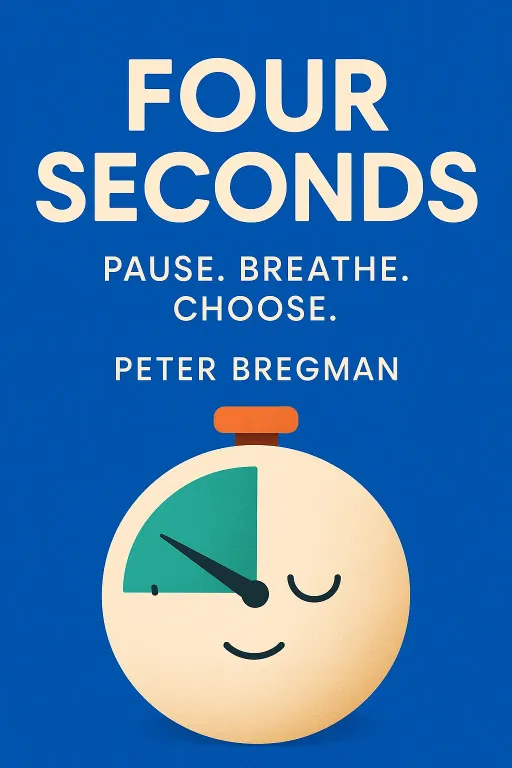
Nova: Exactly. And that is why we are looking at two distinct, yet deeply complementary, blueprints for reclaiming control today. We are diving into the core principles of Peter Bregman’s Four Seconds, which is all about that tiny, critical gap between a trigger and our reaction. And we are balancing that against the systemic approach in The 5 Resets by Dr. Aditi Nerurkar.
Atlas: I have always been fascinated by this. We are essentially talking about the difference between a tactical strike—that four-second pause—and a long-term infrastructure project, which is the nervous system reset. It is the difference between putting out a fire and fireproofing the building.
Nova: That is a perfect way to frame it. Peter Bregman, who has spent decades coaching high-level executives, really identifies that the problem is not the stress itself. It is the automatic, defensive reflex we have when that stress hits. He argues that if we can just buy ourselves a window of time—literally four seconds—we can change the entire trajectory of an interaction.
Atlas: Four seconds sounds so simple. Almost trivial. But I suspect that is the trap. Because when I am in the middle of a high-pressure situation, four seconds feels like an eternity.
The Tactical Pause and the Biology of Reaction
SECTION
Nova: That is the crux of it. It feels like an eternity because your amygdala, that ancient part of your brain responsible for the fight-or-flight response, is screaming at you to act. It wants you to survive, not to be diplomatic. When Bregman talks about those four seconds, he is not suggesting you take a nap or go for a walk. He is talking about the time it takes to draw a single, deep breath.
Atlas: So, walk me through the mechanics of this. I am in a meeting. Someone critiques my project in a way that feels unfair. My blood pressure spikes. My instinct is to defend myself, maybe even counter-attack. How do I actually utilize that four-second gap?
Nova: The first step is recognizing the physiological trigger. You feel that heat in your chest or the tightness in your jaw. That is your signal. Most people ignore that signal and go straight to the output, which is usually a snarky comment or a defensive justification. Bregman’s method requires you to treat that physical sensation as a stop sign. You inhale for four seconds.
Atlas: Just breathing.
Nova: Just breathing. But with intent. In those four seconds, you are essentially telling your prefrontal cortex—the logical, reasoning part of your brain—that it is time to come back online. You are taking the steering wheel away from your emotional brain. You are asking yourself one critical question: What is the outcome I actually want here?
Atlas: That is the game changer. Because usually, my "outcome" in that moment is to win the argument or to protect my ego. But if I take those four seconds, I might realize that the outcome I actually want is to understand the critique or to keep the project moving forward.
Nova: Precisely. If you are only focused on the immediate emotional relief of "winning," you will almost always lose the long game. Bregman points out that defensive reactions are rarely about the present moment. They are usually about old patterns, old insecurities, or old habits. By pausing, you are essentially breaking the circuit of that old habit. You are choosing to be an architect of your response rather than a victim of your reflex.
Atlas: I can see how that works for a single meeting. But what happens when the stress is not just a single, sharp moment? What happens when you are in a state of chronic, low-grade stress that lasts for weeks? That is where the four-second pause starts to feel like putting a bandage on a broken leg.
The Systemic Reset
SECTION
Nova: And that is exactly where we need to bring in Dr. Aditi Nerurkar. She is a Harvard-trained physician who looks at this through the lens of the nervous system. She would argue that if you are constantly needing to use that four-second pause, you are already running on a depleted battery. Her work in The 5 Resets is about identifying those chronic triggers before they even reach the burnout stage.
Atlas: I like that distinction. Bregman is the tactical response; Nerurkar is the systemic maintenance. Because, let’s be honest, if my nervous system is fried, no amount of four-second breathing is going to make me a zen master in a high-stakes environment.
Nova: Exactly. Dr. Aditi’s approach is about recognizing that stress is not just a mindset; it is a physiological state. She talks about the difference between acute stress, which can actually be helpful, and chronic stress, which is the slow-moving car crash of burnout. She suggests that we need to systematically reset our nervous system.
Atlas: So, what does a "reset" look like in her framework? Is it just meditation and green juice? Because if it is, I think a lot of our listeners who are managing complex, chaotic lives are going to check out.
Nova: It is much more practical than that. She emphasizes "micro-resets." For example, she talks about the importance of managing our information intake. We treat our brains like infinite sponges, but they have a finite capacity. If you are constantly flooding your system with news, notifications, and work emails, you are never allowing your nervous system to return to baseline.
Atlas: That resonates. It is like leaving a hundred browser tabs open on a computer. Eventually, the fan starts whirring, the system slows down, and eventually, it crashes. We do that to ourselves every single day.
Nova: And her solution is not to go live in a cave. It is to build intentional "off-ramps." Maybe that means setting a strict boundary on when you check your email. Maybe it means creating a ritual that signals to your body that the workday is over. These are not just "self-care" tips; they are physiological interventions.
Atlas: It sounds like we are talking about energy management rather than time management. Most of us are obsessed with time management—how to squeeze more tasks into the day. But if you have zero energy, time management is irrelevant.
Nova: That is the insight. If you are operating from a place of burnout, you are not making choices; you are making errors. You are reactively responding to stimuli because you do not have the cognitive bandwidth to do anything else. When you implement these resets, you are essentially increasing your capacity to handle stress. You are widening your window of tolerance.
Atlas: So, let’s connect these two. If I use Aditi’s framework to lower my baseline stress through better habits, then Bregman’s four-second pause becomes much more effective because I have the cognitive reserve to actually use it.
Nova: You nailed it. Think of it as an ecosystem. The five resets are the soil health. If the soil is healthy, the plant grows strong. The four-second pause is the pruning. It is the immediate, tactical action you take when a branch starts growing in the wrong direction. You cannot just prune a dead plant and expect it to thrive, and you cannot just have good soil and ignore the pruning. You need both.
Synthesis & Takeaways
SECTION
Atlas: This is a powerful combination for anyone who feels like they are constantly putting out fires. It changes the goal from "not being stressed" to "being resilient."
Nova: Right. Stress is inevitable. We cannot eliminate it. But we can change how we interact with it. The takeaway for our listeners today is simple but demanding. Start with the four seconds. The next time you feel that urge to fire off a defensive email or snap back at a colleague, count to four. Take that breath. Use the gap.
Atlas: And then, look at your day-to-day. Ask yourself where the leaks are in your energy. Are you doom-scrolling first thing in the morning? Are you skipping lunch? Are you working through the weekend? Those are not professional virtues; they are systemic failures. Pick one reset from Aditi’s framework—just one—and implement it this week.
Nova: It is about moving from being a reactive participant in your life to being the architect of your own experience. It is not about becoming a robot who never feels stress. It is about becoming a human who understands how to process that stress, integrate it, and move forward with intention.
Atlas: That is a much more sustainable way to live. It is about mastering the art of being human in a world that constantly demands we act like machines.
Nova: Exactly. And the beauty of this is that it compounds. You do the four-second pause once, and you feel a little more in control. You do it ten times, and it becomes a habit. You reset your nervous system for a week, and you find you are not even triggered as often. It is a slow, quiet, powerful transformation.
Atlas: I love that. It is the quiet, unglamorous work that actually moves the needle. It is not about the big, dramatic change. It is about the tiny, four-second, intentional shift.
Nova: That is the path to mastery. It is not found in the grand gestures, but in the small, repeated choices we make every single day. We hope you take that four seconds today. It might just be the most important thing you do.
Atlas: And with that, we leave you to your day—and your next four seconds. This is Aibrary. Congratulations on your growth!