

Cultivating Profound Thinking & Learning
Golden Hook & Introduction
SECTION
Nova: What if everything you thought you knew about "smart" was wrong? What if true intellectual power isn't about being right, but about being brilliantly, productively wrong?
Atlas: Whoa, Nova, that's a bold claim. Being wrong is usually something we try to avoid, especially in high-stakes environments where decisions have real consequences. You're saying we should embrace it?
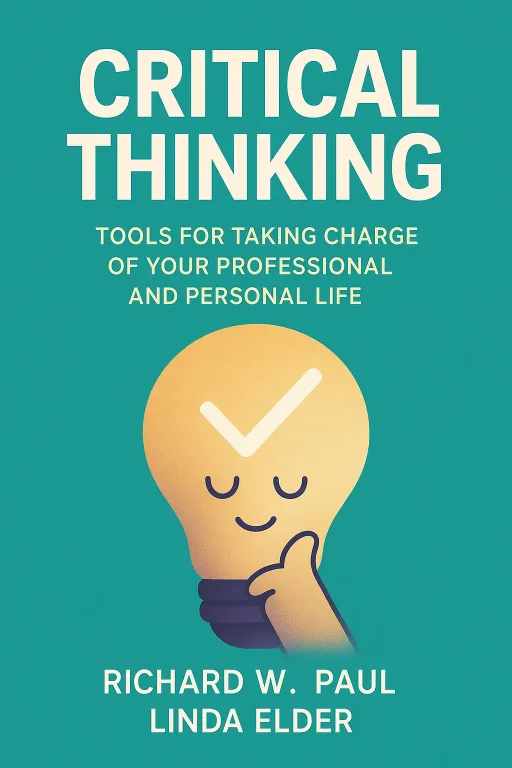
Nova: Absolutely! That's just one of the counter-intuitive insights we're diving into today. We're cracking open two foundational texts: by Edward B. Burger and Michael Starbird, and by Richard W. Paul and Linda Elder.
Atlas: Those names sound incredibly academic. Are we talking about dense philosophy here?
Nova: Not at all, Atlas. What's truly fascinating is how these authors, all deeply rooted in education and mathematics, came together to distill centuries of philosophical thought into incredibly practical, actionable frameworks for everyday intellectual growth. They’re not just theorizing; they’re giving us a toolkit.
Atlas: That makes sense. For anyone building something from scratch, or trying to navigate rapid change, the ability to think clearly and strategically isn't a luxury; it's the core engine of growth. But it often feels like we're just reacting. So, where do we even begin to cultivate this kind of profound thinking?
Deep Dive into Core Topic 1: The Five Elements of Effective Thinking
SECTION
Nova: Well, Burger and Starbird offer a fantastic starting point with their "Five Elements." They argue that profound intellectual processes boil down to: deep understanding, making mistakes, questioning, following the flow of ideas, and changing perspective. Let's tackle deep understanding first. It’s not just about memorizing facts or rattling off definitions.
Atlas: Okay, so what it then? Because in the world of rapid iteration, sometimes a surface-level understanding feels "good enough" to move forward.
Nova: That’s a common trap! Deep understanding is about getting to the "why." It's like learning a language. You can memorize vocabulary and grammar rules, but you don't understand it until you can think, joke, and dream in that language. You need to grasp the underlying structure, the interconnectedness, the foundational principles. It’s about building a robust mental model, not just collecting data points.
Atlas: I can see that. It's the difference between knowing a formula is and understanding it works and to apply it. But that takes time, right? For listeners who are constantly building and iterating, how do you find that space for deep understanding amidst the pressure to deliver quickly?
Nova: It’s a mind shift. It means being deliberate about asking not just "what happened?" but "why did it happen?" and "what fundamental principle does this illustrate?" This leads us directly to the second element: making mistakes. Many people view mistakes as failures, especially in professional settings. But Burger and Starbird frame them as absolutely crucial learning tools.
Atlas: Wait, hold on. Productive mistakes? For someone building 0-1 strategies, every mistake can feel like a setback, costing time, resources, or market share. How do you embrace "making mistakes" without actually, you know, making catastrophic mistakes?
Nova: That’s a brilliant distinction, Atlas. It's not about being reckless. It’s about creating an environment where is prioritized. Think of it like a brilliant engineer I heard about, developing a new material. They ran hundreds of "failed" experiments, each one providing a tiny piece of data, ruling out an incorrect assumption, or revealing an unexpected property. They meticulously documented each attempt didn't work, refining their understanding with every "failure."
Atlas: So it's about designing experiments, even small ones, with the explicit goal of learning, rather than just expecting success every time. It’s like a controlled crash test, not just hoping the car doesn’t crash.
Nova: Exactly! It's about approaching challenges with a "scientific mindset," where every outcome, even an undesirable one, is a data point. This process of iterative learning, driven by understanding why something didn't work, is what truly builds profound knowledge and robust solutions. It’s a shift from "avoid mistakes" to "learn maximally from every outcome."
Deep Dive into Core Topic 2: Critical Thinking for Intellectual Self-Assessment
SECTION
Nova: That idea of productive struggle and deep understanding leads perfectly into our next framework, because once you're thinking deeply, you need to make sure you're thinking. Richard Paul and Linda Elder's work on Critical Thinking provides a comprehensive framework for intellectual self-assessment and improvement. It’s about analyzing your own thought, identifying assumptions, and evaluating information for clarity, accuracy, and relevance.
Atlas: That sounds like a meta-skill. Thinking about thinking. For anyone in a leadership role, making countless decisions every day, how do you even begin to analyze your own thought processes without getting bogged down?
Nova: It starts with a conscious effort to step outside your own head, almost as if you’re observing your own brain in action. Paul and Elder emphasize identifying assumptions. These are the hidden drivers of our thinking – beliefs we hold, often unconsciously, that shape how we interpret information and make decisions. We all have them.
Atlas: So you’re saying, before I even start to solve a problem, I should hit pause and ask myself, "What am I about this situation?" That’s a powerful idea. I imagine a lot of our listeners in fast-paced roles feel that pressure to just.
Nova: Exactly. Let me give you an example. I recall a case study about a startup launching a new educational product for a specific demographic. Their initial assumption was that users would prefer a highly gamified experience based on current market trends. They spent months building features around this. But when they rigorously applied critical thinking—questioning that assumption, talking to potential users, and evaluating early feedback for to their specific demographic—they realized their target audience actually preferred a simpler, more direct learning path.
Atlas: So if they hadn't questioned that initial assumption, they would have built the wrong product for the right market. That’s a costly mistake. How do you quickly identify those critical assumptions, especially when you’re building something from zero and often operating with incomplete information?
Nova: It’s about asking targeted questions. "What do I believe to be true about this situation that I haven't explicitly verified?" "What alternative perspectives could explain this data?" And then, crucially, evaluating the information for clarity, accuracy, and relevance. Is the data clear? Is it factually correct? And most importantly, is it to the specific problem I'm trying to solve right now?
Atlas: That makes me wonder, for anyone balancing demanding professional roles with significant personal responsibilities, how do you even begin to carve out the space for this kind of deep, reflective thinking and rigorous self-assessment? It feels like it requires a certain amount of mental bandwidth that can be scarce.
Nova: It’s less about carving out time, and more about optimizing the time you have. It’s about integrating these practices into your existing workflow. A quick five-minute "assumption check" before a key meeting, or a brief "what did I learn from that mistake?" reflection after a project, can make a huge difference. It transforms reactive thinking into proactive, strategic thinking.
Synthesis & Takeaways
SECTION
Nova: So, when we bring these two powerful frameworks together, we see a complete picture. Burger and Starbird give us the engine for how to profound thought—by seeking deep understanding, embracing mistakes, questioning everything, and staying open to new perspectives. Paul and Elder provide the quality control—the rigorous self-assessment to ensure that the thought we're generating is clear, accurate, and relevant.
Atlas: It’s like having a powerful car, and then also having a meticulous mechanic who constantly checks the engine, alignment, and fuel quality. Both are essential for a smooth, effective journey. It’s not enough to just think; you have to think about you’re thinking.
Nova: Precisely. This intellectual robustness is what allows for true innovation and sustainable growth, whether you're building an AI startup or navigating complex personal decisions. It transforms challenges into opportunities for profound learning. It’s about cultivating a mind that isn't just smart, but strategically wise and endlessly adaptable.
Atlas: That’s actually really inspiring. It frames intellectual growth not as a fixed state, but as a dynamic, ongoing process. So, to our listeners, I’d pose the deep question from our input today: Reflect on a recent significant decision. How might applying the '5 Elements of Effective Thinking'—like questioning assumptions or changing perspective—have altered your approach or outcome?
Nova: A powerful question to leave us with. This is Aibrary. Congratulations on your growth!









