

Architecting a Superior Mind
Opening
SECTION
Nova: Content` format for every line.
Nova: Section Name]` headers.
Golden Hook & Introduction
SECTION
Nova: We often think genius means having a brain like a supercomputer, crammed with endless facts and complex theories. But what if I told you the true mark of brilliance isn't about how much you know, but how profoundly you understand the simplest things?
Atlas: Whoa, Nova, that's a bold claim. "How profoundly you understand the simplest things"? Sounds almost… counter-intuitive for anyone trying to soak up knowledge efficiently and make informed choices. My instinct is always to learn more, not less.
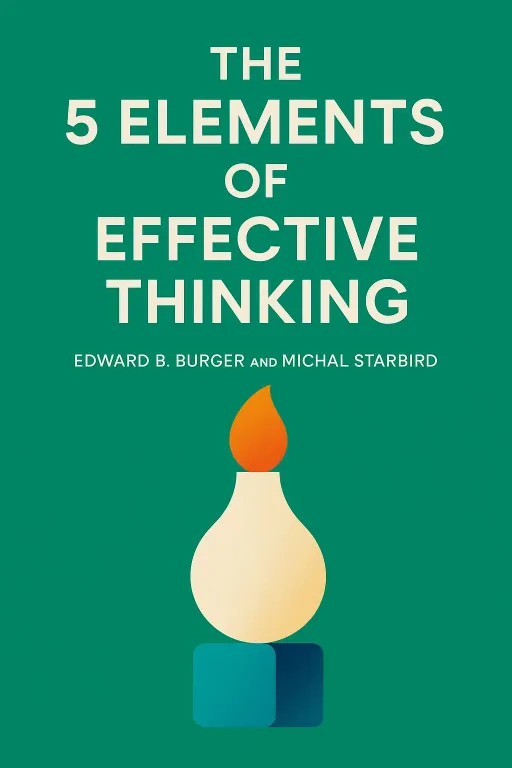
Nova: Exactly! It flips our usual approach to learning on its head, doesn't it? Today, we're diving into the art of "Architecting a Superior Mind," pulling profound insights from two highly regarded works: "The 5 Elements of Effective Thinking" by mathematicians Edward B. Burger and Michael Starbird, and "Critical Thinking" by educational theorists Richard W. Paul and Linda Elder. It’s fascinating how these authors, from different fields, converge on a similar, surprising truth about how we truly master information. Burger and Starbird, both celebrated educators known for making complex mathematical concepts accessible, really drive home this point about simplicity. And Paul and Elder, influential in shaping modern educational frameworks, provide the practical tools.
Atlas: So, it's not just academic theory, then. These are principles from people who spend their lives breaking down complex ideas for others. I’m curious how that translates into maximizing our own impact.
Nova: Precisely. What they reveal, across their different disciplines, is a powerful system for deep learning and critical assessment. It’s not about accumulating; it’s about.
The Power of Deep Understanding
SECTION
Nova: Let's start with Burger and Starbird. Their core message is that understanding simple ideas deeply is the root of all genius. It's not about being a walking encyclopedia. It’s about peeling back layers, asking 'why' until you hit the fundamental, often elegant, truth.
Atlas: That’s intriguing. For our listeners who are constantly trying to learn new things—maybe about personal finance, or navigating new tech trends, or even just building a better personal philosophy—it's not about cramming more facts, but truly grasping the foundational few? I mean, how does that work when everything feels so interconnected and complex, and time is always at a premium?
Nova: It works by giving you a robust framework that can apply to. Think about a master chef. They don't just memorize a thousand recipes. They deeply understand the fundamental properties of ingredients: how salt affects flavor, how heat changes texture, the basic chemical reactions. With that deep understanding of simple elements, they can improvise, create new dishes, and fix mistakes. A novice, on the other hand, might meticulously follow a complex recipe but completely fall apart if one ingredient is missing or if something goes slightly wrong, because their understanding is superficial.
Atlas: That’s a great analogy. It’s like trying to build a skyscraper without truly understanding simple physics. You need those bedrock principles. I can definitely see how it’s tempting to just jump to the "advanced" stuff, thinking that's where the real value is, especially when you feel pressed for time. You want the quick win.
Nova: And that's where the illusion lies. The quick win often leads to brittle knowledge. Consider Isaac Newton. His laws of motion seem incredibly simple now, almost intuitive. But his genius wasn't in discovering a million complex phenomena; it was in distilling the universe's movements into a few elegant, profoundly simple principles. That deep understanding unlocked vast scientific progress for centuries. True genius simplifies, rather than complicates. It finds the universal in the particular.
Atlas: So, it's about seeing the forest for the trees, but with the added insight of understanding the trees grow in the first place. That makes me wonder, how do we actually to that deep, simple understanding? It sounds like it requires a lot of introspection.
The Framework of Critical Thinking
SECTION
Nova: And that naturally leads us to the crucial 'how.' How do you that deep understanding? This is where Paul and Elder's work on critical thinking becomes indispensable. They give us a powerful, actionable framework: to truly understand anything, you must identify its purpose and its underlying assumptions.
Atlas: Okay, so this is the toolkit for peeling back those layers you mentioned. For someone driven by making informed choices, especially in areas like wealth management or even just understanding societal trends, identifying purpose and assumptions sounds incredibly powerful. It feels like it cuts through a lot of noise. Can you give us an example where this framework really shines?
Nova: Absolutely. Let's take something seemingly innocuous, like a new social media platform or a new diet trend that suddenly goes viral. Most people jump right into using it or trying it. But a critical thinker, following Paul and Elder, would first ask: What is the of this platform or diet? Is it genuinely to connect people, or is it primarily to gather data for advertisers? Is the diet truly for long-term health, or is its main purpose to sell supplements or a specific program?
Atlas: That's a sharp distinction. The stated purpose isn't always the actual purpose, is it?
Nova: Exactly. And then, what are the underpinning it? The platform might assume everyone wants to share everything, or that constant connectivity is beneficial. The diet might assume that one specific food group is inherently bad for, or that all metabolisms respond identically to certain restrictions. By consciously asking, "What is the purpose here?" and "What assumptions is this built upon?", you start to see the hidden mechanics, the potential biases, and where the vulnerabilities might lie. You move from passively consuming to actively evaluating.
Atlas: That's a perfect example. I mean, how many times do we just accept information or adopt a new trend at face value without really dissecting its core? It's like being a future navigator; you need to question the map's assumptions and its creator's intent before you chart your course, otherwise, you might end up somewhere you didn't intend. This sounds like an essential skill for maximizing impact in our choices.
Nova: It truly is. This isn't about being cynical; it's about being discerning. It’s about building a mental defense system against superficiality and manipulation, allowing you to truly grasp the essence of things, which then feeds back into that deep understanding we talked about earlier.
The "Explain It to a Child" Test
SECTION
Nova: Now, after all that deep diving and critical thinking, after you've identified the simple core and dissected its purpose and assumptions, how do you you've truly understood something? This is where our practical takeaway comes in, the ultimate litmus test for mastery: the "explain it to a child" challenge.
Atlas: I love that. It’s the ultimate "efficiency hack" for learning, isn't it? If you can't simplify it down to its most basic, understandable components, you haven't truly mastered it yourself. So, for our listeners looking to boost their financial literacy, like explaining 'compounding' to a 7-year-old, what's the actual benefit beyond just verifying your own knowledge? It sounds like a great way to check yourself, but is there more to it?
Nova: There's so much more to it than just verification, Atlas. It's a powerful act of. When you attempt to explain a complex concept like compounding—the idea that your money can earn money, and then that new money can also earn money, growing exponentially over time—to a child, you're forced to strip away all the jargon, all the academic fluff. You have to find analogies they can grasp, like a magical money tree that grows new branches that grow money.
Atlas: Right, like planting a tiny seed that grows into a tree, and then that tree drops more seeds, which grow into more trees, and suddenly you have a whole forest from one little seed.
Nova: Exactly! That act of translating, of simplifying, forces your own brain to organize and internalize the information in a new, more robust way. It exposes the fuzzy edges of your understanding, the places where you were just relying on memorization or vague concepts. It turns shallow knowledge into deep, actionable insight because you've had to rebuild it from the ground up, in a way that is fundamentally accessible. It's a powerful feedback loop for your own learning.
Atlas: So it's not just a test; it's a that deepens your understanding even further. You understand deeply, you critically analyze its components, and then you test and solidify that understanding by simplifying it for someone else. It feels like a complete system for architects of their own minds, ensuring that what you know is truly robust and useful.
Nova: Precisely. It builds mental models that are clear, resilient, and transferable. This isn't just about being able to teach; it's about building a mind that doesn't just collect facts, but truly the world, allowing you to navigate its complexities with profound clarity and make those informed choices you value so much.
Synthesis & Takeaways
SECTION
Nova: So, as we wrap up, remember this powerful sequence for architecting a superior mind: first, embrace the genius of deep understanding, focusing on truly mastering simple, foundational ideas rather than accumulating superficial knowledge.
Atlas: Then, apply the critical thinking framework from Paul and Elder: always identify the core purpose and the underlying assumptions of any situation or concept you encounter. This cuts through the noise and helps you make discerning choices.
Nova: And finally, put your understanding to the ultimate test: try to explain that complex idea to a child. If you can simplify it for them, you've not only verified your own depth of knowledge but profoundly solidified it. This isn't just about being "smarter" in an academic sense; it's about being more discerning, making more informed choices, and maximizing the impact of our learning, especially when time is a precious commodity. It's about building a robust mental architecture, brick by simple, deeply understood brick.
Atlas: That deep, simple understanding is the ultimate wealth, whether you're building financial literacy, a personal philosophy, or trying to understand the future. It empowers you to truly own your knowledge.
Nova: Absolutely. And it starts with that small, daily commitment to truly grasp one simple idea. What one simple idea will you truly master today?
Nova: This is Aibrary. Congratulations on your growth!









