

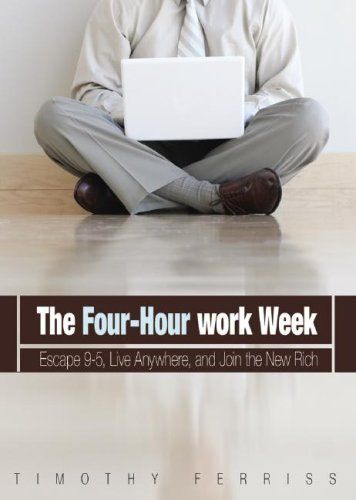
The 4-Hour Workweek
Introduction
Nova: Picture this: a 29-year-old entrepreneur writes a book that gets rejected by 26 out of 27 publishers. The one publisher who finally takes a chance on it gets an email from a major bookseller telling them, basically, don't expect much. Historical bestseller statistics say this won't work. Fast forward a few years, and that book has sold over 2.1 million copies, been translated into 40 languages, and spent four years on the New York Times bestseller list. The book? The 4-Hour Workweek by Tim Ferriss.
Nova: That is the perfect question to kick us off, because the title is both the book's greatest marketing asset and its biggest misunderstanding. Tim Ferriss himself has said it's not meant literally. The real thesis is about lifestyle design—escaping what he calls the "deferred-life plan," where you work grueling hours for decades, save money, and hope to enjoy life at age 65. He asks: why wait? Why not design a life of time, money, and mobility right now?
Nova: Let's do it. Today we're unpacking The 4-Hour Workweek—the framework, the controversy, the cultural impact, and whether any of it actually holds up nearly two decades later.
The DEAL Framework and the New Rich
Redefining the Game
Nova: At the heart of the book is a four-step framework called DEAL. D for Definition, E for Elimination, A for Automation, and L for Liberation. It's meant to be followed in order. And the first step, Definition, is arguably the most philosophical.
Nova: Exactly. He introduces this concept of the "New Rich," or NR. These aren't necessarily millionaires in the traditional sense. They're people who have replaced the deferred-life plan with what he calls luxury lifestyle design. And the currencies are time and mobility, not just money. Ferriss says something really striking: money is multiplied in value depending on how many W's you control. What you do, when you do it, where you do it, and with whom you do it.
Nova: That's the argument. And then Ferriss lays out what he calls the rules that change the rules. There are ten of them, and a few are genuinely paradigm-shifting. For example: retirement is worst-case-scenario insurance, not the goal. Interest and energy are cyclical—so you should work only when you're most effective. Less is not laziness. The timing is never right, so stop waiting for someday.
Nova: Ferriss calls "someday" a disease that takes your dreams to the grave with you. And then he offers one of the most memorable exercises in the whole book: fear-setting.
Nova: Yes. You write down the worst thing that could happen if you took a big risk, then you figure out how you'd repair the damage if it did happen. Then you consider the upside of taking action. And here's the kicker—you also calculate the cost of inaction. Where will you be in one year, five years, ten years if you don't pursue what excites you? Ferriss says most people dramatically overestimate the downside risk and catastrophically underestimate the cost of doing nothing.
Nova: That's where dream-lining comes in. Ferriss says most people ask the wrong questions. Don't ask "what do I want?" or "what are my goals?" Instead ask: "what would excite me?" He argues that excitement is the practical synonym for happiness. Boredom is the enemy, not failure.
Nova: Yes. You list what you'd do if you could not fail, create six-month and twelve-month timelines, pick your four most important dreams, calculate exactly what they would cost per month, and then define three immediate action steps for each one. The first step should take less than five minutes. The idea is that once you see the monthly price tag of your dream life, it often turns out to be surprisingly achievable.
Elimination and the 80/20 Principle
Cutting the Fat
Nova: Step two is Elimination, and this is where Ferriss gets really radical. He says time management as we know it is obsolete. The goal isn't to do more in less time—it's to do only the right things. He invokes two classic principles: Pareto's Law, also known as the 80/20 rule, and Parkinson's Law.
Nova: Parkinson's Law states that work expands to fill the time available for its completion. So Ferriss says: identify the 20% of activities that produce 80% of your results, and then use Parkinson's Law to compress your work time. Set short, hard deadlines. If you give yourself a week to do something that actually takes two hours, you'll find ways to fill the week.
Nova: Exactly. And Ferriss has this provocative thought experiment. He asks: if you had a heart attack and could only work two hours a day, what would you do differently? Then: what if you had a second heart attack and could only work two hours a week? It forces you to identify what actually matters.
Nova: Ferriss prescribes what he calls a low-information diet. He says most information is time-consuming, negative, irrelevant to your goals, and outside your influence. So he recommends a one-week media fast—no newspapers, no news websites, no TV except one hour of pleasure viewing. Only consume information that is immediate, important, and actionable. He calls it "just-in-time" information versus "just-in-case" information.
Nova: It is hard. And Ferriss extends this to email, which he calls the single biggest interruption in modern work life. He recommends checking email only twice a day, never first thing in the morning, and setting up an autoresponder so people know to expect delayed responses. He also says you should never have more than two mission-critical items on your daily to-do list. Just two.
Nova: And that's exactly his point. He argues that long to-do lists are a form of procrastination. They make you feel productive without actually being productive. He wants you to ask yourself three times a day: am I being productive or just active? Am I inventing things to do to avoid the important? There's a great line from the book: doing something unimportant well does not make it important.
Automation, Outsourcing, and the Muse
Building the Machine
Nova: Once you've eliminated the unnecessary, step three is Automation. And this is where the book shifts from philosophy to practical business building. Ferriss introduces the concept of the "muse"—a low-maintenance business that generates cash without consuming your time.
Nova: A muse is specifically designed to be automated. Unlike a traditional business that demands your constant presence, a muse should eventually run without you. Ferriss gives very specific criteria: the product should cost between $50 and $200, because that price range provides the most profit for the least customer service hassle. The main benefit should be explainable in one sentence. It should take less than four weeks to manufacture. And it should be fully explainable in a good online FAQ.
Nova: He argues that below $50, you need volume—tons of customers—to make real money, which means more support headaches. Above $200, customers expect a premium experience and are more likely to demand refunds or complain. The sweet spot is where customers make impulse purchases but don't feel the need to obsess over every penny.
Nova: Ferriss says it's easier to fill existing demand than to create new demand. He recommends looking at groups you already belong to or understand—social, professional, industry groups—and finding out what products they're already buying. Then either resell existing products, license someone else's idea, or create an information product. Information products—courses, guides, digital downloads—are his favorite because they're low-cost to produce, fast to manufacture, and hard for competitors to duplicate quickly.
Nova: Through what was, in 2007, a pretty radical idea: virtual assistants. Ferriss was one of the first mainstream authors to advocate for hiring remote workers, often in countries with lower costs of living, to handle everything from customer service to scheduling to research. He used a service called AskSunday and paid assistants a fraction of what a U. S.-based employee would cost.
Nova: Yes, we'll get to the controversies. But Ferriss's core principle is sound: eliminate before you delegate, automate before you delegate, and only then bring in people. He says using people to leverage a refined process multiplies production; using people as a solution to a poor process multiplies problems. He also gives very practical advice—give precise directions, ask assistants to rephrase tasks to confirm understanding, break large tasks into small milestones, and send only one task at a time.
Nova: That's the pitch, and it leads us to the final step: Liberation.
Liberation, Mini-Retirements, and the Mobile Life
Breaking Free
Nova: Liberation is about mobility—the ability to run your business and live your life from anywhere in the world. Ferriss argues that this is the third pillar of the New Rich lifestyle, alongside time and income. And it's not just about being a digital nomad. It's about fundamentally rethinking how work fits into your life.
Nova: Instead of deferring all your leisure and travel to the end of your life, Ferriss advocates taking extended breaks throughout your career. A mini-retirement might be three months, six months, even a year, where you go live in another country, learn a new skill, immerse yourself in a different culture, and then return to work refreshed. He did this himself—he spent time in Buenos Aires learning tango, becoming a world-record holder in the process. He took intensive language courses. He trained in martial arts.
Nova: Exactly. And Ferriss was prescient about remote work. Back in 2007, he was writing about how to negotiate with your boss to let you work from home. He even suggested a somewhat sneaky strategy: call in sick for two days but work from home, then show your boss the productivity records to prove virtual work is effective.
Nova: It was. The New Yorker published a fascinating retrospective on the book in 2021, written by Cal Newport. He pointed out that the context in 2007 was all about hustle culture—Silicon Valley's "10x engineers," the glorification of overwork, BlackBerrys buzzing with emails at all hours. Ferriss walked into South by Southwest that year and told a room full of hard-charging tech enthusiasts that their professional lives were unsustainable. And the overflow crowd loved it.
Nova: Newport makes exactly that argument. He says the enthusiastic reception Ferriss got was a warning shot—an early sign that the always-on knowledge work model had serious flaws. But at the time, the culture wasn't ready to fully hear the message. It was easier to dismiss Ferriss as just another productivity guru with a gimmicky title.
Criticisms, Privilege, and What the Book Gets Wrong
The Controversy
Nova: Let's talk about the criticisms, because there are legitimate ones. The book has been called exploitative, unrealistic, and emblematic of a certain kind of privilege.
Nova: It does. Critics argue it perpetuates economic inequalities. There's also the "fake expert" critique—Ferriss advises that you can become an expert in something by reading a few books on a topic and synthesizing the information, which some people see as encouraging superficial knowledge over genuine expertise. Meagan Day, writing in Jacobin, specifically criticized this aspect.
Nova: That's a fair point and one that Ferriss's critics have raised consistently. The book is largely written from the perspective of a Princeton-educated, able-bodied American man with no dependents. And even Ferris himself worked 14-hour days building his business before he could step back. The four-hour week was the destination, not the journey.
Nova: There's also the uncomfortable fact that Ferriss himself probably works far more than four hours a week—he runs a massively successful podcast, writes books, invests in startups, and maintains a public presence. The New York Times pointed out early on that he spends many hours blogging and self-promoting, which he describes as "evangelizing" rather than working. It's a semantic distinction that doesn't hold up under scrutiny.
Nova: Absolutely. And that's the paradox of the book. It's flawed, it's controversial, some of the specific tactics are dated or ethically questionable, and yet millions of people have found genuine value in its core message: question the default path, design your life intentionally, and don't wait until retirement to start living.
Digital Nomads, Great Resignation, and Why the Book Still Matters
The Legacy
Nova: So nearly two decades after publication, what's the legacy of The 4-Hour Workweek?
Nova: And many digital nomads directly credit Ferriss's book as the catalyst. It gave them a vocabulary and a framework. The DEAL process, the idea of a muse business, the concept of geographic arbitrage—living in cheaper countries while earning in stronger currencies. These ideas have shaped a generation of entrepreneurs.
Nova: Cal Newport made this point in his New Yorker piece. He said if we had been more willing to recognize the radical nature of Ferriss's dissent back in 2007, we might have been less caught off guard by the upheaval of the pandemic era. The book was a prophecy that many weren't ready to hear.
Nova: That's true. But the deeper principles—the 80/20 rule, Parkinson's Law, fear-setting, dream-lining, selective ignorance—those are timeless. They're not dependent on any particular technology or economic moment. Ferriss himself revisited the book in 2025 on his podcast, talking about "the end of time management," and he still stands by the core frameworks.
Conclusion
Nova: So let's bring it all together. The 4-Hour Workweek is not really about working four hours a week. It's about rejecting the deferred-life plan and designing a life that prioritizes time, mobility, and meaningful work over busyness and conventional success. The DEAL framework—Definition, Elimination, Automation, Liberation—gives you a step-by-step path, even if you don't follow every single tactic.
Nova: Fourth, if you're building something, validate before you build. Always be validating. And fifth, consider whether relative income—money relative to time spent and location flexibility—matters more to you than absolute income.
Nova: Beautifully put. Twenty-six publishers rejected this book. One took a chance. And nearly twenty years later, we're still talking about it. That tells you something about the power of a provocative idea delivered with conviction.