

Deconstructing the Faith in Technology and Wealth
Golden Hook & Introduction
SECTION
Nova: Imagine for a moment that you wake up tomorrow and every digital interface has vanished. The banking apps, the social feeds, the algorithmic recommendations, the very concept of a digital wallet. You are left with nothing but physical objects and human relationships. Most people would panic, not because they lack resources, but because they have forgotten how to navigate a world that isn't mediated by software or abstract financial ledgers.
Atlas: That is a terrifying thought experiment, mainly because I rely on my banking app just to know if I can afford lunch today. But I see where you are going with this. We treat these systems like they are the laws of physics, like gravity or the speed of light, when in reality, they are just inventions. We built them, we maintain them, and yet, we treat them as if they have the moral authority to tell us how to live our lives.
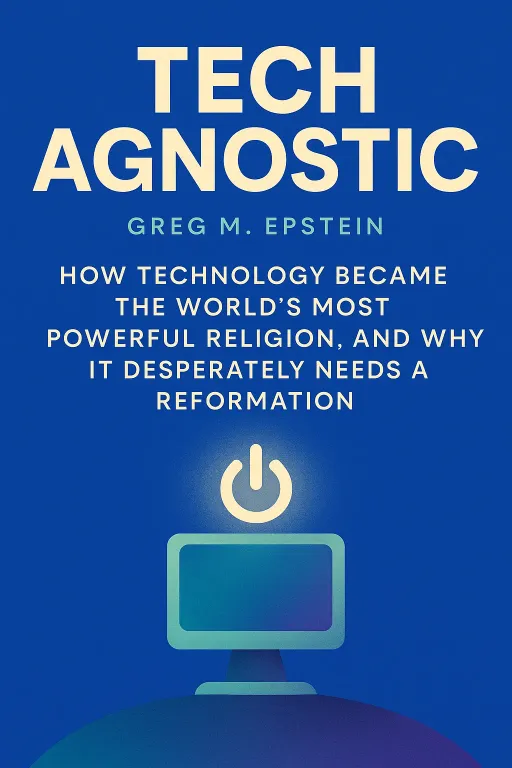
Nova: Exactly. And that is the friction point we are exploring today. We are looking at two books that dismantle the invisible scaffolding of modern life. First, we have Tech Agnostic by Greg M. Epstein, which argues that our devotion to technology has become a dangerous form of secular dogma. Then, we are pairing that with The Evolution of Money by David Orrell and Roman Chlupatý, a deep dive into how our financial systems are not objective realities, but fragile social agreements.
Atlas: I love the pairing of these two. It is like taking the two biggest pillars of modern society—how we connect and how we value our time—and realizing that both are held up by nothing more than our collective agreement to keep believing in them. It is the perfect starting point for anyone who feels like they are running on a treadmill they did not choose.
The Church of the Algorithm
SECTION
Nova: Let’s start with the tech side. Greg M. Epstein is fascinating because he is a humanist chaplain at Harvard. He spent his career helping people find meaning without religion, and he brings that same lens to the tech industry. He isn't anti-technology, but he is fiercely anti-dogma. He points out that we have essentially replaced traditional religion with the Church of the Algorithm. We look to tech giants for salvation, for moral guidance, and for the solutions to all our problems, without ever stopping to ask if they actually have the right to hold that authority.
Atlas: That sounds like a heavy claim, but I see it everywhere. Look at how we treat data. If a metric says we are productive, we are productive. If an algorithm suggests a career path or a lifestyle change, we assume it is the optimal path because, well, the computer said so. We have outsourced our intuition to a server farm in California.
Nova: It is the ultimate outsourcing of agency. Epstein’s core argument is that when we become tech-agnostic, we stop treating technology as an infallible deity. Think about the way we talk about artificial intelligence today. It is almost mystical. We talk about it as if it has a will, a destiny, or a moral compass. But it is just code. When we treat it as an objective truth, we lose the ability to question the bias, the profit motive, and the human decisions that went into building it.
Atlas: I have been thinking about this in the context of my own work. When I use a project management tool, I sometimes find myself bending my workflow to fit the software's constraints rather than the other way around. Is that what you mean by this dogma? We start to believe the software is the reality?
Nova: That is a perfect example. It is the reversal of the tool-user relationship. Instead of the tool serving your creative vision, you become a cog in the tool’s logic. Epstein argues that we need to reclaim our moral authority. If a piece of technology encourages us to be more isolated, more anxious, or more obsessed with metrics that do not actually matter, we should not just accept it as the cost of doing business. We should question whether that tool belongs in our lives at all.
Atlas: That makes sense, but how does one actually practice this tech-agnosticism? I cannot just quit the internet. I have a career. I have responsibilities. If I suddenly stop using these tools, I am not being a conscious creator, I am just being unemployed.
Nova: That is the crucial distinction. Being tech-agnostic does not mean becoming a Luddite. It means becoming a skeptic of the cult. It means asking, when you pick up a tool, what is this actually doing to my cognitive freedom? If you are a designer, for example, and you realize that a specific software suite is forcing you into a repetitive, uninspired design pattern, a tech-agnostic approach says you might need to change your process, or even change your tool, even if everyone else in the industry is using the standard. It is about prioritizing your sovereignty over the convenience of the status quo.
Atlas: I can see how that would be liberating. It is about intentionality. Instead of saying, I use this because it is the industry standard, I am saying, I use this because it actively serves my specific goal. It is a shift from being a passive consumer of tech to being an active architect of my own digital environment.
Nova: Exactly. And the moment you realize that the tech giants are not moral authorities, but just companies trying to maximize engagement or revenue, the spell breaks. You stop looking at their updates as divine commandments and start looking at them as business decisions that you can choose to ignore, adapt, or circumvent.
The Fiction of Finance
SECTION
Atlas: Okay, I am on board with reclaiming agency from the algorithm. But let’s pivot to the second part of our discussion, because this is where I think things get even stickier. We have established that tech is a construct, but money? Money feels real. When I look at my bank account, that number feels like an objective fact. But you are telling me that The Evolution of Money suggests otherwise?
Nova: It is the most persistent illusion we have. David Orrell and Roman Chlupatý do a brilliant job of stripping away the mysticism around money. We like to think of money as a commodity, like gold or silver, or perhaps as a scientific measurement of value. But they trace the history of money and show that it has always been, and will always be, a social agreement. It is a ledger of trust.
Atlas: I remember reading about the Rai stones on the island of Yap. They were these massive stone discs used as currency. And there is a famous story where a stone was lost at sea, but the community still traded it as money because everyone agreed it still existed and held value. It is the ultimate proof that money is just a collective hallucination.
Nova: That is the perfect analogy. The Rai stones are the best evidence that value is not in the object, but in the agreement. Modern money is just a digital version of that. When you hold a dollar, or see a number in your bank app, you are holding a claim on a social contract. You are betting that other people will also agree that this number has value tomorrow. If that trust evaporates, the money becomes worthless paper or, in our case, worthless pixels.
Atlas: That is both comforting and deeply unsettling. It is comforting because it means money is not some immutable law of the universe that controls my destiny. It is unsettling because it means the foundation of my life is built on something as fickle as human trust. If everyone loses faith in the system, the system collapses.
Nova: And that is precisely why it is so important for a Strategic Architect to understand this. If you view money as an absolute truth, you become a slave to the system. You think, I must do X, Y, and Z to get more of this objective substance called money. But if you view money as a social construct, you realize that your primary asset is not the money itself, but your ability to participate in, create, and maintain those trust networks.
Atlas: That changes how I think about career moves. I have always thought about my career in terms of climbing a ladder to get more money. But if money is just a mechanism for social trust, then maybe I should be optimizing for trust and reputation rather than just the paycheck.
Nova: Now you are seeing the framework. When you realize that wealth is just a representation of social agreement, you start to see that the most valuable things you can build are the ones that foster genuine trust and provide real value to others. That is how you become sovereign. You are no longer chasing the currency; you are building the capacity to generate value that others will inherently trust.
Atlas: This reminds me of the shift from the industrial era to the creative or knowledge economy. In the industrial era, you needed physical capital, which was tied to money. Today, you can build a massive amount of "social trust capital" with nothing more than a laptop and a good idea. That is why the barriers to entry for building something meaningful are lower than ever.
Nova: Precisely. And that is where the two books intersect. Technology is the infrastructure of this new trust economy. If you are tech-agnostic, you are not being blinded by the flashy tools, which means you can use those tools to build deeper, more authentic trust. You are using the technology to facilitate human connection and value exchange, rather than using the technology to just extract attention for profit.
Building Your Sovereign Blueprint
SECTION
Atlas: I want to push on this for a second because I know our listeners are probably thinking, this sounds great in theory, but how do I pay my rent? How do I translate this philosophy into a Monday morning action plan? If I am a conscious creator, how do I apply this "tech-agnostic, money-as-trust" framework to my daily grind?
Nova: That is the right question. It starts with a audit of your own systems. Take the next 30 minutes. Do not start a new project. Instead, look at your existing workflow. Ask yourself, which of these tools am I using because they actually serve my output, and which am I using because they are the "default" or the "standard"? If you find a tool that is causing you anxiety or forcing you into a way of working that feels unnatural, try to find an alternative or strip it out completely.
Atlas: I love that. It is the Marie Kondo approach to digital tools. Does this app spark joy? No, does this app spark agency? If not, get rid of it. And for the money side?
Nova: For the money side, perform a trust audit. Look at your income streams. Are they based on commoditized labor, where you are just a replaceable unit of output? Or are they based on relationships, reputation, and unique value? The more you can shift your work toward the latter, the more you are capitalizing on the fact that money is just a social agreement. You are building a reputation that is distinct from the fluctuating value of the currency itself.
Atlas: It is about moving from being a commodity to being a creator. A commodity is easily replaced because its value is tied to a standard price. A creator is difficult to replace because their value is tied to a unique trust relationship.
Nova: That is exactly it. And when you stop seeing yourself as a commodity in a tech-driven marketplace, you stop feeling the need to constantly optimize for the algorithms that are designed to commoditize you. You start optimizing for the people you serve. That is how you break the dogma.
Atlas: I am thinking about the listeners who might feel overwhelmed by all of this. They are looking at the future of work, they are looking at AI, they are looking at the economy, and they feel like they are being swept away by a tide. This conversation feels like learning how to swim, rather than just trying to tread water.
Nova: It is learning to swim. And the first step of swimming is realizing you are not drowning. You are in a medium you can navigate. The tech is not a god, and money is not a law. They are environments. You can reshape your environment. You can choose which parts of the digital world you inhabit and which parts you ignore. You can choose to build your financial life around trust and value rather than just chasing the next paycheck.
Atlas: That is such a powerful reframe. It takes the pressure off. If I don't need to be a slave to the "digital gods" or the "financial deities," I can actually breathe. I can focus on the work that matters.
Nova: And that is the definition of sovereignty. It is not about controlling everything. It is about knowing what you are responsible for and what you are not. You are responsible for your creative output, your integrity, and the trust you build with others. You are not responsible for keeping up with every new tech trend or playing the financial game by rules that were designed to keep you a passive participant.
Atlas: I think I have my blueprint for the next 30 minutes. I am going to look at my screen time data, not to see how long I spent on my phone, but to see which apps are actually facilitating my goals versus which ones are just consuming my attention. And then I am going to look at my current projects and ask, am I building trust, or am I just chasing a metric?
Nova: That is a perfect application. And remember, this is not a one-time thing. It is a practice. You will get pulled back into the dogma. You will start worrying about the currency again. But every time you catch yourself, you can just step back and remember: it is all a construct. And you are the one who gets to decide how you engage with it.
Synthesis & Takeaways
SECTION
Atlas: This has been a massive shift in perspective for me. We started by talking about the "Church of the Algorithm" and the "Fiction of Finance." It sounds like the overarching takeaway here is that we are living in a world of our own making, even if we have forgotten that we are the ones who made it.
Nova: That is the core of it. We have built these systems to serve us, but somewhere along the way, we started serving them. The evidence from both Epstein and the team of Orrell and Chlupatý is clear: when you realize the systems are human-made, you realize they are malleable. You are not a victim of the tech or the economy. You are a participant in a grand, ongoing negotiation.
Atlas: It is empowering. It means the future is not something that happens to us; it is something we are actively constructing every time we make a decision about which tool to use, which work to value, and who to trust.
Nova: Exactly. And that is the ultimate goal of being a Conscious Creator. You do not just create content or products. You create a life that is aligned with your own values, rather than the values embedded in the software or the financial systems you use.
Atlas: I love that. We are not just users. We are architects. And I think that is the perfect note to end on. If you are listening to this, don't just consume this episode—apply it. Take that 30-minute audit we talked about. Start small, but start now.
Nova: The tools are yours to command. The trust is yours to build. And the future is yours to define.
Atlas: This is Aibrary. Congratulations on your growth!