

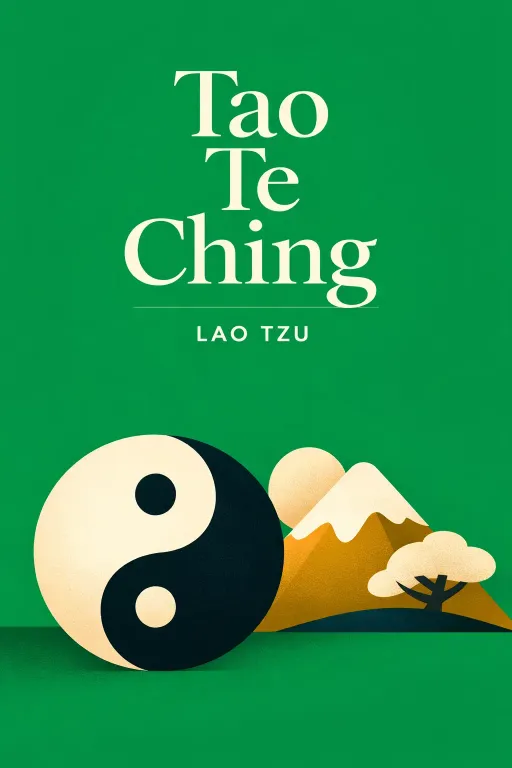
The Unseen Engine
Golden Hook & Introduction
SECTION
Michael: Alright Kevin, quick-fire. What do you know about the Tao Te Ching? Kevin: Uh, it’s that super short book that’s impossible to understand, written by a guy who may or may not have existed, and its main advice is basically... 'don't try so hard.' It’s the official philosophy of senioritis. Michael: The philosophy of senioritis! I love that. And you're not entirely wrong. Today we are diving into the Tao Te Ching by Lao Tzu. And that mystery you mentioned is a huge part of its appeal. It’s widely acclaimed, but also polarizing for that very reason. Kevin: Wait, so who even was Lao Tzu? Was he a real guy? Michael: That's the million-dollar question. The historical consensus is that "Lao Tzu," which just means "Old Master," was likely a composite figure, a legend built from many ancient sages. The book itself probably evolved over centuries from oral traditions before being written down around the 4th century BCE. Kevin: So it’s like a greatest hits album from a band that never existed. Michael: Exactly! But the legend is fantastic. The story goes that he was a court archivist, a contemporary of Confucius. When Confucius met him, he was so blown away by Lao Tzu's profound, mysterious wisdom that he later told his students, "Today, meeting Lao Tzu, it was like facing a dragon." Kevin: A dragon! Not, "he had some good points." He was a dragon. That's a heck of an endorsement. Michael: It is. And despite the mystery, the Tao Te Ching has become one of the most translated texts in world history, second only to the Bible. Its influence is immeasurable. Kevin: Okay, so it's either the most profound wisdom ever or the world's oldest, most successful prank. I'm in. Let's see if we can crack the code.
The Unseen Engine: Understanding the Tao as Absence and Presence
SECTION
Michael: Well, the code starts with a warning. The very first line of the book is, "A Way called Way isn’t the perennial Way. A name that names isn’t the perennial name." Kevin: Right. So the first rule of Tao Club is you don't talk about Tao Club. Got it. What does that even mean? Michael: It means the ultimate reality, the 'Tao' or 'The Way,' is beyond our words and concepts. Language can point to it, but it can't capture it. To explain this, Lao Tzu splits reality into two ideas: Yu and Wu. Kevin: Yu and Wu. Sounds like a comedy duo. Michael: Close. Yu is 'Presence.' It's everything we can see, touch, and name—the "ten thousand things," as the book calls them. Your desk, this microphone, the stars. That's Presence. Kevin: Okay, simple enough. The stuff in the world. What's Wu? Michael: Wu is 'Absence.' It’s the formless, invisible, generative source from which Presence arises. It's the ultimate mystery. The book says, "In perennial Absence you see mystery, and in perennial Presence you see appearance." Kevin: Hold on. To most people, 'absence' means 'nothing.' Are you telling me the secret to the universe is... nothingness? That sounds like a great excuse to not do my laundry. "Sorry, honey, I'm contemplating the generative void." Michael: That's the brilliant, counter-intuitive leap. It’s not nothingness in the sense of a vacuum. It’s a productive, potential-filled emptiness. Lao Tzu gives a perfect, concrete example in Chapter 11. He says, think of a potter making a jar. Kevin: Okay, I'm picturing it. Clay on a wheel. Michael: The potter takes the clay—the Presence—and shapes it. But what makes the jar useful? It's the empty space inside. The 'Absence.' He says, "Presence gives things their value, but absence makes them work." Kevin: Huh. I've never thought of it that way. Michael: He does it again with a wheel. "Thirty spokes gathered at each hub: absence makes the cart work." The hole in the center is what allows the entire wheel to function. Or a house—you build walls, but it's the empty space for doors, windows, and rooms that makes it a home. Kevin: Wow. Okay, that's actually a really powerful point. The empty space is where the action happens. It's not just a lack of something; it's the potential for something. Michael: Exactly. It's the space that allows for function, for life, for movement. Kevin: That’s a bit like the silence between musical notes. The silence is what gives the notes their rhythm and meaning. Without the 'absence,' you just have a wall of noise. Michael: That's a perfect analogy. The Tao is both the notes and the silence. It's the interplay between the visible and the invisible. And Taoist wisdom is about learning to appreciate and work with that unseen, empty, but incredibly powerful 'Absence.' It’s the engine of reality, hidden in plain sight. Kevin: My mind is officially a little bit bent. So the world we see is just the foam on top of this deep, invisible ocean of 'Absence.' Michael: Precisely. And that's a huge shift in perspective. We are obsessed with the foam—with what's visible, measurable, and solid. Lao Tzu is telling us to pay attention to the ocean.
The Power of Water: Mastering 'Wu Wei' (Effortless Action)
SECTION
Kevin: Okay, my brain hurts a little, but I think I get the 'emptiness is useful' thing. But how does this apply to, you know, living? Are we supposed to just sit around being empty? It still feels a little passive. Michael: That's the perfect question, and it leads directly to the most famous, and maybe most misunderstood, Taoist concept: Wu Wei. Kevin: Wu Wei. I've heard of this. It's usually translated as 'non-action,' right? Which again, sounds like a great philosophy for a Sunday afternoon nap. Michael: And that's the common mistake. A better translation is 'effortless action' or 'nothing's own doing.' It doesn't mean being lazy. It means acting in a way that is so aligned with the natural flow of things that it feels effortless. It’s about achieving more by doing less. Kevin: That sounds like a marketing slogan for a four-hour workweek. How is that possible? Michael: Lao Tzu uses the most powerful metaphor for Wu Wei: water. In Chapter 8, he says, "Water’s nobility is to enrich the ten thousand things and yet never strive: it just settles through places people everywhere loathe." It flows to the lowest point. It's humble. Kevin: Right, it doesn't fight to be on top of the mountain. It naturally flows down into the valley. Michael: Exactly. But then in Chapter 78, he shows the other side of water's power. He says, "Nothing in all beneath heaven is so soft and weak as water. And yet, for conquering the hard and strong, nothing succeeds like water." Kevin: That gives me chills. A tiny, persistent drip of water can wear a hole through solid granite. Or a river can carve the Grand Canyon. Michael: Precisely. The hard and strong, the rock, is brittle. It resists, and eventually, it breaks. A strong tree snaps in a hurricane. But the soft and weak, the water, yields. It flows around the obstacle, or it patiently wears it down. It adapts. It never fights a direct battle, yet it always wins in the end. That is Wu Wei. It's the integrity of peacefulness. Kevin: This is the total opposite of 'hustle culture.' Our entire society screams at us to be the rock. Be strong, be tough, push through, force it to happen. Grind! But Lao Tzu is saying, "Be the water." Michael: He is. He's saying that forceful striving is actually a sign of weakness because it's inefficient and unsustainable. He says, "Stretch onto tiptoes and you never stand firm. Hurry long strides and you never travel far." It’s a critique of that desperate, ego-driven effort. Kevin: Okay, let's make this real. I'm in a business negotiation. The other side is being a rock—stubborn, demanding. The 'hustle' playbook says I need to be a bigger, harder rock. Push back, show strength. How does 'being water' work here without just getting steamrolled? Michael: It's not about surrendering. It's about changing your approach. Instead of a head-on collision, you flow. You listen deeply. You don't resist their points; you absorb them. You ask questions. You find the cracks in their logic, the small openings. You yield on unimportant points to gain ground on what matters. You guide the conversation into the channels you want it to go, not by force, but by finding the path of least resistance. Kevin: So you're not breaking down their wall; you're finding the open gate next to it. Michael: Exactly. You're using their own rigidity against them. Lao Tzu has this amazing line for leaders: "Govern a great nation as you would cook a small fish." Kevin: What? How does that connect? Michael: How do you cook a small, delicate fish? You handle it as little as possible. If you keep poking it and flipping it and messing with it, it falls apart. The best way to govern, to lead, to manage a project, is with a light touch. Don't over-manage. Don't force. Create the right conditions and let things unfold naturally. That is Wu Wei in action.
Synthesis & Takeaways
SECTION
Kevin: Wow. So it seems like the entire philosophy is a giant collection of paradoxes. To be full, be empty. To be strong, be weak. To do everything, do nothing. Michael: Exactly. And all those paradoxes point to one central target: a profound critique of the human ego. The ego wants to be the rock. It wants to be seen, to be solid, to strive, to control, and to force its will on the world. The ego thinks that's where power comes from. Kevin: And the Tao Te Ching is saying that's a complete illusion. Michael: A complete illusion. It teaches that true, enduring power comes from letting go of that ego, from becoming selfless and aligning with the natural flow of the Tao, which is infinitely more powerful than our individual, frantic efforts. It's a fundamental shift in how we see ourselves in the universe. It’s moving from a warrior mindset to a dancer's mindset. Kevin: A warrior tries to conquer the world. A dancer moves with it. That’s a great way to put it. The warrior gets tired, but the dance can go on forever. Michael: And the dance is more effective. The book says, "The Way of heaven profits without harm, and the Way of a sage acts without contending." You stop fighting, and suddenly, nothing is fighting you. Kevin: That's a beautiful, and honestly, very challenging thought for our hyper-competitive world. It feels like a relief, but also kind of scary. Michael: It is. It requires trust in a process larger than yourself. Here’s a simple way to try it. For just one day this week, try to approach one task with the 'spirit of water.' It could be a difficult conversation, a creative block, or even just navigating traffic. Kevin: And what does that mean, practically? Michael: It means instead of forcing a solution, just pause and observe. See where the natural energy is flowing. Don't push, just guide. Don't try to be a rock, blocking the flow; be the riverbank, gently directing it. See what happens when you stop striving and start yielding. Kevin: And maybe ask yourself: where in my life am I being a rock when I should be water? I can think of a few places already. Michael: We all can. It's a lifelong practice. The book is short, but its wisdom is deep enough to last a lifetime. Kevin: We'd love to hear how that goes for you all. Share your 'water' or 'rock' moments with us on our community page. It’s a conversation worth having. Michael: Absolutely. Kevin: This is Aibrary, signing off.