

Communicating Your Vision: From Ideas to Impact
Golden Hook & Introduction
SECTION
Nova: You know, Atlas, I was reading this wild statistic the other day. Apparently, the average person spends about 70% of their waking hours communicating, but only a fraction of that time is truly effective. It makes you wonder, are we even speaking the same language, or just making noise?
Atlas: Oh, I've been there! You pour your heart and soul into explaining something, only to get blank stares or, worse, a completely different interpretation. It's like you're sending out a perfectly crafted message in a bottle, and it washes ashore somewhere completely unexpected.
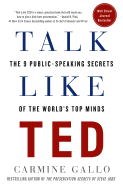
Nova: Exactly! And that's why today, we're diving into a pair of books that are essentially a masterclass in making your words count. We're talking about "Talk Like TED: The 9 Public-Speaking Secrets of the World's Top Minds" by Carmine Gallo, and "Made to Stick: Why Some Ideas Survive and Others Die" by Chip Heath and Dan Heath.
Atlas: Ah, the Heath brothers! They have this incredible knack for dissecting why some ideas just… well,, and others vanish into the ether. And Gallo's work on TED Talks—it's like he reverse-engineered charisma.
Nova: He really did. Gallo, a former journalist and communications coach, spent countless hours analyzing hundreds of TED talks to distill the common threads of what makes a presentation not just good, but truly unforgettable. He observed that many of the most celebrated speakers weren't necessarily born orators; they simply mastered a set of repeatable principles. It's not about being a natural, it's about being strategic.
Atlas: And the Heath brothers, one a Stanford professor and the other a Duke professor, have a similar approach, but for ideas themselves. Their work, which has been widely acclaimed and cited across various fields, really breaks down the anatomy of an influential concept. They're not just giving you tips; they're giving you a framework.
Nova: It's fascinating how both books, though approaching communication from slightly different angles, converge on the same fundamental truth: powerful communication isn't a mystical gift; it's a skill built on understanding your audience and structuring your message for maximum clarity and emotional resonance. It's about engineering impact.
Atlas: That resonates so much with me, and I imagine with many of our listeners who are trying to articulate a vision, whether it's for a team, a project, or even just a personal goal. It’s not enough to a great idea; you have to it effectively.
Nova: Precisely. And that leads us perfectly into our first big idea: the architecture of engaging communication. What makes a message not just heard, but truly and?
The Architecture of Engaging Communication
SECTION
Atlas: So, when you talk about the architecture of engaging communication, what's the blueprint we're looking at here? What are the foundational elements?
Nova: Well, both books offer incredible insights. Gallo, in "Talk Like TED," deconstructs the most impactful TED Talks, revealing nine common traits of successful presentations. He found that the best speakers do things like make emotional connections, introduce novelty, and, crucially, tell stories. They’re not just presenting data; they're crafting an experience.
Atlas: That makes sense. I mean, think about the TED Talks that really stick with you. It’s rarely the one that just throws a bunch of facts at you. It’s the one that makes you something or introduces you to a concept you’d never considered before.
Nova: Exactly. One of Gallo’s key findings is that you need to "make 'em laugh, make 'em cry, make 'em think." He emphasizes that emotional connection is paramount. For instance, he points to figures like Bryan Stevenson, who founded the Equal Justice Initiative. Stevenson’s TED Talk on justice and mercy wasn't just a recitation of facts; it was a deeply personal narrative, filled with vivid anecdotes that brought the abstract concepts of injustice and redemption to life. He spoke with such conviction and vulnerability that you couldn't help but be moved.
Atlas: That’s a powerful example. It’s not about manipulating emotions, but about authentically sharing the human stakes of your message. But what about the other side of the coin – the actual itself? How do you make that sticky?
Nova: That’s where Chip and Dan Heath's "Made to Stick" comes in. They introduce the SUCCESs principles: Simple, Unexpected, Concrete, Credible, Emotional, Stories. If you can bake these elements into your message, it has a far greater chance of surviving and influencing.
Atlas: Simple, Unexpected, Concrete, Credible, Emotional, Stories. That's a lot to remember. Can you break down one or two of those for us?
Nova: Absolutely. Let's take "Unexpected" and "Concrete." The Heath brothers argue that to get attention, you need to break a pattern. Our brains are wired to notice things that are out of the ordinary. Think about the "velvet hammer" example they use: a seemingly contradictory phrase that grabs your attention precisely because it doesn't quite fit. Or a CEO who brings a live chicken into a meeting to illustrate a point about process. It's unexpected, and suddenly, everyone is paying attention.
Atlas: I can see how that would work. It’s like a pattern interrupt. In a world full of noise, you need something that jolts people out of their autopilot.
Nova: Precisely. And then "Concrete" is about making your ideas tangible. Instead of saying "our customer service is excellent," you say, "Our customer service guarantees that if you're not satisfied, we'll send a technician to your home within 60 minutes." That's concrete. You can visualize it. The Heath brothers famously cite the example of a "bag of popcorn" in a movie theater, where they reveal that a medium popcorn can contain more saturated fat than a day's worth of unhealthy meals. It's not just a statistic; it's a specific, relatable item that makes the health implications viscerally real.
Atlas: That’s a stark difference. Instead of an abstract number, it’s a bag of popcorn I can picture in my hand. That hits different. So, both Gallo and the Heath brothers are essentially saying that to communicate effectively, you need to engage both the head and the heart, right?
Nova: Exactly. Gallo's "emotional connection" aligns perfectly with the Heath's "Emotional" principle, and Gallo's emphasis on "storytelling" is a direct echo of the "Stories" principle. They're complementary frameworks for building messages that resonate deeply. It's about moving beyond just conveying information to creating understanding and inspiring action.
Your Communication Toolkit: Speak with Purpose
SECTION
Atlas: So, we’ve got these incredible frameworks, the nine secrets from TED Talks, and the SUCCESs principles. How do we actually put this into practice? For aspiring leaders or anyone who wants to articulate their vision more clearly, what's a tangible next step?
Nova: That's the million-dollar question, isn't it? It's one thing to understand the theory, another to wield it. The tiny step we recommend this week is to choose one idea you want to communicate. It could be a project proposal, a team goal, or even just explaining a new concept to a colleague.
Atlas: Just one idea. That feels manageable.
Nova: Right. And then, apply at least two of the SUCCESs principles from "Made to Stick" to refine your message. Let's say you're trying to explain a new, somewhat complex software feature. Instead of just listing its capabilities, think about how you can make it "Unexpected" – perhaps by starting with a surprising statistic about the problem it solves. Then, make it "Concrete" – describe a specific scenario where the feature saves someone time or prevents a headache, rather than just saying it "improves efficiency."
Atlas: So, instead of saying, "Our new software increases productivity," I might say, "Imagine you're rushing to meet a deadline, and suddenly, with one click, our software automates that tedious data entry task that used to take you an hour. That's what this new feature does."
Nova: Boom! You just nailed "Unexpected" and "Concrete." You created a mini-story that's relatable and paints a clear picture. And then, the second part of the tiny step: practice delivering it with the passion Gallo describes.
Atlas: Ah, the passion. That’s where the "Talk Like TED" part comes in. It’s not just you say, but you say it.
Nova: Precisely. Gallo talks about having an authentic delivery, using your voice, your body language, and your eyes to convey your conviction. It's about being genuinely enthusiastic about your message. Think of someone like Sir Ken Robinson, whose TED Talk on schools killing creativity remains one of the most viewed of all time. He didn't just rattle off facts; he performed. He used humor, personal anecdotes, and a dynamic presence to make his profound point unforgettable.
Atlas: It’s not about being theatrical for the sake of it, is it? It’s about letting your genuine belief in the idea shine through.
Nova: Exactly. It's about finding that sweet spot where your authentic self connects with the power of your message. It's about understanding that communication is a performance, not in a fake sense, but in the sense that you are presenting something valuable to an audience. And like any good performer, you need to rehearse, refine, and bring your whole self to it.
Atlas: That’s a powerful distinction. It takes it from being a chore to being an opportunity to truly connect and influence. It's about moving from simply transmitting information to truly inspiring.
Synthesis & Takeaways
SECTION
Nova: So, what we're really talking about today is moving beyond just having good ideas to becoming a master architect of those ideas, building them into messages that not only reach people but genuinely move them and stick with them.
Atlas: It’s empowering, actually. It takes away the mystique of "natural communicators" and gives us a clear path, a toolkit to build our own communication muscles. It’s not magic; it’s method.
Nova: And it's a method that centers on understanding the human element. Whether it's Gallo emphasizing emotional connection and storytelling, or the Heath brothers providing a framework to make ideas memorable, both paths lead to the same destination: impact. It’s about building a bridge between your mind and the minds of others, ensuring your vision doesn't just flicker, but truly ignites.
Atlas: And for anyone who's ever felt like their brilliant ideas were just bouncing off walls, this offers a tangible way to make them resonate. It’s about building that future, one clear, compelling message at a time.
Nova: That’s it. Remember, strong communication isn't about being the smartest person in the room; it’s about being the most effective at sharing your wisdom.
Atlas: This is Aibrary. Congratulations on your growth!