

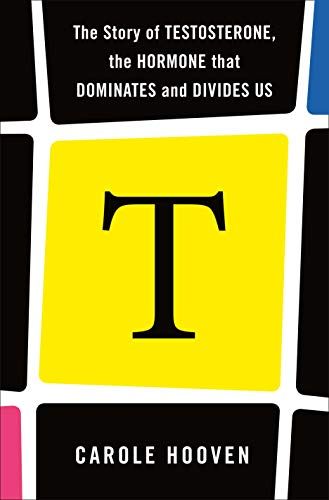
T
The Story of the Hormone That Dominates and Divides Us
Introduction: The Hormone That Divides Us
Introduction: The Hormone That Divides Us
Nova: Welcome to Aibrary. Today, we are diving into a book that tackles one of the most politically charged molecules in the human body: testosterone. When you hear that word, what pops into your head? Maybe aggression, maybe machismo, maybe the stereotype of the hyper-competitive male. But what if that’s only half the story?
Nova: : That’s exactly what I was thinking, Nova. It feels like testosterone has become shorthand for every negative stereotype about masculinity. It’s the ultimate scapegoat, or maybe the ultimate excuse, depending on who you ask. So, what’s the book that’s trying to untangle this mess?
Nova: The book is "T: The Story of Testosterone, the Hormone that Dominates and Divides Us," by Carole Hooven. Hooven is a Harvard evolutionary biologist, and she’s not here to say testosterone is irrelevant. Far from it. She argues it is a force shaping human behavior and sex differences. But her central, provocative claim is that acknowledging this biological reality doesn't mean we have to accept stifling gender norms or patriarchal values.
Nova: : That sounds like walking a tightrope. If you say biology matters, people immediately assume you’re dismissing culture or social conditioning entirely. What makes Hooven’s take different from the usual nature versus nurture shouting match?
Nova: That’s the key. She’s not arguing for determinism. She’s arguing for. She wants us to look at the hard science—the evolutionary biology—to understand the baseline differences between the sexes, which she argues are driven by T, and then see how culture builds upon that foundation. She wants to move the conversation past ideology and back to empirical data. It’s a deep dive into why men and women, on average, behave differently across domains like risk-taking, social interaction, and yes, aggression.
Nova: : So, we’re not just talking about gym bros and steroids. We’re talking about the fundamental biological architecture that evolution has built into us. I’m ready to see the evidence. Let’s start by understanding who Dr. Hooven is and what her scientific credentials bring to this explosive topic.
Nova: Absolutely. Let’s set the stage with the scientist herself. This is going to be fascinating.
Key Insight 1: Biology Explains the Spectrum, Not the Sentence
The Evolutionary Blueprint: T as a Driver, Not a Jailer
Nova: Let’s ground ourselves in Hooven’s background. She earned her Ph. D. in Human Evolutionary Biology from Harvard, where she specifically researched sex differences and testosterone. This isn't a pundit offering opinions; this is someone who has spent decades in the lab looking at the data.
Nova: : That context is crucial. When she talks about evolution, she’s talking about deep time pressures. What is the core evolutionary argument she makes for why testosterone is so central to sex differences?
Nova: The argument is rooted in reproductive strategy. In many species, including our ancestors, males and females faced different selective pressures. Testosterone, in its various forms, is the chemical messenger that drives the development of traits that maximize male reproductive success—traits often associated with competition, risk-taking, and physical prowess. It’s about maximizing mating opportunities.
Nova: : So, T is essentially the biological mechanism that pushes males toward a more competitive, high-stakes strategy, while the hormonal profile of females pushes them toward a different set of successful strategies, perhaps centered more on long-term care and social cohesion?
Nova: Precisely. And here’s where the nuance starts. Hooven stresses that this evolutionary pressure doesn't result in a single, monolithic male or female. She emphasizes that T creates a of behaviors. Think of it like this: If T pushes you toward the competitive end of a spectrum, it doesn't mean you have to be at the extreme end. It just means your biological starting point is shifted compared to someone with lower T levels.
Nova: : That’s a powerful distinction. It moves the conversation from 'Men are X' to 'Testosterone influences the probability of X.' I read one review mentioning that she argues acknowledging T doesn't reinforce patriarchy. How does she defend that?
Nova: She argues that ignoring the biology is what allows ideology to run wild. If we pretend there are no underlying biological tendencies—no hormonal influences—then observed difference in behavior between the sexes must be blamed entirely on social oppression or cultural constructs. By admitting T’s role, we can then have an honest conversation about how much of the observed difference is biological predisposition and how much is cultural reinforcement or suppression.
Nova: : It’s like saying, 'Okay, the engine is built to run fast, but we still control the steering wheel and the brakes.' If we pretend the engine isn't there, we can't properly diagnose why the car swerved.
Nova: Exactly. She uses historical examples, like the life of eunuchs in ancient China or Rome, to show that when you remove the primary source of T, the behavioral profile shifts dramatically toward what we might consider more typically feminine traits—less aggression, more focus on social bonding. This isn't just theory; it’s historical observation supporting the hormone’s influence.
Nova: : That’s a stark illustration. So, Chapter One establishes that T is a fundamental, evolutionarily conserved driver of sex-specific traits, but it’s a driver of a, not a dictator of destiny.
Nova: A perfect summary. It sets the stage for us to explore the most controversial aspect: aggression.
Key Insight 2: Testosterone's Effect is Context-Dependent
The Aggression Paradox: Challenge, Context, and Cooperation
Nova: Let’s tackle the elephant in the room: aggression. Testosterone is often labeled the 'aggression hormone.' Hooven doesn't deny the link, but she insists it’s far more complicated than 'more T equals more violence.'
Nova: : Right. In popular culture, it’s always the bad guy with the raging T levels. What does the science, as presented by Hooven, actually say about the relationship between T and aggression?
Nova: She leans heavily on what’s known as the Challenge Hypothesis. This theory suggests that testosterone doesn't just cause aggression randomly. Instead, it primes the body to respond aggressively or when a status opportunity arises. If there’s no challenge, T levels might be high, but the aggressive behavior won't necessarily manifest.
Nova: : So, T is like the fuel, but the challenge is the spark plug. If you’re in a stable, non-competitive environment, high T might not lead to fighting. That makes intuitive sense. But what about cooperation? We often hear that T only drives dominance and conflict.
Nova: That’s the nuance that gets lost! Hooven points out that T is also linked to behaviors that facilitate male bonding and cooperation a group, especially when that group is facing an external threat. Think about soldiers or sports teams. High T levels can drive the competitive spirit needed to defend the in-group, which requires intense cooperation among the males involved.
Nova: : That’s fascinating. So, T drives the competitive drive that can be directed either outward toward rivals or inward toward group goals, depending on the context. It’s a tool for status acquisition, and status can be gained through fighting through successful group leadership.
Nova: Exactly. And she highlights that the effect of T is mediated by receptors. The body’s response isn't just about the amount of hormone floating around; it’s about how sensitive the target tissues are to that hormone. This is another layer of complexity that prevents us from making blanket statements about individuals.
Nova: : I remember reading a review that suggested one criticism of the book was that it didn't explore the of known sex differences. Does Hooven acknowledge that T isn't the sole explanation for everything?
Nova: Absolutely. She’s very clear that T is not the 'everything hormone.' She focuses on areas where the evidence for T’s causal role is strongest—aggression, risk-taking, and certain aspects of spatial cognition. She’s not trying to explain every single difference between men and women with one molecule. She’s trying to establish the strong, undeniable role of T where it dominant, to counter the narrative that biology is irrelevant everywhere.
Nova: : It sounds like her goal is to be scientifically rigorous by focusing on where the evidence is strongest, rather than trying to be ideologically comprehensive by stretching the science too thin.
Nova: Precisely. She’s building a strong case for the foundation, allowing others to build the cultural superstructure on top of it, rather than pretending the foundation doesn't exist.
Key Insight 3: The Cost of Dissent in Public Discourse
Navigating the Culture Wars: Science vs. Ideology
Nova: This brings us to the most volatile part of the book: its reception. Discussing testosterone and sex differences in the current climate is inherently risky, and Hooven has certainly faced backlash, even reportedly leaving her position at Harvard amidst controversy.
Nova: : That suggests the stakes are incredibly high. Why does this scientific discussion provoke such intense ideological resistance? What is the 'cost of dissent' she mentions?
Nova: The resistance stems from the fear that accepting biological differences validates historical and current inequalities. If men are biologically predisposed to be more aggressive or risk-seeking, critics worry this will be used to justify keeping women out of certain roles or excusing male bad behavior.
Nova: : But Hooven’s counter-argument is that ignoring the biology is actually dangerous because it forces us to attribute differences to malice or oppression, which isn't always the case. It removes the possibility of understanding behavior through a biological lens.
Nova: That’s right. She frames it as a failure of intellectual honesty. She wants us to be able to hold two truths simultaneously: 1) Testosterone drives significant, measurable sex differences in behavior, and 2) Society must strive for equality of opportunity and outcome regardless of those underlying tendencies. The two ideas are not mutually exclusive.
Nova: : It’s the classic 'is vs. ought' problem. Science tells us what —the biological reality of T. Ethics and politics dictate what to be—how we structure our society. Hooven is trying to keep those two separate, which is apparently very difficult in public debate.
Nova: Very difficult. She notes that the current discourse often conflates the two, demanding that science conform to a preferred social outcome. Her book is an attempt to re-establish the boundary. She uses accessible language and personal stories to make this complex material digestible, which is why it resonated with so many people looking for a data-driven perspective.
Nova: : It sounds like the book is less about proving men are 'better' or 'worse' and more about providing a robust, evidence-based framework for understanding we are the way we are, which is the first step toward making informed choices about how we want to live together.
Nova: Precisely. It’s a call for intellectual courage—the courage to look at data that might be uncomfortable, but which is necessary for a complete picture of human nature. It forces us to ask: If we understand the biological currents, how can we better navigate the social waters?
Conclusion: Integrating Biology for a Better Future
Conclusion: Integrating Biology for a Better Future
Nova: We’ve covered a lot of ground today, moving from the evolutionary origins of testosterone to its complex role in modern social dynamics. What is the single biggest takeaway you’re walking away with regarding Carole Hooven’s "T"?
Nova: : I think the most important takeaway is the necessity of nuance. We are so conditioned to seek simple, binary answers—nature nurture. Hooven forces us to accept that it’s nature nurture, and that the biological layer, driven by hormones like T, sets the stage for the cultural drama.
Nova: I agree. The idea that acknowledging biological reality doesn't equate to surrendering to outdated social structures is powerful. It empowers us to address social problems by understanding their full context, rather than pretending one half of the equation doesn't exist.
Nova: : So, for our listeners who might be curious but intimidated by the topic, what’s the actionable takeaway? How should they think about testosterone differently now?
Nova: Think of T not as a label for 'bad behavior,' but as a powerful, ancient signaling system that influences our propensity for risk, competition, and status-seeking. Understanding that propensity allows us to build better systems—better workplaces, better relationships—that channel those drives constructively, rather than trying to pretend the drives aren't there.
Nova: : It’s about building a society that respects the biological reality of human variation while vigorously pursuing equality of opportunity. It’s a challenging but necessary synthesis.
Nova: Indeed. Hooven gives us the scientific vocabulary to have a more mature, less ideological conversation about what it means to be male and female in the 21st century. It’s a book that demands we think harder, not just react faster.
Nova: : A fantastic deep dive into a molecule that truly dominates and, as Hooven shows, often divides us. Thank you for guiding us through this research, Nova.
Nova: My pleasure. Remember to seek out the data, even when it’s complex. This is Aibrary. Congratulations on your growth!