

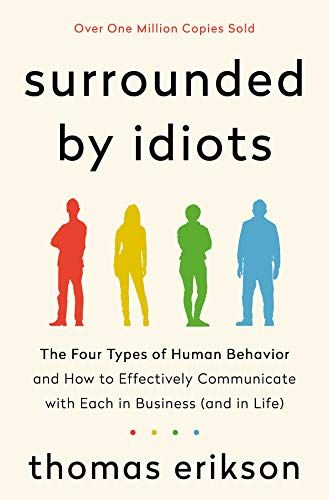
Surrounded by Idiots
The Four Types of Human Behavior and How to Effectively Communicate with Each in Business (and in Life)
Introduction
Nova: Have you ever been in a meeting, or maybe just at a family dinner, and thought to yourself, how is it possible that I am the only sane person in this room? Why does it feel like I am literally surrounded by idiots?
Nova: Well, according to Thomas Erikson and his massive bestseller, Surrounded by Idiots, they are not actually idiots. They just have fundamentally different communication styles than you do. The book has sold millions of copies and basically turned into a global phenomenon by categorizing the entire human race into four simple colors.
Nova: That is exactly the promise. Erikson uses a framework called the DISC model to explain that what we perceive as idiocy is often just a mismatch in how we process information and interact with the world. Today, we are going to dive deep into these colors, look at how to handle each type, and also talk about the massive controversy surrounding this book. Because, believe it or not, some people think the real idiot might be the one believing in the system itself.
Key Insight 1
The Color Palette of Humanity
Nova: Let's start with the basics. Erikson breaks people down into Red, Yellow, Green, and Blue. Think of it as a map for human behavior. If you can identify someone's color, you supposedly have the secret key to talking to them.
Nova: You nailed it. Reds are the Dominant types. They are ambitious, driven, and very, very blunt. If you have a boss who sends one-word emails and hates small talk, they are likely a Red. They care about results, not feelings. To a Red, a long explanation is just a waste of time.
Nova: Yellows are the Inspiring types. They are the life of the party. Optimistic, creative, and incredibly talkative. They are the ones who come into the office with a million new ideas but might forget to actually finish the project they started last week. They crave social recognition and hate being ignored.
Nova: Then we have the Greens, which Erikson says make up the vast majority of the population. They are the Stable types. Calm, reliable, and very resistant to change. They are the glue that holds teams together because they hate conflict. But, because they are so quiet, they are often the ones who feel most surrounded by the louder colors.
Nova: Exactly. Blues are the Analytical types. Think of the person who reads every single line of a contract or the friend who corrects your grammar in a text message. They are obsessed with details, logic, and being correct. To a Blue, a mistake is a personal failure.
Nova: Erikson actually addresses that. He says only about five percent of people are a pure single color. Most of us are a mix of two, and some are even three. But almost nobody is all four. The goal isn't to label yourself forever, but to recognize the dominant traits in others so you can stop banging your head against the wall when they don't react the way you want them to.
Key Insight 2
The Science and the Skeptics
Nova: That is the million-dollar question, and it is where things get really heated. The book is based on the DISC model, which was developed by a psychologist named William Moulton Marston back in the 1920s. Fun fact: Marston also created the polygraph test and the character Wonder Woman.
Nova: Not exactly. In fact, in Erikson's home country of Sweden, the book caused a massive stir. In 2018, the Swedish Skeptics Society actually gave Erikson the Fraud of the Year award. They argued that his claims have zero scientific basis and that the DISC model is essentially pseudoscience when used this way.
Nova: The critics argue that human personality is far too complex to be reduced to four categories. They point out that the DISC model hasn't been validated by modern psychological research in the same way that something like the Big Five personality traits has. They worry that people use these colors to put themselves and others in boxes, which can lead to stereotyping and even discrimination in the workplace.
Nova: Precisely. And Erikson himself isn't a trained psychologist; he is a consultant and a coach. Critics say he took a very old, simplified model and marketed it as a universal truth. However, Erikson's defense is that he never claimed it was a hard science. He calls it a tool for communication, not a clinical diagnosis. He argues that if it helps people understand each other better, the scientific rigor matters less than the practical result.
Key Insight 3
Mastering the Art of Adaptation
Nova: Regardless of the scientific debate, the reason the book is so popular is the practical advice on how to adapt. Erikson argues that the burden of communication is always on the sender. If you want to be understood, you have to speak the other person's language.
Nova: Exactly. If you are talking to a Red, you need to be fast. Get straight to the point. Don't provide ten pages of data if one bullet point will do. They value efficiency over everything. If you ramble, they stop listening and start thinking you are, well, an idiot.
Nova: Spot on. With a Blue, you need the data. You need the footnotes. You need to show your work. If you make a claim, you better have the evidence to back it up. They don't care about your enthusiasm; they care about your accuracy.
Nova: It is not about changing who you are; it is about adjusting your volume. Think of it like a radio dial. When you talk to a Yellow, you turn up the energy and the storytelling. You let them talk, you laugh at their jokes, and you focus on the big picture. If you try to pin a Yellow down with spreadsheets and rules right away, you will kill their creativity.
Nova: With Greens, the key is security and time. They hate being put on the spot. If you want a Green to agree to a new project, don't demand an answer in the meeting. Give them the information, let them process it, and reassure them that the change won't be a disaster. They need to feel safe before they can move forward.
Key Insight 4
The Psychology of the Label
Nova: There is a psychological reason why we love these systems so much, even if they are flawed. It is called the Barnum Effect, or the Forer Effect. It is the same reason people believe in horoscopes. We tend to accept vague, general descriptions of personality as being uniquely applicable to ourselves.
Nova: Partly. These descriptions are designed to be relatable. But there is also a huge relief in being told that you aren't broken, you are just a certain type. If you have always felt like you were too blunt, being told you are a Red makes it feel like a trait rather than a flaw.
Nova: That is the biggest danger of the book. Erikson warns against using the colors as an excuse for bad behavior. Being a Red doesn't give you a license to be a jerk, and being a Green doesn't give you a license to never take a stand. The goal is self-awareness, not self-justification.
Nova: Exactly. Erikson points out that we judge ourselves by our intentions, but we judge others by their behavior. If I am a Red and I am being blunt, I think I am being helpful and efficient. But the Green sitting across from me thinks I am being a bully. The book forces you to step out of your own perspective and see your behavior through the lens of another color's values.
Conclusion
Nova: We have covered a lot of ground today. From the high-energy world of the Yellows and the results-driven focus of the Reds, to the steady reliability of the Greens and the precision of the Blues. We have also looked at the very real criticisms that suggest we should take these categories with a grain of salt.
Nova: That is a perfect summary. Whether you believe in the four colors or not, the core message is undeniable: communication is not about what you say, it is about what the other person hears. If you can learn to adjust your frequency, you might just find that the idiots in your life are actually just people who speak a different language.
Nova: Fair enough. Just remember to keep your emails short when you talk to them. Thank you for joining us on this deep dive into the colorful world of human behavior. If you found this helpful, try identifying the colors of the people in your next meeting. You might be surprised by what you see.
Nova: Good advice. This is Aibrary. Congratulations on your growth!