The Feynman Playbook: Cracking Codes, Safes, and the Secrets of Innovation
Golden Hook & Introduction
SECTION
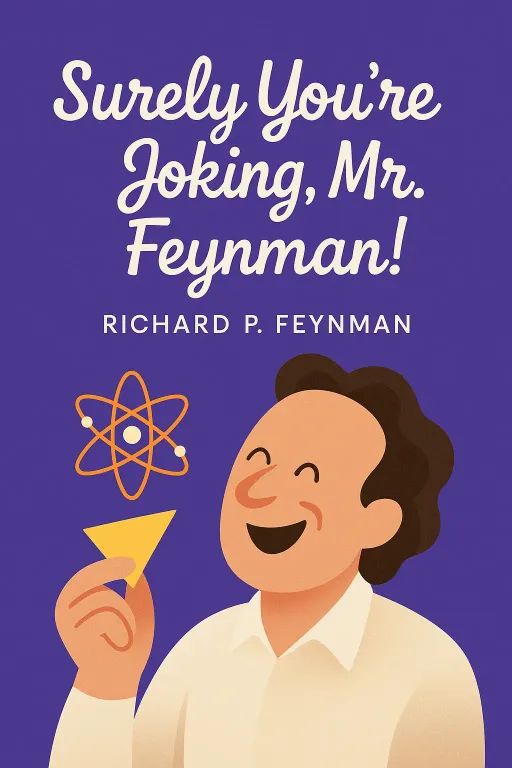
Nova: What's the real difference between someone who's just smart, and a true innovator like a Steve Jobs or an Einstein? Is it just raw intelligence? Or is it something else... a different way of looking at the world? Today, we’re diving into the mind of one of the 20th century's most brilliant and mischievous thinkers, the physicist Richard Feynman, through his book, "Surely You're Joking, Mr. Feynman!" He was a man who could crack top-secret safes for fun, but also help build the atomic bomb.
希逸: He's a fascinating figure because he seems to embody that intersection of pure genius and almost childlike playfulness. It’s a combination you don't see very often.
Nova: Exactly! And that's why he's a patron saint of playful curiosity. For anyone, like you, 希逸, who's interested in technology, creativity, and innovation, Feynman's life is like a masterclass. So today we'll dive deep into Feynman's genius from two perspectives. First, we'll explore his 'Fix it by Thinking' mindset and how he used first principles to solve problems nobody else could.
希逸: I’m excited for that. It’s the idea of deconstructing a problem to its absolute basics.
Nova: Precisely. Then, we'll discuss his hilarious and insightful battles with bureaucracy, and what they reveal about the eternal struggle between innovation and rigid systems. It's a playbook for anyone who wants to think differently.
Deep Dive into Core Topic 1: The 'Fix it by Thinking' Mindset
SECTION
Nova: So let's start at the beginning. Long before the Nobel Prize, Feynman was just a kid in Far Rockaway during the Great Depression, and he had a reputation. But it wasn't for being a genius... it was for fixing radios.
希逸: A very practical skill to have back then.
Nova: Incredibly. And one story in particular just perfectly captures his whole approach. A man comes to him with a brand-new radio that’s broken. He turns it on, and it makes this horrible noise... a loud "ROOAARR-R-R-r-r..." that slowly fades out, and then... silence. The man is baffled. He’s taken it to other repair shops, and they’re all stumped.
希逸: So they've probably tried the standard stuff, right? Checking the plug, looking for a loose wire.
Nova: Exactly. But Feynman does something different. He doesn't even open it up at first. He just sits there and thinks. He tells the man, "Turn it on again." The man does, and again, the "ROOAARR-R-R-r-r..." and then silence. Feynman watches the radio, and he notices something. The tubes inside are supposed to heat up in a specific order, but they're lighting up all wrong. The amplifier tubes are getting hot before the rectifier tube.
希逸: Ah, so the sequence is broken. The power is surging to the wrong place at the wrong time, causing that roar before it cuts out.
Nova: You got it. So, without touching a single wire, Feynman just reaches in, pulls the tubes out, rearranges them into the correct order, and pushes them back in. He tells the man to try it now. The man turns it on, and it works perfectly. The man is so stunned, he runs around the neighborhood telling everyone this incredible thing: "He fixes radios by thinking!"
希逸: That’s fantastic. It’s such a simple story, but it’s so profound.
Nova: It really is. 希逸, as someone who's into technology and innovation, what does that phrase—'He fixes radios by thinking'—really mean to you?
希逸: It means he wasn't just following a repair manual. He was debugging the system from first principles. He understood the of the machine—that the tubes had a specific startup sequence. Instead of just replacing parts, which is what most people would do, he diagnosed the root cause. That's the foundation of all great engineering and even business strategy. You don't just treat the symptoms; you understand the system.
Nova: It's not about knowing the answer, but knowing how to the answer. He had this deep, internal model of how things work.
希逸: And he trusted his own model more than the conventional wisdom. The other repairmen were probably looking for a broken part. Feynman was looking for a broken. It's a total shift in perspective.
Nova: He even did this with something as established as mathematics. In high school, he found the standard symbols for things like sine, cosine, and logarithms to be confusing and unintuitive. So what did he do?
希逸: He just invented his own.
Nova: He just invented his own! He created a whole new set of symbols that made sense to. He eventually had to give it up to communicate with others, but it shows this incredible willingness to rebuild the tools if the existing ones aren't right for the job.
希逸: That's a huge insight for creativity and innovation. It’s like saying, 'The existing programming language is clunky, I'll write my own.' It shows a deep confidence in your own reasoning over established convention. That's a trait you see in figures like Jobs or Einstein—they weren't afraid to rebuild the tools if the old ones didn't work for them. It’s about owning the problem at the most fundamental level.
Nova: And that confidence, that trust in his own logic, is exactly what makes our next topic so fascinating. What happens when a mind like Feynman's, built for innovation, collides with a system that absolutely hates it?
Deep Dive into Core Topic 2: The Innovator's Dilemma
SECTION
Nova: This brings us to his disastrous summer job at a hotel. It’s a series of stories from a chapter called "String Beans," and it's just a perfect, humorous metaphor for the challenges innovators face.
希逸: I have a feeling this isn't going to go as well as the radio repair.
Nova: Not even close. So, he's working in the hotel kitchen, and one of his jobs is to cut string beans into one-inch pieces. It's tedious, slow, mind-numbing work. So, Feynman the innovator kicks in. He thinks, "There has to be a better way." He builds a little rig. He sticks a razor blade into a block of wood, and now he can hold a whole handful of beans and slice them all at once. He's created a bean-slicing production line.
希逸: That's brilliant. He's applying industrial efficiency to a kitchen task.
Nova: Totally! He's going faster than anyone, a true process-improvement genius... until... he gets going a little too fast, and he slices his finger. A little bit of blood gets on the beans. The boss comes over, and what do you think he says?
希逸: Oh no. I'm guessing he wasn't impressed with the increased throughput.
Nova: He was furious! But not about the cut. He yells at Feynman for wasting the beans! He doesn't see the brilliant new process; he just sees a few contaminated beans that have to be thrown out. The innovation is completely dismissed because of one small, fixable error.
希逸: Wow. It’s such a funny but painful story. He has this brilliant idea, and it's completely rejected.
Nova: It is. 希逸, you're interested in leadership. What does this story say about creating a culture of innovation?
希逸: It's a perfect example of a failure in leadership. The boss's key metric wasn't efficiency; it was 'don't make a mess' or 'don't waste anything.' In a system like that, innovation is seen as a risk, not an opportunity. A good leader would have seen the potential in Feynman's idea and said, 'Okay, that didn't work, but the concept is good. How can we make it safer? Let's build a better guard for the blade.' They would iterate on it.
Nova: Instead, the message was: 'Stop trying to be clever and just cut the beans the slow, old way.'
希逸: Exactly. And that kills creativity. It teaches people that trying something new, even if it has huge potential upside, will only get you in trouble if it's not perfect the first time. And innovation is perfect the first time.
Nova: That's so true. Feynman concludes the chapter by saying he learned that "innovation is a very difficult thing in the real world." It's not just about having a good idea.
希逸: The idea is maybe 10% of it. The other 90% is navigating the system, the people, and the culture. You need both the technical creativity to invent the bean-slicer and the social or leadership creativity to get people to actually adopt it. Feynman had the first part in spades, but the hotel boss completely lacked the second.
Nova: And it’s a pattern we see again and again. He also invented a system to answer the hotel switchboard faster, but his aunt, the manager, couldn't understand his contraption of threads and paper clips and just yelled at him to take it down. The system worked, but it looked weird, so it was rejected.
希逸: It's the "not invented here" syndrome, or just a general resistance to change. If the person in charge doesn't understand it, or if it disrupts their comfortable routine, they'll often kill it, regardless of its merits. It’s a lesson every innovator has to learn, often the hard way.
Synthesis & Takeaways
SECTION
Nova: So, we have these two sides of the Feynman coin. On one side, the power of pure, first-principles thinking to solve any problem. The ability to fix a radio just by observing and thinking.
希逸: And on the other side, the hard reality that even the best ideas, like his bean-slicer, can be crushed by a rigid system that isn't designed to accommodate change.
Nova: It really feels like the lesson is that a true innovator needs to be fluent in both languages.
希逸: I think so. You need the analytical mind to see the solution that no one else does. But you also need the strategic, sometimes mischievous, mind to navigate the human world that has to accept that solution. You have to know when to use pure logic, and when you might need a little bit of playful subversion to get your idea across.
Nova: I love that. It's the perfect takeaway. The Feynman Playbook isn't just about being smart; it's about being cleverly, playfully effective.
希逸: It’s about knowing which problems are about physics and which are about psychology.
Nova: Beautifully put. So for everyone listening, and for you, 希逸, here's the question to ponder this week, inspired by Mr. Feynman: Where in your work or life is there a 'stupid' rule or an inefficient process just waiting for a bit of creative, maybe even mischievous, thinking? And how can you apply that 'Fix it by Thinking' mindset to find a better way?