The Feynman Code: Debugging Rote Learning and Upgrading Your Curiosity
Golden Hook & Introduction
SECTION
Nova: Imagine you are living during the Great Depression, your radio is broken, and an eleven-year-old kid walks into your house carrying nothing but a giant screwdriver. He doesn't touch the radio at first. Instead, he just paces up and down the room, thinking, while you get more and more annoyed. Then, suddenly, he walks over, swaps two vacuum tubes, plugs it in, and it works perfectly. That kid was the future Nobel Prize-winning physicist Richard Feynman, and his neighbor famously declared, "He fixes radios by thinking!"
Jayasree: I love that story so much, Nova. As a software engineer, it resonates with me deeply. So often in tech, when something breaks, our first instinct is to start changing lines of code randomly, hoping something sticks. But Feynman's approach was the exact opposite. He stopped, analyzed the system, and figured out the underlying logic before making a single move.
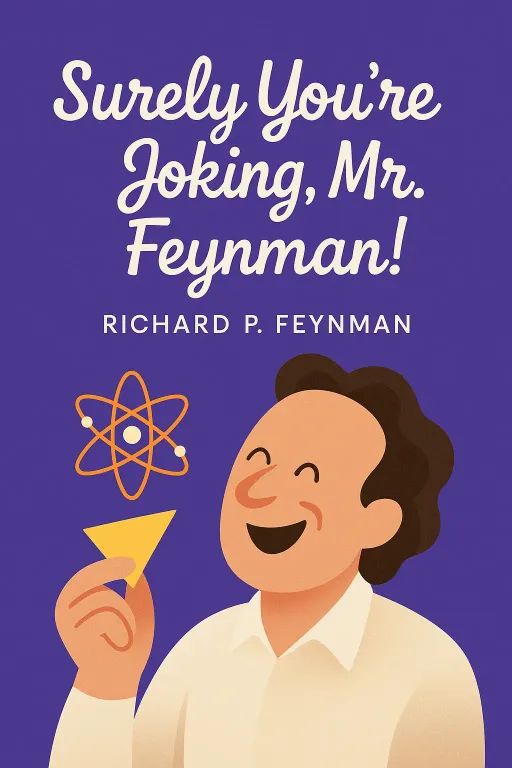
Nova: Exactly, Jayasree! And that is exactly what we are diving into today. We are going to tackle Richard Feynman's classic memoir, "Surely You're Joking, Mr. Feynman!" through three game-changing angles for anyone looking to upgrade their learning mindset. First, we will explore the power of first-principles thinking and why understanding a system beats memorizing its parts. Second, we will look at the trap of "Cargo Cult Science" and how it applies to modern software development and AI. And finally, we will share practical ways to build your own "sandbox" for playful, fearless experimentation. We are so glad you are here with us, Jayasree!
Jayasree: I am absolutely thrilled to be here, Nova. I think this book is a goldmine for anyone in tech, especially if you want to transition from just memorizing syntax to truly understanding how things work under the hood.
Deep Dive into Core Topic 1
SECTION
Nova: Let's start with that radio story because it is such a perfect metaphor. When Feynman was a kid in Far Rockaway, he built a little home laboratory in his house using an old wooden packing box. He installed a heater, a storage battery, and a lamp bank to experiment with different voltages. He was constantly playing with electricity, even inventing a simple burglar alarm that startled his parents when they opened his door. So, when he started fixing radios for neighbors during the Depression, he wasn't just following a manual. He actually understood how the current flowed through the circuits.
Jayasree: Right, and that is the key difference between a technician who just replaces parts and a true problem-solver. In the book, Feynman describes a specific radio that made a horrible, loud screeching noise when it was first turned on, but then quieted down after a while. The owner was skeptical because Feynman was so young and was just pacing around. But Feynman was thinking: why would it screech only at the beginning? He realized that the tubes were heating up in the wrong order. The pre-amplifier tube was heating up before the amplifier tube was ready to receive the signal, creating a feedback loop. By simply swapping the tubes, he solved the problem.
Nova: It is so elegant because it shows that his diagnostic tool wasn't just his hands; it was his mind. He understood the cause-and-effect chain. How does that translate to what you do in software engineering, Jayasree?
Jayasree: Oh, it is incredibly relevant! When we get a bug report or a stack trace, the temptation is to immediately copy and paste the error message into a search engine, find a quick fix on Stack Overflow, and paste it in. That is the equivalent of randomly swapping radio parts without knowing what they do. You might temporarily quiet the screech, but you haven't fixed the underlying architectural issue. Feynman teaches us to pause and trace the data flow. We need to ask: what is the state of the system at this exact moment? Why is this variable null? Understanding the system's state is how you "debug by thinking."
Nova: I love that phrase, "debugging by thinking." It takes patience, doesn't it? Feynman once said, "Once I get on a puzzle, I can't get off." He had this relentless drive to solve things. And he didn't just apply this to physics or radios. Remember when he was at Princeton and he challenged the mathematicians?
Jayasree: Yes! He used to hang out in the graduate lounge where the mathematicians would discuss incredibly abstract concepts like topology. Feynman would challenge them to state any complex theorem, and he promised he would tell them whether it was true or false. And he was almost always right!
Nova: It seemed like magic to them! But how did he actually do it?
Jayasree: It was all about concrete visualization. While the mathematicians were speaking in abstract formulas, Feynman was building a specific, physical model in his head. If they talked about a multi-dimensional space, he would imagine a green ball or a ball with hairs growing out of it. As they laid out the conditions of the theorem, he would test them against his mental model. If the theorem didn't work for his simple, concrete example, he knew it was false. He bypassed the complex jargon by grounding the abstract in reality.
Nova: That is such a powerful cognitive strength. He stripped away the complexity to find the core truth. It reminds me of how he learned integration. In high school, his physics teacher, Mr. Bader, noticed Feynman was bored and disrupting the class. So, he gave Feynman a college textbook called "Advanced Calculus" by Woods. Feynman studied it independently and mastered a technique called "differentiating under the integral sign." It wasn't taught in standard university courses at the time.
Jayasree: And that became his secret weapon! Later at MIT and Princeton, when other brilliant minds would get stuck on a incredibly difficult integral using standard tools, they would bring it to Feynman. He would use his unique "box of tools" and solve it in minutes. He wasn't necessarily smarter than them; he just had a different perspective and a different set of problem-solving tools.
Nova: That is a beautiful lesson for anyone starting out in tech. You don't have to know everything, but having a unique tool or a different way of looking at a problem can make you incredibly valuable. We don't all need the same standard toolbox.
Jayasree: Exactly. In software, that might mean learning a different programming paradigm, like functional programming, or understanding how compilers work under the hood. It gives you a different lens to view your code, which helps you find elegant solutions that others might miss.
Deep Dive into Core Topic 2
SECTION
Nova: That transition from superficial knowledge to deep understanding brings us to our second major theme, which is one of Feynman's most famous concepts: "Cargo Cult Science." This came from his 1974 commencement address at Caltech. He used the analogy of the indigenous people in the South Seas after World War II. During the war, they saw airplanes land with amazing cargo, food, and supplies. When the war ended and the planes stopped coming, they wanted the cargo back. So, what did they do? They built mock runways, put wooden boxes on their heads like headphones, stood in bamboo control towers, and lit fires to guide the planes.
Jayasree: It is a heartbreaking but incredibly powerful analogy. They did everything right on the surface. They mimicked the exact appearance and form of the airfield. But, as Feynman pointed out, the planes didn't land. Why? Because they were missing the actual, invisible infrastructure that made the system work—the radio waves, the global supply chains, the actual technology.
Nova: "Because the planes don't land." That line is so haunting. Feynman argued that a lot of academic research and daily work is just like that—it looks like science, it has the forms and the jargon, but it lacks the absolute honesty and integrity to test if the ideas actually work. He called it a lack of "leaning over backwards" to prove yourself wrong.
Jayasree: We see "Cargo Cult Software Engineering" all the time today, Nova. Especially now with the rise of AI assistants and code generators. It is so easy to ask an AI to write a script, copy the output, and run it. It looks like software engineering. It has the correct syntax, the brackets are in the right place, and it might even run. But if you don't understand it works, or what the underlying algorithms are, you are just standing in a bamboo control tower wearing wooden headphones. The moment the system faces a real-world edge case or a security threat, the planes are going to crash.
Nova: Oh, that is a brilliant connection, Jayasree! Copy-pasting AI prompts without understanding the logic is the ultimate modern cargo cult. You are mimicking the output of a software engineer without doing the actual engineering.
Jayasree: Exactly. And Feynman gave us a perfect historical example of this in the book when he talked about Robert Millikan's famous oil drop experiment, which measured the charge of an electron. Millikan's initial value was slightly off because he used an incorrect value for the viscosity of air. When subsequent scientists replicated the experiment, they got values that were slightly higher. But instead of publishing their raw, higher results, they looked at their data and thought, "Oh, I must have made a mistake, Millikan is a genius." So they searched for errors in their own work and adjusted their numbers to be closer to Millikan's.
Nova: That is fascinating and a bit shocking! They were unconsciously biasing their own results to fit the accepted authority.
Jayasree: Yes! It took years of gradual increases for scientists to finally settle on the correct, higher value. They fooled themselves because they prioritized the "expected" result over rigorous, honest methodology. Feynman's first principle of scientific integrity is: "You must not fool yourself—and you are the easiest person to fool."
Nova: "You are the easiest person to fool." We have to be so vigilant about our own biases, especially when we want our code or our projects to work so badly that we ignore the warning signs.
Jayasree: Absolutely. In debugging, if you have a theory about why a bug is happening, you will naturally look for evidence that supports your theory. But Feynman teaches us to do the opposite—to "lean over backwards" to prove our own theories wrong. We should actively try to break our own code. If it survives our best attempts to break it, only then can we start to trust it.
Nova: That requires a lot of intellectual humility. You have to be willing to say, "I might be wrong, let's test it." Feynman had that humility in spades, even when dealing with giants like Albert Einstein or Niels Bohr. When he was a young graduate student at Princeton, he had to give his very first technical talk on a new theory of electrodynamics. He was incredibly nervous because the audience included Einstein, Wolfgang Pauli, and John von Neumann!
Jayasree: Talk about a high-pressure situation! I would have been absolutely terrified.
Nova: Right? But Feynman realized something beautiful. He said that the moment he started thinking about the physics, his mind completely focused on the problem, and he became entirely immune to being nervous. The beauty of the science chased away the fear of the authority.
Jayasree: That is a wonderful lesson for junior developers or anyone starting a new career. When you focus on the problem itself—on the logic, the system, the puzzle—your imposter syndrome fades away. You aren't worrying about what people think of you; you are just trying to understand the truth of the system.
Synthesis & Takeaways
SECTION
Nova: This has been such an incredibly rich conversation, Jayasree. We have covered so much ground, from Feynman's childhood radio repairs to the deep philosophical warnings of Cargo Cult Science. As we start to wrap up, let's synthesize some of these key lessons into actionable takeaways for our listeners, and especially for your own journey in tech.
Jayasree: I think the first big takeaway is to prioritize deep understanding over rote memorization. Feynman famously said that there is a huge difference between knowing the of something and knowing the itself. You can memorize all the programming syntax, the names of every framework, and the latest tech buzzwords, but if you don't understand the underlying concepts—like data structures, memory management, and network protocols—you won't be able to solve novel problems.
Nova: Yes! Learn the "thing," not just the "name." And the second takeaway has to be the importance of playful, fearless experimentation. Feynman never stopped playing. Whether he was learning to play the bongo drums, deciphering Mayan hieroglyphics on his honeymoon, or learning how to crack combination safes at Los Alamos just to point out security flaws, he approached everything with a sense of wonder and fun. He only regained his scientific spark at Cornell when he decided to stop worrying about doing "important" research and just decided to "play" with physics, like analyzing why a wobbling cafeteria plate rotates the way it does. That playful analysis actually led to his Nobel Prize!
Jayasree: That is so liberating. We need to build our own "sandboxes"—little, low-stakes projects where we can write messy code, break things, and experiment purely for the joy of discovery. Don't worry about building the next big startup; just build a silly app that solves a tiny problem, or write a script that automates a boring task. Play with the technology.
Nova: I love that. Build a sandbox and just play! And finally, let's remember the ultimate test of understanding: the Feynman Technique. If you want to know if you truly understand a concept, try explaining it simply to a child, or to someone who has no background in your field. If you have to resort to complex jargon or hand-waving, you probably don't understand it as well as you think.
Jayasree: That is a daily practice for me now. Explaining a technical concept simply forces you to strip away the "cargo cult" jargon and find the core logic. It builds incredible confidence.
Nova: Well, Jayasree, you have explained these concepts so beautifully today. Thank you so much for sharing your insights and your unique perspective with us. You are going to do amazing things in the tech industry with this mindset!
Jayasree: Thank you, Nova! This has been an absolute joy. It has really inspired me to keep questioning, keep playing, and keep debugging by thinking.
Nova: And to our listeners, we leave you with one final question to ponder: What is one concept in your life or work that you have been merely memorizing, and how can you start truly understanding it today? Build your sandbox, avoid the cargo cults, and remember—never stop playing! Until next time, keep learning, keep growing, and we will talk to you soon!